Anatomy of a settlement

A very interesting article in the Morning Call about the Hirko settlement. It could have been a $30 million or even a $100 million award (which would have really damaged the city). This article shows how the two sides worked together and is a very interesting look behind the scenes.

Callahan told Hirko family lawyer John Karoly Jr. that the city was willing to make police reforms part of the settlement, that the city had gotten the message that the police force needed reforms….

It was something Karoly and his clients had been waiting to hear for seven years — that city officials recognized police had erred during the disastrous raid.

Without that new direction in the settlement talks– and without the willingness of Karoly’s side to compromise financially — the case might not have been settled last week.

The Morning Call has been outstanding in its coverage of the Hirko case. Here’s the archive of their articles.

[Thanks again to Patrick Dickinson!]
Posted in Uncategorized | Comments Off on Anatomy of a settlement

TV Alert: Primetime Thursday: Peter Jennings Reporting: Ecstasy Rising

A picture named ecstasyjennings.jpg
Tonight, Thursday, April 1, 2004 at 10 pm Eastern, 9 pm Central.

“Government is best when government is most honest, especially for the younger generation, which is more susceptible to trying drugs,” says ABC’s “World News Tonight” veteran anchor.æ “If ( young people ) can’t rely on the government for good and honest information, then government has lost something enormously valuable, which is people’s belief in the government’s credibility.” …

“This was an opportunity for us to look at whether or not the government isn’t its own worst enemy in trying to control illegal drugs,” Jennings says.æ

And is it?

“Yes,” Jennings replies.æ “I believe a lot of people in government understood the science ( about Ecstasy’s negative side effects ) was not good.æ But not until real attention was drawn to it did they take down their Web site on Ecstasy.” …

Jennings admits working on the special was educational for him.æ

“I had no idea Ecstasy was as old as it is,” he says.æ “I had no idea that it had been introduced in California through psychotherapy, and I had no idea how effective it seemed to have been for some psychotherapists.æ I remember one psychologist telling us that one session with a patient on Ecstasy was equal to four years ( of treatment ) with a similar patient.”

Although practically everyone has heard of Ecstasy, which was made illegal in 1985, most people aren’t familiar with the drug’s origins.æ “Ecstasy Rising” serves as a fascinating history lesson.æ

Posted in Uncategorized | Comments Off on TV Alert: Primetime Thursday: Peter Jennings Reporting: Ecstasy Rising

Affidavit for a Search Warrant

The Smoking Gun has the actual affidavit for the warrant to search the Dagy family residence based on their electrical usage (see my earlier story).
It’s an amusing read, particularly when you already know how wrong they were.

[Thanks to Patrick]
Posted in Uncategorized | Comments Off on Affidavit for a Search Warrant

You have the right to remain… dead

A picture named michaelnewby.jpg
Michael Newby, a 19-year-old black teenager, was fatally shot 3 times in the back by a white officer.
A grand jury has indicted the officer, McKenzie Mattingly, on murder and wanton endangerment charges.
Now, three months after the shooting, Louisville police have charged the dead teenager with drug and weapons offences.
Now I don’t know all the facts in this case (and some we won’t know), but their claim that it was only to meet federal regulations seems a bit strange.
I wonder if they went to his grave and read him his rights.

[Thanks to Jeff Sanderson for the tip.]
Posted in Uncategorized | Comments Off on You have the right to remain… dead

The Federal Medical Marijuana program

A picture named russo-figure4.jpg
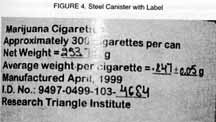
With all the demonization of medical marijuana by the federal government, it’s important to remember now and then that the feds have been growing marijuana, rolling and packaging marijuana cigarettes, and supplying canisters of this medical marijuana to patients since the mid-1970s.
It was part of the “compassionate use” program. Unfortunately it’s been discontinued so that no new patients are accepted, but they continue supplying the original handful until they die (something the feds likely hope happens soon).
Nikkie at Vice Squad has the info on one of these patients who won the right to fly on airlines with his marijuana.
The NIDA website contains some interesting information about the issues related to their growing methods at the University of Mississippi.
A picture named russo-figure6.jpg
Of course, just like in Canada, the feds have not shown an ability to grow or roll very good pot – even for medical purposes.
Additionally, the government has a monopoly on marijuana for research purposes. If you want to do a study on marijuana, not only do you have to go through years of jumping through hoops and a horrific approval process (one that’s much easier if you’re a drug company or someone trying to find negative effects of marijuana), but you have to use the crap they grow at the University of Mississippi (forget using a high-quality, high-potency marijuana that might deliver better results with less smoking.

Posted in Uncategorized | Comments Off on The Federal Medical Marijuana program

Cost of a pound of pot

A picture named gray-d1.jpg

Vietnam Veteran Douglas Lamar Gray had a roofing business in Moulton, a wife and a son. In 1989, he bought $900 worth of marijuana in a motel room..

Until then, the longest Gray had been locked up was a few months for a burglary in his teens, then two more burglaries in his early 20s….

A police informant with a criminal record had lured Gray to the motel. Gray bought the marijuana…

Gray was sentenced to life in prison without parole.

That no one was injured during his crimes doesn’t matter. Gray, 49, will die behind bars.

Before the drug bust, he had not been arrested in 14 years.

“Made real good money, owned my own house, my own land,” he said. “Watched my little boy grow up, then they set me up and sold me a pound of pot.”

His wife divorced him. His son, now 16, is in trouble with the law.

“He said he was going to get into trouble and come to prison so he could be with me,” Gray said.

The state has spent $150,000 to keep Gray locked up. So far.

How much more the state spends depends on how long Gray lives.

Carla Crowder’s article in yesterday’s Birmingham News.
You can read more about Gray at the November Coalition
Posted in Uncategorized | Comments Off on Cost of a pound of pot

Don’t forget to turn out the lights.

Via Three Sheets to the Wind comes one of those amusing human interest stories that’s also a whole lot more:

CARLSBAD, Calif. – When police noticed Dina Dagy’s family was spending $250 to $300 a month on electricity, they suspected a marijuana farm was flourishing under high-intensity lights inside their suburban home.

What they found when they showed up with a drug-sniffing dog and a search warrant was a wife and mother who does several loads of laundry a day, keeps a dishwashing machine going, has three electricity-guzzling computers and three kids who can’t remember to turn the lights out when they leave a room.

“It’s hard to believe a high utility bill would be enough to issue a state warrant,” said Dagy, who is demanding the Police Department issue a written apology.

Now the police also did apparently send “a police dog to the neighborhood, and it reacted as though it had smelled drugs” – a pretty vague indication (I guess you better be careful if your neighborhood smells of drugs). And then the kicker — the final point that justified the warrant:

They also noticed the family had put its trash out that morning, something police say drug growers often do to hide the evidence. In the Dagys’ case, however, it was trash day.

Ah, yes. They put out their trash. They must be criminals.
Over and over again, you see evidence of how the drug war has perverted the system and infringed on individual rights. If it wasn’t for prohibition, none of this would be an issue.
Back to the story… Notice the use of the bland word “noticed.” They “noticed” the trash had been put out (Probably after hours of watching the house.)
And the one I love — they “noticed” Dagy’s family was spending $250-300 a month on electricity. How do you “notice” something like that if you’re the police? It means, of course, that the police were examining citizens’ utility bills.
This gets pretty creepy. I suddenly have images of law enforcement analyzing my everday activities to see if I “put my trash out”. “Look, he parked his car in the garage – just like what a drug dealer would do.” “His living room light is on at 2 am – he must be smoking pot.” “OK, get the search warrant. We just checked his cable bill and he ordered Willy Wonka and the Chocolate Factory and 2001: A Space Odyssey
Or am I just being paranoid?

A picture named White-House-Night.jpg
Another house with a high electric bill
that should be investigated.
Posted in Uncategorized | Comments Off on Don’t forget to turn out the lights.

Former U.S. Surgeon General on Medical Marijuana

A picture named elders.jpg
Joycelyn Elders: Myths about medical marijuana in Friday’s Providence Journal.
What an amazing piece by Elders. Dr. Andrea Barthwell (Drug Czar wench) – are you reading this? Here’s a medical professional with integrity who is willing to look at the facts.

THE RHODE ISLAND General Assembly is now considering legislation to permit the medical use of marijuana by seriously ill patients whose physicians have recommended it.

This sensible, humane bill deserves swift passage. The evidence is overwhelming that marijuana can relieve certain types of pain, nausea, vomiting and other symptoms caused by such illnesses as multiple sclerosis, cancer and AIDS — or by the harsh drugs sometimes used to treat them. And it can do so with remarkable safety. Indeed, marijuana is less toxic than many of the drugs that physicians prescribe every day.

But right now, Rhode Island law subjects seriously ill patients to the threat of arrest and jail for simply trying to relieve some of their misery. There is no good reason that sick people should face such treatment.

Dr. Elders then takes the Drug Czar’s usual myths and destroys them one by one:

“There is no evidence that marijuana is a medicine.” The truth: The medical literature on marijuana goes back 5,000 years. In a 1999 study commissioned by the White House, the Institute of Medicine reported, “nausea, appetite loss, pain and anxiety . . . all can be mitigated by marijuana.” In its April 2003 issue, the British medical journal The Lancet reported that marijuana relieves pain in virtually every test that scientists use to measure pain relief.

“The medical community doesn’t support this; just a bunch of drug legalizers do.” The truth: Numerous medical and public-health organizations support legal access to medical marijuana. National groups include the American Academy of Family Physicians, the American Public Health Association and the American Nurses Association. Regional groups include the New York State Association of County Health Officials, the California Medical Association and the Rhode Island Medical Society.

I know of no medical group that believes that jailing sick and dying people is good for them.

“Marijuana is too dangerous to be medicine; it’s bad for the immune system, endangering AIDS and cancer patients.” The truth: Unlike many of the drugs we prescribe every day, marijuana has never been proven to cause a fatal overdose. Research on AIDS patients has debunked the claim of harm to the immune system: In a study at San Francisco General Hospital, AIDS patients using medical marijuana gained immune-system cells and kept their virus under control as well as patients who received a placebo. They also gained more needed weight.

“There are other drugs that work as well as marijuana, including Marinol, the pill containing THC (the main psychoactive chemical in marijuana).” The truth: These other drugs don’t work for everyone. The Institute of Medicine noted: “It is well recognized that Marinol’s oral route of administration hampers its effectiveness, because of slow absorption and patients’ desire for more control over dosing.” Inhalation gives a more rapid response and better results. For some very sick people, marijuana simply works better.

“Smoke is not medicine; no real medicine is smoked.” The truth: Marijuana does not need to be smoked. Some patients prefer to eat it, while those who need the fast action and dose control provided by inhalation can avoid the hazards of smoke through simple devices called vaporizers. For many who need only a small amount — such as cancer patients trying to get through a few months of chemotherapy — the risks of smoking are minor.

“Medical-marijuana laws send the wrong message to kids, encouraging teen marijuana use.” The truth: That fear, raised in 1996, when California passed the first effective medical-marijuana law, has not come true. According to the official California Student Survey, teen marijuana use in California rose steadily from 1990 to 1996, but began falling immediately after the medical-marijuana law was passed. Among ninth graders, marijuana use in the last six months fell by more than 40 percent from 1995-96 to 2001-02 (the most recent available figures).

We need Joycelyn Elders on the national stage talking about this!

Posted in Uncategorized | Comments Off on Former U.S. Surgeon General on Medical Marijuana

Weekend Reading

“bullet” The Road to Hell. Disturbing news via TalkLeft. If you live in Louisiana, Texas, or Mississippi, the 5th Circuit Court of Appeals has just taken away some of your constitutional rights.

The 5th U.S. Circuit Court of Appeals ruled that police do not need an arrest or search warrant to conduct a swift sweep of private property to ensure their own safety. Any evidence discovered during that search now is admissible in court as long as the search is a “cursory inspection,” and if police entered the site for a legitimate law enforcement purpose and believed it may be dangerous.

The case involved a dangerous criminal, but you know how such a ruling will be used. Cops come to your home because of a noise complaint when you’re having a party. Routine. But, to “insure their safety” they’re going to take a look around your house. So they go into all the rooms, and, Oh look, there’s a marijuana pipe on the dresser in your bedroom. Busted.
Hope this one gets squashed by the Supremes.
“bullet” Go to LastOneSpeaks and check out this story and this one about spraying in Columbia. It seems that some courageous Columbians are standing up to oppose the destruction of their country by the DEA.

To not fumigate the national parks would be, for one honorable time, to put the national interest of a country with the second greatest environmental wealth on the planet before the interest of the United States.”

Excellent coverage at Last One Speaks.
“bullet” Jim at Vice Squad has a somewhat amusing story from Indiana. Seems an appeals court won’t allow seized cocaine to be used in a prosecution. Why? Could it be…

  • The bust was set up by an informant who suggested a sting
  • The informant arranged to speed through town with the mark, so the cops would pull him over and discover cocaine on the passenger
  • The informant mentioned to police that he had been drinking and using coke and the police went along with having him speed through town anyway
  • The informant was supposed to be on home detention at the time, which the officers knew

Gee, why would the judges throw out that brilliantly conceived sting? Prospect, Indiana. Police I.Q.: 0
Vice Squad also has a post by Mike detailing some interesting drug war anecdotes from Moscow to Texas.
“bullet” Check out this week’s Drug Chronicle, complete with updates from Canada, Peru, Arkansas, Australia, Nevada, and Oklahoma.
“bullet” Drug Sense’s Weekly Newsletter is online here.

Posted in Uncategorized | Comments Off on Weekend Reading

Drug Testing in Schools – Pros, Cons and Lawsuits

A picture named peed.jpg
The discussions of drug testing in schools are going to heat up even more as time goes on. With Bush promising millions in tax dollars, and the Drug Czar pulling out all the stops (and the lies) to promote this, you’re going to be hearing a lot more. And it’s going to take a major effort to prevent a nation-wide policy of teaching humiliated children that they are always under suspicion, that they have no rights of privacy, and that they must prove themselves innocent in this country.
The Atlanta Journal Constitution ran opposing view OpEds today on the topic “Should Students be Randomly Tested for Drugs?” and they were quite instructive.
“bullet” First you have the Drug Czar’s pet doctor Andrea Barthwell, with “YES: it Reverses the Spread of Addiction.” The title of her OpEd was pretty bizarre on its own — Barthwell’s trying to tie in drug testing with such things as school tuberculosis tests:

Addiction is a pediatric-onset disease that needs a public health response. In much the same way that school tuberculosis tests identify children who are sick and can spread a dangerous disease, student drug testing helps identify kids who have a problem with drugs and prevents the spread of the disease of addiction. Each child prevented from using drugs means there is one fewer child able to pass the disease of addiction to his or her peers

Of course, she fails to discuss the fact that drug testing has nothing to do with addiction, and that it can actually intensify addiction problems in school children, by diverting them to harder drugs less likely to show up in drug tests, convincing students not to participate in extracurricular activities, etc.
She “demonstrated” the effectiveness of drug testing by relating anecdotal evidence in one school, and using the military as an example.
And she includes with a completely unsupported statement: “Drug testing saves lives.” But then again, remember that the Drug Czar’s office isn’t required to actually tell the truth.
“bullet” On the other side of the debate, we have Martha Rosenbaum, director of the Safety First project of the Drug Policy Alliance in San Francisco with “NO: It’s costly, humiliating and not a deterrent.”

Random drug testing alienates students. Students must be observed (by a teacher or other adult) as they urinate to be sure the sample is their own. It is a humiliating violation of privacy. Testing can also have the unanticipated effect of keeping students from participating in after-school, extracurricular programs — activities that would fill their time during the peak teenage drug-using hours of 3-6 p.m.

A student in Tulia, Texas, summed it up: “I know lots of kids who don’t want to get into sports . . . because they don’t want to get drug tested. That’s one of the reasons I’m not into any [activity]. I’m on medication, so I would always test positive, and then they would have to ask me about my medication, and I would be embarrassed.”

School administrators in Dublin, Ohio, for example, calculated that their $35,000 per year drug-testing program was not cost-efficient. Of 1,473 students tested at $24 each, 11 tested positive, for a total cost of $3,200 per “positive” student. They canceled the program and, with the savings, were able to hire a full-time counselor and provide prevention programs that reached all 3,581 students.

Some will argue that students need drug testing to help them say “no.” But in 2003, the “State of Our Nation’s Youth” survey found that, contrary to popular belief, most teens are not pressured to use drugs. The same survey found, much to the surprise of many parents, that 75 percent of teenagers actually enjoy spending time with their parents. Trusting, open relationships with parents and other adults have been proven to decrease teen drug use.

Unfortunately, drug testing actually has the effect of undermining parental influence, forcing adults to say to teenagers, in essence, “I don’t trust you.”

I believe Marsha’s the clear winner here.
“bullet” In other school drug testing news, TalkLeft has the details on the Arkansas parents who have filed suit in federal court to stop random drug testing of their kids.

[Parent Mr.] Plopper, a journalism professor at the University of Arkansas at Little Rock, said the administrators and school personnel “who support and maintain suspicionless drug testing are like schoolyard bullies who torment students just because they can. “In this case, however, these people are worse than such bullies because they are educated and should know better than to turn the civil liberties of equal protection and privacy into empty promises.”

“bullet” Don’t forget that you can have your own T-Shirt with “Have you peed in a cup for your government today?” on it.

Posted in Uncategorized | 2 Comments