Drug Czar’s efforts on prescription drugs

Mark Kleiman comments on the White House plan to make the abuse of diverted pharmaceuticals a major target for drug enforcement.

Actually, this looks like a good move to me….

There are some complicated issues around doctor-shopping and script-kiting, which are the other major sources of diverted pills. The trick is to make life harder for the scammers without making it harder for the legitimate patients.

But it’s good to see the drug czar’s office focusing, for once, on a real problem where there might be some real solutions.

I have to disagree with Mark on this one. I’m not at all heartened by the shift (or additional emphasis) toward prescription drug abuse.

  • First of all, any possible thought that enforcement will be focused on stolen or diverted drugs is delusional. What will happen is that enforcement will go after doctors who have a different idea of pain management than the DEA has — it’s much easier to go after people who are listed in the phone book (just consider the major “investigations” of medical marijuana coops in California, and bong manufacturers) than actual criminals.
  • I am very uncomfortable with federal enforcement determining what proper pain management is for patients. A crackdown in this area is going to increase the pressure on doctors to be more conservative with pain medication — at the expense of patients’ health and lives. The proper regulation of pain prescriptions is through medical licensing organizations, not federal law enforcement.
  • Even the efforts against diversion of prescription drugs are problematic. Just like all other prohibition efforts, if the feds are at all successful at arresting those who are making drugs available on the black market, then the prices will rise and increase the attractiveness for organized criminals to get involved in prescription drugs.

If the feds want to be useful in this area, the best thing they can do is educate people as to the dangers of using prescription drugs without the advice of a doctor.
Update: This piece by Anthony Gregory, with the Independent Institute, covers the situation well in my opinion.

Posted in Uncategorized | 2 Comments

Michele Leonhart confirmed to DEA despite disdain for truth

Here’s a little item I missed. Michele Leonhart was quietly confirmed as Deputy Administrator of the DEA earlier this month (see my article DEA Bad Girl Michele Leonhart for background on her.)
There’s a lot about her there, but here’s the kicker. When talking about a snitch who put a lot of people behind bars but was discovered to be lying on a regular basis, she said:

“The only criticism (of Chambers) I’ve ever heard is what defense attorneys will characterize as perjury or a lie on the stand.”

She continued by saying that once prosecutors check him out, they’ll agree with his admirers in DEA that he’s “an outstanding testifier.”
Yep, according to her, lying isn’t such a bad thing as long as you get the conviction.
Well, her views on the truth will fit in just fine with the drug warriors. After all, didn’t the GAO already state that drug warriors practically had to lie in order to do their job?
My prediction on Leonhart’s confirmation was:

The Senate Judiciary Committee must, at the very least, investigate Leonhart’s connection to Andrew Chambers. The fact that she apparently has no objection to the use of perjury in attaining a conviction should be an automatic disqualifier. Based on past experience, however, it is likely that Leonhart will be confirmed without discussion or recorded vote.

Well, I called that right. The Judiciary Committee passed her on without comment on March 4, and the Senate confirmed on voice vote with a whole list of other nominees.

Posted in Uncategorized | 1 Comment

Small but important step in medical marijuana history

TalkLeft has the info on a federal judge in California who has allowed defendants to raise medical marijuana use as a defense to cultivation charges.
Here’s some background if you haven’t been following:

  • When Congress restricted marijuana through the Controlled Substances Act, they placed it in Schedule 1, which is defined in part as having no accepted medical use. This is just a definition by Congress and has no actual reality, but it has had legal authority.
  • Because of this little fact, judges in federal courts have consistently not permitted defendants to even mention 1) their medical condition, 2) why they had the marijuana, or 3) the fact that medical marijuana is legal in their state. With these, their only arguments, denied to them, many had no choice but to plead guilty. This resulted in numerous miscarriages of justice, including the death of Peter McWilliams, the flight of others to Canada for asylum, and an angry jury (in the case of Ed Rosenthal)
  • In December, the 9th Circuit Court of Appeals made a major controversial ruling to prevent the Federal government from interfering with non-commercial medical marijuana activities in states where medical marijuana is legal.
  • Now a federal judge is using that ruling to allow defendants to attempt to use medical marijuana as a defense in a federal trafficking charge.

    Progress.
    For real progress, encourage Congress to pass the Truth in Trials act. Send a letter easily here.

Posted in Uncategorized | Comments Off on Small but important step in medical marijuana history

Bethlehem to pay $7.89M Hirko Settlement. Communities put on notice.

Just released in the Morning Call:

Mayor John Callahan on Monday announced that the
city of Bethlehem will pay $7.89 million to settle the John Hirko Jr. federal
civil case, a figure that avoids a potentially higher jury award and one
Callahan believes should prevent the need for raising taxes to cover the
settlement.

Callahan and defense attorney John Karoly Jr. shook hands at the federal
courthouse in Allentown in what amounted to a media photo opportunity. But it
was symbolic nonetheless.

It marked the end of a seven-year ordeal that began when Hirko was shot and
killed and his residence was set on fire in a drug raid…

Callahan said as part of the agreement the city would seek a $5 million grant
for additional training for the police department.

Background on the Hirko case is available here and here and here and here.
This follows closely on the heels of a $5 million
settlement
in the Tulia, Texas case.
Both of these cases could have ended up with massive jury judgments that could
bankrupt a city, so the settlements are really relatively small.
This is a wake-up call that communities need to be aware of the tactics being
used by drug task forces in their area. A mistake by them could end up with
significantly increased taxes. Citizens cannot afford to sit back and assume
that drug task forces work properly. In fact, the nature of these task forces
makes them an extreme high-risk for communities to employ, which is why such tactics
should only be used as an absolute last resort (such as hostage situations), not for everyday drug busts.

Posted in Uncategorized | Comments Off on Bethlehem to pay $7.89M Hirko Settlement. Communities put on notice.

Elsewhere…

“bullet” At TalkLeft — Canada to put marijuana in pharmacies. Of course, until they learn to grow the good stuff, it’ll sit on the shelf getting stale.
“bullet” Good piece at LastOneSpeaks on Cyber Warfare Too Hard to Handle. The DEA is apparently trying to get foreign countries to help them snoop on the internet.

Posted in Uncategorized | Comments Off on Elsewhere…

U.S. administration (and others) guilty of aiding and abetting terrorism

Newsweek’s Investigative Correspondent Michael Isikoff and Assistant Managing Editor Evan Thomas, in the March 29 issue (available on the stands tomorrow), note that in the first few months of the administration:

Attorney General John Ashcroft downgraded terrorism as a priority, choosing to place more emphasis on drug trafficking and gun violence…

This is additional verification of reports that have been circulating for some time. This June, 2002 colunmn in Alternet noted:

While Osama bin Laden and his al-Qaida minions were diligently preparing for their murderous mission, the FBI was looking the other way with equal determination. More than twice as many FBI agents were assigned to fighting drugs (2,500) than fighting terrorism (1,151). And a far greater amount of the FBI’s financial resources was dedicated to the war on drugs….

In Phoenix, where the now infamous Ken Williams memo originated, counterterrorism agents complained bitterly about their efforts being given “the lowest investigative priority” by a supervisor who preferred glamorous drug-fighting investigations.

And now we also hear this weekend from Network of European Foundation’s (NEF) Comite de Sages that world-wide drug policy is encouraging terrorism by creating a profitable black market:

“This regime fosters terrorism because it provides the funds for terrorism and it endangers international security,” NEF member Sir Keith Morris, a former British ambassador to Colombia, told a press conference….

…former Interpol secretary general Raymond Kendall, a member of the NEF, argued Wednesday that the UN should “change its approach from repressive law enforcement to look at consumption and demand and harm reduction methods.”

Eugene Oscapella, from the Canadian Foundation for Drug Policy, said: “The UN has not stopped to think that it is precisely prohibition that is making drugs such a desirable commodity.”

The foundation argues in a recent paper that “the drug trade under a system of prohibition has become a major, if not the major, source of funding for many terrorist groups.”

(see also my post Friday on the Senlis Council)
An anonymous reader commented on Friday that:

“As long as terrorists use drugs to finance their murderous activities, I will be against illicit drug usage.”

Well, you’re welcome to be against illicit drug usage, but if you want to prevent terrorists from using drugs to finance their murderous activities, you need to change the prohibitionist policies that make it profitable. It’s that simple.
The evidence is so overwhelming that I find myself wondering if the majority of our political leaders (on both sides of the aisle, and both sides of the ocean) are:

  1. Stupid
  2. Cowards who are unwilling to take a difficult political stand that will make a positive impact in the world
  3. Corrupt criminals who getting paid by special interests to continue a corrupt drug war
  4. Willfully ignorant, preferring to hold on to an irrational belief, because any other course would undermine their world view.
  5. Terrorists

What’s your vote? Combination of the above? Something else entirely?

Posted in Uncategorized | Comments Off on U.S. administration (and others) guilty of aiding and abetting terrorism

Oooh look… the Drug Czar can do magic!

A picture named magic.jpgHere’s an amazing little item that slipped by me while I was out of town. I did not realize that the Drug Czar was so incredibly talented!

You may recall last September in Seattle that the Drug Czar was criticizing a vote to de-emphasize marijuana enforcement activities, and he said:


“The real issue is should we legalize marijuana,”
Walters said. “Let’s have a debate about that.”

Well, naturally, I, and most other drug reformers said “Any time, any place.” I even offered to pay my own way.
Well it looks like there can be no debate. The Czar waved his magic wand last week in Las Vegas and declared that legalizing marijuana “is not an area for legitimate debate.”
Wow! The magnitude of his powers!
Rather than actually debating, he was able to magically negate the existence of alternate viewpoints or awkward facts!
Note: While you’re at it, check out Steve Sebelius in the Las Vegas Mercury who seems to be almost as outraged about Walters as I am.

Posted in Uncategorized | Comments Off on Oooh look… the Drug Czar can do magic!

Sloppy evidence and unethical state officials

Ross, a defense attorney and regular reader of Drug WarRant (nice to know!), tipped me off to this story in the Seattle Post-Intelligencer.
Arnold Melnikoff is being fired for sloppy work. For years he’s been working for the state of Washington, as a crime lab forensic scientist, doing tests that end up as evidence in trials, and often end up being the basis for lengthy prison sentences. An audit determined that he used improper procedures in his work — an audit that was called because several of his “convictions” ended up exonerated by other testing.

Ten of the 14 cases criticized in the audit as having “insufficient” data to identify substances could not be retested because law enforcement agencies had discarded the evidence, Logan said.

The audit described Melnikoff’s overall drug-analysis work as “sloppy” and “built around speed and shortcuts.”

In the previous five years, he’d handled 1,315 drug cases for almost 100 federal, county and municipal law enforcement agencies, according to State Patrol records.

The kicker? The Seattle Post Intelligencer discovered that a year after the audit, state officials had not notified anyone about these flaws. Now, three days after their investigative report, the state is grudgingly releasing some of the information to some of the county prosecutors.

Defense attorneys also weighed in yesterday, saying it wasn’t up to crime lab officials to decide whether Melnikoff’s alleged mistakes warranted disclosure.

“That’s like asking the fox to watch the henhouse,” said Roger Hunko, president of the 750-member Washington Association of Criminal Defense Lawyers.

Posted in Uncategorized | Comments Off on Sloppy evidence and unethical state officials

Interesting reads…

“bullet” TalkLeft has the unbelievable story of Miguel Mendoza Palominos, a poor Mexican who just received 10 years in federal prison for the crime of being duped into being a patsy for a marijuana grow operation. So now we’ll spend about $25,000 a year to house him in prison and then we’ll send him back to Mexico. Dumb.
“bullet” Also from TalkLeft comes this article by Paul Armentano of the NORML Foundation:

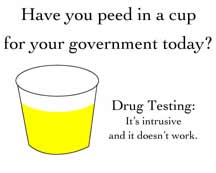
Suspicionless student drug testing is a humiliating, invasive practice that runs contrary the principles of due process. It compels teens to submit evidence against themselves and to forfeit their privacy rights as a necessary requirement for attending school. Rather than presuming our school children innocent of illicit activity — as statistically, the overwhelming majority of them are — until proven guilty, this policy presumes them guilty until they prove themselves innocent. Is this truly the message the Bush administration wishes to send to America’s young people?

You can make your voice heard here.
“bullet” LastOneSpeaks is on top of the continuing problem of spraying in Columbia and points out the new online version of the Columbia Week newsletter.

State Department figures from 2002 found a resulting 15 percent decline in Colombian coca cultivation, but also showed a 23 percent jump in Bolivian cultivation and an 8 percent jump in cultivation in Peru. Even within Colombia, spraying has spurred a balloon effect, spreading cultivation to provinces and regions previously free of coca, including Colombia’s highly biodiverse national parks.

Just is case you want to know what our foreign policy in Latin America looks like, check this out.

Posted in Uncategorized | Comments Off on Interesting reads…

Canadian Senator takes on US and UN drug policies

A picture named nolin_pierre_claude.jpg
From the Senlis Council release on the 17th:

Canadian Senator, Pierre Claude Nolin, strongly criticised the US led drug war at a press conference in Vienna today, following an International Symposium on Global Drug Policy organised by The Senlis Council in parallel to the 47th Session of the Commission on Narcotic drugs (CND). Senator Nolin served as the Chair of the Canadian Special Committee of the Senate on Illicit Drugs.

“Drug war policies threaten the basis of democracy, economy and the rule of law in many countries or regions of the world,” Senator Nolin stated. “The world deserves drug policies that are global, effective and respectful of human rights,” he continued.

“Sooner of later, governments of the world will have to, in the names of transparency and honesty, acknowledge that the drug war is a massive failure,” declared the Senator. “The war on drug discourse is outdated and disrespectful. It is time to make world leaders accountable.”

 The Senator underlined the importance of society’s involvement in the creation of drug policies. “In a free and democratic society, the population should be part of the debate. Citizen involvement in the discussions about the future of drug policy is the magic ingredient.”

This Canadian senator is one to watch. I like him.
The Senlis Council, an international drug policy think tank has taken a strong position opposing UN drug policies and US influences in those policies in particular.

“The dominant role played by the United States in determining UNODC policies should be scrutinised,” said Emmanuel Reinert, Executive Director of The Senlis Council. “It is unacceptable that a UN agency should find itself hostage to the political agenda of one country”, he continued….

“The present UNODC global drug policy has become another failed US war, but this time under a UN flag”, Mr. Reinert continued, “For the US to denounce harm reduction policies is deeply irresponsible. It is urgent for these programmes to be fully recognised by the UN drug control bodies to prevent a world health disaster.”…

“We cannot simply sit back and let this situation continue. Current drug policy is failing dramatically,” he concluded, “It is time to face facts. This is a war without end. The US domination of the global drug policy is a dead end.”

Posted in Uncategorized | Comments Off on Canadian Senator takes on US and UN drug policies