Ballot Access in Illinois

So Jeff Trigg over at Random Act of Kindness is trying to drum up the support of Illinois-based bloggers to promote his pet cause — improving ballot access for Libertarian Party candidates.
But you know what? It’s a good idea anyway. And it doesn’t matter if you support Libertarians or some other third party, or even one of the major parties.
If you’re interested in drug policy reform, you want improved ballot access. Third party candidates (and Libertarians in particular) are much more likely to support drug policy reform publicly. (When I did drug policy-based voting guides, it was mostly the Libertarian candidates who wrote me to thank me for the endorsement. Not a single Democrat or Republican did.) Democrat and Republican politicians not only won’t discuss drug policy reform, they often don’t have to because they’re running unopposed in Illinois. Even a Libertarian candidate that doesn’t have a chance of winning can ask the questions and start the dialog.
So I’m 100% behind this idea. If you’re in Illinois, do your part to help out. Here are the instructions from Jeff:

House Bill 758 is a bill that would reduce the petition signatures that independent and third party candidates need to get in 90 days so they can appear on the ballot. Currently, independent and third party candidates often need 30 to 40 times the number of signatures that Republicans and Democrats need. In the recent Iraq election ALL candidates had the exact same requirement. HB758 would reduce the signatures needed to only double what the Republicans and Democrats need. Passing HB758 is simply the right thing to do.

First, email “Chris Rhodes” ( chris@joincross.com ) and ask him to talk to his boss, Leader Tom Cross, about sponsoring HB758 and getting his leadership team to do likewise. Ask Chris to find out from Tom his thoughts/stance on HB758 and to post those on his blog. (Sorry to put you on the spot Chris but I had to. I’ll try to make it up to you somehow.)

Second, email, call, fax, mail, or otherwise ask our own State Representative to sponsor HB758 immediately.

Don’t know who your rep is? Go here and type in your address.

Now that you know the name of your Rep., go here and find their phone and fax numbers and their addresses.

Some Republican House Member email addresses are here.

For full disclosure – Jeff Trigg, Libertarian – put me up to this but I agree our ballot access laws need to be more free and equal. Please just take a few simple steps and ten minutes to help us out.

Posted in Uncategorized | Comments Off on Ballot Access in Illinois

More on the Bush Wead tapes

Be sure to check out Joe Conason’s take on the tapes.

…The Texas politician couldn’t reassure his friend that he hadn’t used cocaine, let alone marijuana, but as governor he was imprisoning young men and women unlucky enough to be arrested in possession of those narcotics, often for draconian mandatory-minimum sentences. He always cherished his image as a tough, swaggering, law-and-order politician who didn’t hesitate to imprison teenagers.

But that isn’t what happens to people from good families….

[thanks to Scott]
Posted in Uncategorized | Comments Off on More on the Bush Wead tapes

Medical Marijuana roundup

While I’ve been pretty wrapped up in the Illinois medical marijuana effort, it’s important to note that some other efforts are ongoing around the country…
“bullet” D’Alliance shares a nice editorial about Senate Bill 795 in New Mexico, and also reports on how it did in committee:

Our medical marijuana bill unanimously passed the Senate Public Affairs Committee! After all of our mmj patients spoke, the committee asked if anyone was there to oppose the bill – and there was DEAD SILENCE!

What? We get the Drug Czar and a former DEA head and New Mexico gets nothing? Odd.
“bullet” Texans for Medical Marijuana are working hard on HB 658.
“bullet” Loretta reports on New Jersey and Connecticut bills.
“bullet” Cannabis News passed on this report last week that “Medical marijuana advocates have filed suit against the California Highway Patrol, demanding that officers stop confiscating pot from authorized users.” That should be interesting.
“bullet” Check out Kevin Hayden’s piece over at the Street. He starts with a report on the medical marijuana bill in Texas and then moves to a call for decriminalization.

I’ve read the myths, I’ve read the research through the years. I trust what I’ve seen and experienced directly, the most. Medicinal? Obviously. Who knows better than actual patients? Adults should have this choice especially. But they also should have its use available for non-medical purposes. Bush smoked pot. A pretzel put him at greater risk of physical harm.
Posted in Uncategorized | Comments Off on Medical Marijuana roundup

Wead smokes Bush

[Thanks to Casey for the inspiration, and thanks to Roger Ailes for the headline.]

A lot has been made today of the revelation of tapes of George W. Bush prior to becoming president, secretly recorded by Doug Wead, a former Assemblies of God minister who was acquainted with the President. Personally, I don’t think it’s so much a case of startlingly frank admissions secretly recorded, as it is an indication that strategies had already been discussed and established for the George Bush presidency.
First, I don’t think anyone seriously doubts (or has doubted) that Bush used marijuana and coke along with his early alcohol “youthful indiscretions,” so the marijuana admission is not big news, but what is interesting is the notion of establishing an approach where “truth” is considered improper.
Check out the recording as reported in the NY Times:

Mr. Bush, who has acknowledged a drinking problem years ago, told Mr. Wead on the tapes that he could withstand scrutiny of his past. He said it involved nothing more than “just, you know, wild behavior.” He worried, though, that allegations of cocaine use would surface in the campaign, and he blamed his opponents for stirring rumors. “If nobody shows up, there’s no story,” he told Mr. Wead, “and if somebody shows up, it is going to be made up.” But when Mr. Wead said that Mr. Bush had in the past publicly denied using cocaine, Mr. Bush replied, “I haven’t denied anything.”

He refused to answer reporters’ questions about his past behavior, he said, even though it might cost him the election. Defending his approach, Mr. Bush said: “I wouldn’t answer the marijuana questions. You know why? Because I don’t want some little kid doing what I tried.”

He mocked Vice President Al Gore for acknowledging marijuana use. “Baby boomers have got to grow up and say, yeah, I may have done drugs, but instead of admitting it, say to kids, don’t do them,” he said

Now check out a drug policy approach that was promoted by Bush’s drug czar a couple of years later:

DRUG CZAR: JUST SAY NO ABOUT DRUG USE

Don’t Worry If It’s A Lie, Parents Told

Note to boomer parents: It’s OK to lie to your children about your youthful drug use, the federal drug czar said Thursday in New Orleans.

“They’re your kids, not your confessors,” said John Walters, director of the White House Office of National Drug Control Policy.æ “Don’t treat them like your peers.æ Treat them like your children.” [emphasis added]

Sound familiar?
The Drug Czar’s specific guidance received very little positive press, so it was quickly dropped (the current line is “It’s not your father’s marijuana”), but the notion of avoiding “truth” as an approach has been a hallmark of the national drug policy under Bush.
Update: Good discussion in the comments regarding the key issue here. MSNBC contacted me Monday about appearing to talk about this blog entry, but the segment got cancelled at the last minute. So close… However, they seemed interested in a possible future appearance. I’d love to get in a good debate on the drug war.

Posted in Uncategorized | Comments Off on Wead smokes Bush

Welcome Libertarians

I had a great time speaking before the 2005 Libertarian Party of Illinois convention this afternoon. Thanks for your warm reception and welcome to the new visitors to my blog.
Come back regularly — the site is always changing. For first-time visitors, here’s a few stories you may want to check out — some based on references I gave in the talk, and others just for fun.

Posted in Uncategorized | Comments Off on Welcome Libertarians

Compassionate medicine?

Despite the real risk of heart damage and death from drugs such as Celebrex, Bextra and Vioxx…

…federal advisers, after three days of meetings last week, said the drugs offer enough benefits to let a patient and his doctor decide on their use…

The advisers from the Drug Safety and Risk Management Advisory Committee, oddly enough, had nothing to say about letting a patient and their doctor decide on using medical marijuana, which kills nobody.

Posted in Uncategorized | Comments Off on Compassionate medicine?

Irvin Rosenfeld and the Compassionate IND — Medical Marijuana Proof and Government Lies

Irv Rosenfeld’s appearance at the Illinois medical marijuana hearings has drawn quite a bit of attention and interest. People have been asking me questions about him and the program, so I thought I’d go into more detail.
But first… Steve at decrimwatch was also at the hearings yesterday and provides a fabulous perspective on the detention of Irv Rosenfeld.

“The government does give marijuana to patients. I’m living proof,” he told reportersæduring a press conference. “I’m also living proof that it works well. I’m also living proof that the government doesn’t want to know how well it works. If they want to do research, all they have to do is contact me.”

He brought a tin can full of marijuana cigarettes that he picks up at his pharmacy each month and showed them to a room full of astonished state legislators during the hearing. Shortly after his presentation, he found himself surrounded by four burly state security officers…. [read the rest]

You see, Irv Rosenfeld is one of a small group of patients who actually gets medical marijuana legally from the federal government — yep, that same federal government that sends storm troopers to arrest California patients doing the same thing. He is part of the Compassionate IND (Investigational New Drug) program and gets about 300 marijuana cigarettes in a metal tin prescribed to last 25 days.
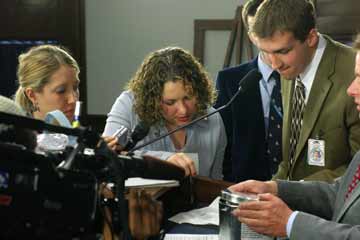
He was a real hit at the Illinois House Committee hearing yesterday. The press was particularly fascinated by the notion that someone could be legally carrying around a tin of marijuana in the State Capital. (seen here examining Irv’s tin and supporting letters)

A picture named press_pot.jpg

And no surprise. It’s not common knowledge. The federal government doesn’t want people to know. They don’t deny the existence of the program, but they sure avoid talking about it.
How did Irv become a federal medical marijuana patient?
It all started in 1976 in a fascinating case

U.S. v. Randall
In 1976, a Washington, D.C. man afflicted by glaucoma employed the little-used Common Law doctrine of necessity to defend himself against criminal charges of marijuana cultivation. On November 24, 1976, federal Judge James Washington ruled Randall’s use of marijuana constituted a “medical necessity.” In part, Judge Washington ruled:

While blindness was shown by competent medical testimony to be the otherwise inevitable result of defendant’s disease, no adverse effects from the smoking of marijuana have been demonstrated…. Medical evidence suggests that the medical prohibition is not well-founded.

Judge Washington dismissed criminal charges against Randall. Concurrent with this judicial determination, federal agencies responding to a May, 1976 petition filed by Randall, began providing this patient with licit, FDA-approved access to government supplies of medical marijuana. Randall was the first American to receive marijuana for the treatment of a medical disorder.

Randall chose not to be silent about his victory, and started organizing others, which led to:

Randall v. U.S.
In 1978, federal agencies, disquieted by Randall’s outspoken opposition to the medical prohibition, sought to silence him by disrupting his legal access to marijuana.
In response, Randall, represented pro bono publico by the law firm of Steptoe & Johnson, brought suit against FDA, DEA, the National Institute on Drug Abuse, the Department of Justice and the Department of Health, Education & Welfare.
Twenty-four hours after the suit was filed, federal agencies requested an out-of-court settlement. The resulting settlement provided Randall with prescriptive access to marijuana through a federal pharmacy located near his home.
The settlement in Randall v. U.S. became the legal basis for FDA’s Compassionate IND program. Initially, this program was limited to patients afflicted by marijuana-responsive disorders and some orphan drugs. In the mid-1980’s however, the Compassionate IND concept was expanded to include HIV-positive people seeking legal access to drugs which had not yet received final FDA marketing approval.

Irv Rosenfeld met Randall, who convinced him to go after the same legal arrangement, which he successfully did (around 1983). Irv has a rare degenerative bone disease called multiple congenital cartilaginous exostoses, a painful bone disease.
More patients joined the Compassionate IND program, but in the 1980s, it looked like it would grow significantly because of AIDS. So The George H.W. Bush administration shut it down in 1991.
Again, from marijuana-as-medicine.org:

The Compassionate IND program was closed because too many people were asking for access to medical marijuana supplies. In order for marijuana to be classified as a prohibited Schedule I drug it must not have “accepted medical use in treatment” in the United States. The federal government knew that hundreds of approved Compassionate INDs would quickly undermine that criteria and marijuana would have to be rescheduled. Rather than respond in an honest and open way, the federal government closed the Compassionate IND program for marijuana.

The existing patients were grandfathered in because it would require public and embarrassing court cases to deny them medicine at this point. The AIDS patients in the program died (this was prior to the AIDS cocktails that could prolong life). And finally, Randall died, making Irv Rosenfeld now the oldest living legal federal marijuana patient.
Seven are alive, two of which remain anonymous.
They continue to get their marijuana on a fairly regular basis. They have to work with a pharmacy that’s been approved by NIDA and that has a secure safe. Then usually a five month supply is shipped at once, and the patient is informed so they can pick it up. The marijuana is grown on a farm at the University of Mississippi, mostly from seeds of Mexican origin, rolled and packaged at the Research Triangle Institute in North Carolina under the supervision of the National Institute on Drug Abuse (NIDA).
Irv’s current supply was grown in 1997, and frozen until needed. It’s low grade marijuana with very low levels of THC, which explains the large amount that must be smoked to serve the medical purposes.
The patients have no other contact with the federal government. There’s no ID card or official paperwork — only some decades-old letters and phone numbers of the pharmacy and an old DEA friend that keep him out of trouble when he’s detained (as he was yesterday).
Irv gets animated and almost angry when he talks about the federal government’s complete and utter lack interest in him over the past 22 years that they’ve been supplying him with 10-12 joints a day.
He notes that they’ve had a perfect opportunity to do a full scale study on long-term controlled use of medical marijuana, and they aren’t interested. They don’t even want to know. All the talk about not having sufficient evidence, about not having controlled scientific studies. Total crap.
“Go ahead, study me!” he exclaimed.
So some of the patients got involved in their own study (excerpts from the study by Ethan Russo, MD are available at CannabisMD). They received MRI scans of the brain, pulmonary function tests, chest x-ray, neuropsychological tests, hormone and immunological assays, electroencephalography (brain wave recording), P300 testing, history, and neurological clinical examination. The results? Other than their original condition for which they were taking marijuana, there was nothing wrong with them. No significant adverse affects from smoking 10-12 joints a day. Irv even had 108% lung capacity. That’s after smoking marijuana for over 30 years, 22 years for the federal government. That’s over 80,000 federal marijuana cigarettes.
This is medical marijuana, the drug that the federal government declares to be too dangerous to be used as medicine, and yet that they supply to 7 patients every month.
Irv Rosenfeld is grateful that he gets his medicine, but finds it extremely unfair that others cannot, so he feels that it’s his responsibility to help spread the word. He was riveting on the Montel show, and was a hit yesterday at the hearing. He single-handedly made numerous people in the room realize how much of a liar the drug czar is (although unfortunately that was not enough, as the Drug Czar carries significant political clout).
Irv’s a real dynamo. He’s a successful stockbroker working in a fast-paced industry while smoking marijuana every day. He’s an outstanding public speaker, and the entire room is drawn to him. He’s a terrific asset to the medical marijuana movement — not only as a good speaker, but because in the end, when the drug warriors claim that medical marijuana is dangerous, Irv stands in front of them proudly and strongly and demands:

“Explain me!”

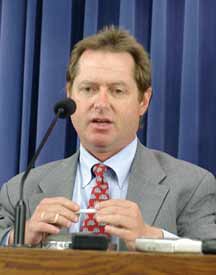
A picture named irvin_rosenfeld.jpg

The truth about medical marijuana:
In the end, it’s really quite simple. Here’s what you say to those who would deny medical marijuana.

  1. When they say there’s no proof that it works, ask them to explain that directly to a medical marijuana patient.
  2. When they say that marijuana is dangerous, ask them to explain Irv Rosenfeld.
  3. When they say they’re worried about the message that’s sent to children, ask them to explain the fact that in states that have passed medical marijuana, recreational use by teens has dropped.
  4. And finally, ask them: “Why do you want to throw sick people in jail for following the advice of their doctor?”

Posted in Uncategorized | Comments Off on Irvin Rosenfeld and the Compassionate IND — Medical Marijuana Proof and Government Lies

Speaking engagement

This Sunday, I’ll be speaking on the drug war to the 2005 Libertarian Party of Illinois Convention. It’s a particularly great honor, since their only other guest speaker is U.S. Presidential Candidate Michael Badnarik.

Posted in Uncategorized | Comments Off on Speaking engagement

Quick Takes

“bullet” Via TalkLeft and NORML — a bad drugged driving bill passes in Ohio that will punish sober drivers who smoked pot weeks ago.
“bullet” An interesting interview with Marijuana Policy Project’s Rob Kampia at the Drug War Chronicle. [thanks, Scott]
“bullet” Drug Policy Alliance has a brief report on Mark Souder’s anti-harm-reduction hearing on Wednesday. Sounds like the drug policy reformers may have held their own. I’m looking for a transcript and hope to report further on this. Apparently Souder chose to lay into Ricardo Cortes’ children’s book “It’s Only a Plant.”
“bullet” In related news, there will be a reading and discussion of “It’s Only a Plant” at Columbia University in New York City on February 22 at 8 pm (Free, bring photo ID to enter campus). Jerome Greene Hall, Room 104. Columbia University Law School. 116th St. & Amsterdam Ave.
“bullet” Loretta Nall’s been very active recently, including talking to children who have been targeted in drug raids.
“bullet” “My head doesn’t feel noisy” At Alternet Drug Reporter: Journeys with Jeffrey.

Posted in Uncategorized | Comments Off on Quick Takes

Illinois Marijuana Lectures still in violation

Since I now know that those responsible for the Illinois Marijuana Lectures website read Drug WarRant… And since you’ve had the time to add material to the site today talking about the hearing in Springfield… And since you won’t even put contact information on your website…
Note: Removing the improper use of the GLATTC logo on the sponsor page was only one part of the correction of your violation. You are still using GLATTC sponsorship information without permission in the following locations: on this page in this thumbnail image, and on this pdf flyer.
We’re also waiting for an explanation as to why you falsified your sponsorship information.
Update (2/20): Final references to GLATTC logo have been removed from the Illinois Marijuana Lectures website.

Posted in Uncategorized | Comments Off on Illinois Marijuana Lectures still in violation