*A Kindred Soul*

A Kindred Soul
I was discovered yesterday! Turns out there’s another blogger out there fighting the drug war. The author of a great blog calledLast One Speaks: A Voice of Reason in the Cacophony of Drug War Rhetoric contacted me and we discovered we had quite a bit in common (Last One Speaks wrote some nice things about me today, so we seem to have a mutual admiration society going).
Last One Speaks already reported several weeks ago on the Medscape poll mentioned in the Boston Globe article below. If you get a chance, check out the recent weeks’ archives, where you’ll find some interesting pieces on Bush’s faith-based drug initiatives, Lou Dobbs, Andrea Barthwell of the ONDCP, and other issues.
Great site. Check it out!

Posted in Uncategorized | Comments Off on *A Kindred Soul*

*The shifting medical view on…

The shifting medical view on marijuana
A picture named grinspoon.gif
Yesterday’s Boston Globe published an article called The Shifting Medical View on Marijuana by Lester Grinspoon (co-author of Marijuana, The Forbidden Medicine. In it, Grinspoon makes note of the recent Medscape poll that showed “76 percent of physicians and 89 percent of nurses said they thought marijuana should be available as a medicine.” Grinspoon has long been an advocate of medical marijuana, and he takes the argument even a step further:

The only workable way of realizing the full potential of this remarkable substance, including its full medical potential, is to free it from a dual set of regulations — the laws that control prescription drugs, and the often cruel and self-defeating criminal laws that control psychoactive substances used to for nonmedical purposes. These mutually reinforcing laws strangle marijuana’s uniquely multifaceted potential. The only way to liberate the potential is to give marijuana the same legal status as alcohol, a far more dangerous substance.

Kudos to the Boston Globe for running the Grinspoon piece. Articles like this one and the Seattle Post-Intelligencer piece I mentioned on Friday may be a sign that the mainstream media is beginning to allow objective anti-prohibition coverage.

Posted in Uncategorized | Comments Off on *The shifting medical view on…

*Drug War Victims* [1]

Drug War Victims
Our drug war results in staggeringly tragic losses. Drugs, when abused, can be dangerous, but they are not nearly as lethal as the drug war itself.
In addition to the blights of an imprisoned population, lost rights, broken families, and economic waste, people are dying in this war. No, these are not deaths from drugs, but from prohibition.
It is important to realize that the vast majority of deaths on the drug war simply would not happen without prohibition. When drug dealers fight it out over territory and they or their neighbors are killed in the process, it is a sympton of prohibition, much as when we suffered the scourge of alcohol prohibition many years ago. Prohibition makes violence profitable.
When drug users overdose from tainted drugs, it is the result of prohibition. When they die from overdoses because they were afraid to seek help, it is the result of prohibition.
A picture named flame.gif
Increasingly, people are dying because of the tactics of the drug war. Military operations are being conducted on our soil, and collateral damage is inevitable.
When drug task forces dressed in black batter in doors without knocking or announcing themselves, the danger to citizens and police alike is enormous. Sometimes the greatest danger is to (or from) the innocent citizen that understandably believes that they are experiencing a home invasion, and rushes to defend their family and property.
Every now and then, a death happens that is particularly grotesque — that points out the horrific folly of our actions. Drug WarRant has started a page to memorialize these tragedies. Unfortunately, it is a page that will be continually updated.
— “Drug War Victims” —

Posted in Uncategorized | Comments Off on *Drug War Victims* [1]

*Signs of Intelligencer*

Signs of Intelligencer
With the federal government attempting to demonize anyone who disagrees with the current war on marijuana use, and even resorting to name-calling (like “cynical, cruel, and immoral”), it’s not surprising that many are reluctant to speak out in favor of any relaxation of laws, let alone outright legalization.
A picture named leafdollar.gif
It was very refreshing to read in yesterday’s Seattle Post-Intelligencer a bold, clear, and common-sense OpEd by attorney Maureen Brown: “Legalize, tax marijuana to fill budget gap.”
While Maureen’s numbers don’t completely add up (for one thing, her numbers assume no reduction in gross prices, and on the other side she neglects many of the incidental cost savings from ending the marijuana wars), they still paint a remarkable picture.
I have long felt that one of the keys to reforming marijuana laws is coherently explaining economic realities. But it’s going to take a major effort to get the money argument out to the people. Under the current system, those who control the war (and thus have attempted to control the discourse) have found the war very profitable for them, at the expense of the ordinary citizen.

Posted in Uncategorized | Comments Off on *Signs of Intelligencer*

*Cops Against the Drug War*

Cops Against the Drug War

The news story is not that the war on drugs has failed, it’s who’s saying it now. It’s not like it’s a front for fringy, pony-tailed pot smokers.

A picture named LEAP.gif
You need to read the excellent article: “Cops Against the Drug War” by Nina Shapiro, in the current issue of Seattle Weekly. This is a feature about the wonderful organization called LEAP: Law Enforcement Against Prohibition, which has done an great job of drawing together some of the real front line warriors who have come to realize that the war doesn’t work, and that drug policies must be changed.
Here are a few quotes from law enforcement personnel (from the article and elsewhere):

  • “I’m tired of putting myself in harm’s way for a losing cause.” (Jonathan Wender, a Mountlake Terrace police officer)
  • “If we put 50-gallon drums out on every street corner in America filled with drugs, we wouldn’t have the problems we have today,” (Peter Christ, a former police officer in New York state who came up with the idea for LEAP)
  • “You can get over an addiction, but you can never get over a conviction,” (Jack Cole, retired from 26 years with the New Jersey Police, board member of LEAP)
  • “After a while, I saw that we spend more and more money and arrest more and more people and have more and more drugs. It doesn’t take a rocket scientist to figure out that this policy is not working. People need to look at this rationally and ask if this is effective. Do we have a healthier society because of drug prohibition? Drug dealers are certainly wealthy because of it. The reason drugs have expanded so much is there is a profit to be made in drug dealing. We need to eliminate that profit motive. ” (Sheriff Bill Masters, author of Drug War Addiction, from an interview with Alternet)

Check out the article, and also stop by LEAP’s website and support their activities.

Posted in Uncategorized | Comments Off on *Cops Against the Drug War*

*”Guest Rant: Ethan Straffin takes…

“Guest Rant: Ethan Straffin takes on Lou Dobbs”
Last week, Lou Dobbs hosted a series on CNN called “The Forgotten War” (entire transcript) in which he gave particular emphasis to the distortions of drug war cheerleaders like former drug czar William Bennett and current drug czar John Walters.
On August 10, Dobbs followed this stunt with an outrageous OpEd in the New York Daily News, in which he parroted false and distorted information from the drug warriors, and ignored his supposed economic credentials.
As a special treat today, I bring you the wonderful response by a fellow drug policy reformer Ethan Straffin. You can also read Lou Dobbs’ original article, and my letter to the editor.
— Read the Full Story —

Posted in Uncategorized | Comments Off on *”Guest Rant: Ethan Straffin takes…

*Federal Government would rather have…

Federal Government would rather have poor children become drug dealers than get an education.
One of the many stupid laws to be passed in the name of the war on drugs is the 1998 revision to the Higher Education Act, which included a new provision that blocked college opportunities to students revealing drug convictions on their Application for Federal Student Aid. If you’ve raped someone, it doesn’t affect your financial aid, but if you’ve had an arrest in your past for smoking a joint, forget about getting federal assistance. This, of course, doesn’t affect the children of congressmen — they can afford college without aid.
Apparently, nobody in Congress thought about the practical aspects. Imagine a promising boy who had some youthful indiscretions, including a bust for possessing a substance that is safer than what the congressman drinks at business lunches. The young person has paid the price for his indiscretion and now wants to make something of himself by going to college. “Sorry. No college for you.” So what does he do? No education. Not many jobs in his community except…
Anyway, Senator Kennedy is planning to soon introduce a bill to overturn this provision. He needs a Republican co-sponsor, and there are a few who could possibly be convinced. So if you live in the states of Senators Mike DeWine (OH), Jeff
Sessions (AL), John Warner (VA),
Sam Brownback (KS), Lincoln Chafee (RI), Olympia Snowe (ME), or Arlen Specter (PA), click on their name to send a targeted letter to them.
For more information, and to write your representatives in general about the HEA, or sign the petition, go to Raise Your Voice.
Oh, and if you live in the district of Mark Souder (IN), who authored this piece of crap, vote him out.
By the way, I’m proud to say that my institution – Illinois State University – was one of the earliest to endorse a resolution calling for the repeal of this horrible provision.

Posted in Uncategorized | Comments Off on *Federal Government would rather have…

*Judiciary Face-off*

Judiciary Face-off
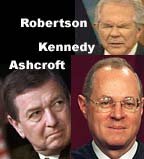
As I mentioned earlier this week, Attorney General John Ashcroft issued a directive requiring prosecutors to snitch on judges who use their own discretion and provide lighter sentences than Ashcroft wants. Senator Edward Kennedy accused Ashcroft of engaging in an “ongoing attack on judicial independence.”
Now another Kennedy has entered the fray — U.S. Supreme Court Justice Anthony Kennedy. While not directly responding to Ashcroft, Kennedy took the opportunity in an address to the annual meeting of the American Bar Association yesterday to blast mandatory minimum sentences.

“I can accept neither the necessity nor the wisdom of federal mandatory minimum sentences,” Kennedy said. “In all too many cases, mandatory minimum sentences are unjust.”

Although Kennedy himself has voted on the Court to uphold mandatory minimums and finds them constitutional he noted that our “resources are misspent, our punishments too severe, our sentences too long,” and that it is “a grave mistake to retain a policy just because a court finds it constitutional.”
A picture named AshKenRob.jpg
As Congress and the Administration continues to take pot-shots at the judiciary (not to mention Pat Robertson, who has organized prayer groups to convince God to “remove” several Supreme Court justices), it will be interesting to see whether or how the judiciary finds additional ways to assert itself.
Here’s an idea. When the next medical marijuana case makes it to the Supreme Court, the justices could send a strong message to the administration by affirming that the Federal Government does not have the right to interfere with state law that is designed to protect the health of its citizens.

Posted in Uncategorized | Comments Off on *Judiciary Face-off*

*Can someone explain this?*

Can someone explain this?
On the DEA website, there is a Drug Intelligence Brief titled: “Area Codes: Frequently Asked Questions (June 2003)”.
A picture named callDEA.gif
After giving a page of general information about how area codes work, and how they’re assigned to different geographic regions, etc., the credits at the bottom note that “This report was prepared by the DEA Intelligence Division, Office of Strategic Intelligence, Domestic Strategic Intelligence Unit and the Dangerous Drugs Strategic Intelligence Unit.”
I’m having a hard time here. Is this really the DEA’s idea of an intelligence briefing? Is the concept of an intelligence briefing given by the DEA an oxymoron? Do they believe that drug dealers are using area codes for some nefarious purpose? Is the DEA looking to take over long distance? Will Carrot-Top start urging us to dial 1-800-CALL-DEA?
Or, perhaps, the DEA is just panicked that when we run out of area codes it will be harder to keep track of the citizens it wants to control.

Posted in Uncategorized | Comments Off on *Can someone explain this?*

*Well, duh!*

Well, duh!
Bush Administration Misuses Science Data, Report Says. “The Bush administration persistently manipulates scientific data to serve its ideology and protect the interests of its political supporters, a report by the minority staff of the House Committee on Government Reform says.” The New York Times article (also covered in other media) gives an overview of a new report called “Politics and Science in the Bush Administration.”
Of course, the drug policy reform world has been quite aware of this fact. From the lies and exaggerations coming from the ONDCP to the ignorance of major scientific evidence on the part of the new Administrator of the DEA, science has been ignored and altered to fit the drug policy agenda of the administration.
This new report doesn’t cover very much, and the one reference to drug policy is old news, but I thought it was worth including it here (full report available as a pdf – thanks to David Harris for the link):


The Administration undermined its ability to obtain scientific advice on substance abuse by using an apparent political litmus test for appointees to an important drug abuse research committee.
In 2002, Dr. William R. Miller, a professor of psychology and psychiatry at University of New Mexico, was invited to join the National Advisory Council on Drug Abuse. This advisory committee guides policy and funding on drug abuse at NIH. Before Dr. Miller could be appointed, however, an official from Secretary Thompson’s office called him to ask several questions. These questions included whether he was sympathetic to faith-based initiatives, whether he supported abortion rights, whether he supported the death penalty for drug kingpins, and whether he had voted for President Bush.
Dr. Miller recalled that Secretary Thompson’s aide said, “I need to vet you to determine whether you might have any views that would be an embarrassment to the president.” After Dr. Miller answered that he does support needle exchange — a public health intervention proven to save lives but opposed by social conservatives — the aide responded, “That’s a problem.” When asked whether he voted for Bush, Dr. Miller said that he had not. The aide asked, “Why didn’t you support the President?”
The aide told Dr. Miller he would determine whether his views were acceptable. Dr. Miller was never called back, and his name was not on the final list of appointees. Informed of what happened, Dr. Donald Kennedy, past president of Stanford University and editor of Science, commented: “I don’t think any administration has penetrated so deeply into the advisory committee structure as this one, and I think it matters . . . . If you start picking people by their ideology instead of their scientific credentials, you are inevitably reducing the quality of the advisory group.”

Posted in Uncategorized | Comments Off on *Well, duh!*