Drug War Victim – Jarrod Shivers

Although Radley Balko’s been on top of this one, I haven’t talked about it yet. I’ve been waiting for a little more information, and it’s coming painfully slow. That, in itself, can lead one to suspect that there is some fishiness in the case. Regardless, it appears certain to me that police officer Jarrod Shivers is a Drug War Victim.
Shivers was shot and killed (shot once in the chest) while serving a drug warrant at the home of Ryan Frederick. Frederick has been charged with first-degree murder.
Here are some details that are surfacing to date:

  • Frederick claims to have been defending his home, having had a break-in the previous week (and says the police told him they knew he had a break-in and knew who did it).
  • The warrant, based on information from an informant (it’s looking a lot like the informant was the one who broke into Frederick’s house), was for a large sophisticated marijuana grow operation in a detached garage. The police, after a very long delay and a second search, claim to have seized some lights and some marijuana (but no indication of seizing any quantity — a sure sign that they only found some smokables).
  • Frederick is into gardening and landscaping and was growing both tomatoes and young Japanese Maple trees (which look like this).
  • Frederick has no record, and admits to being a recreational pot smoker and having a small amount (3 joints) in his home. This is in general supported by statements of family and neighbors.
  • Police say that they announced before their forced entrance. Neighbors never heard it.
  • The city manager today will apparently announce that the police department “will undergo a top-to-bottom examination including looking into procedures, policies and equipment used by the force.”

This one is looking really ugly.
So in Lima, Ohio, we have a mother shot to death by a cop. In Chesapeake, Virginia, we have a cop shot to death by a homeowner. Both of these are cases of drug war victims.
Quite frankly, I’m not qualified to judge whether Frederick was in the right or not, in the context of the situation, when he shot and killed Jarrod Shivers. I’m also not qualified to judge whether Sgt. Joseph Chavalia was in the right or not, in the context of the situation, when he shot and killed Tarika Wilson. I wasn’t there, and I don’t have all the facts.
However, I am qualified to judge that a major, despicable crime occurred. In both cases, the system of justice and the social contract was twisted, perverted and subverted in ways that predictably caused the deaths of innocent people.
We need to root out those criminals, those organized criminals who prey upon our country by creating laws where none should exist and then enforcing them with military tactics against their own people with no accountability.

Radley’s posts to date on the Chesapeake tragedy (and the source for all the details above) in reverse chronological order:

Posted in Uncategorized | Comments Off on Drug War Victim – Jarrod Shivers

Open Thread

“bullet” Communities that feed on prisons. Jeralyn at TalkLeft talks about the New York Times article. Unions, the prison industry, and prison communities are fighting to keep prisons open and stocked because they’ve got their entire existence pegged to prison income.

Count me among those with no sympathy. America’s over-incarceration policies mean corporations make billions and the federal government throws millions to these communities in subsidies.

“bullet” Careful with the hand sanitizer. They purposely make that stuff to smell good. But if you’re 14 and you put some on your hands in school, don’t notice that it smells good, or you may be fingerprinted and charged with delinquency for inducing “a condition of intoxication, hallucination and elation.”
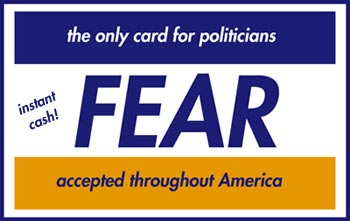
“bullet” Mark Draughn riffs off my FEAR card post and creates his own FEAR credit card.
“bullet” A man wins the lottery (just $1,000) and the police seize the ticket, saying it was purchased with drug money. This could be quite a scam — if they get away with it, you can bet that the big lottery winners will be getting some major scrutiny from police.

Posted in Uncategorized | Comments Off on Open Thread

Heroin users, Prohibitionists, Critics and Enablers

Mark Kleiman points to an excellent NPR story about an incredible, easy-to-use nasal spray that can save lives when applied quickly after a heroin overdose.

The nasal spray is a drug called naloxone, or Narcan. It blocks the brain receptors that heroin activates, instantly reversing an overdose.
Doctors and emergency medical technicians have used Narcan for years in hospitals and ambulances. But it doesn’t require much training because it’s impossible to overdose on Narcan.

Studies have showed the benefit and safety of its use and many lives have been saved. The ONDCP, however, has, of course, objected to making Narcan available to heroin users.

Dr. Bertha Madras, deputy director of the White House Office on National Drug Control Policy, opposes the use of Narcan in overdose-rescue programs.
“First of all, I don’t agree with giving an opioid antidote to non-medical professionals. That’s No. 1,” she says. “I just don’t think that’s good public health policy.”
Madras says drug users aren’t likely to be competent to deal with an overdose emergency. More importantly, she says, Narcan kits may actually encourage drug abusers to keep using heroin because they know overdosing isn’t as likely.

Mark Kleiman correctly notes the moral depravity of the ONDCP’s stance:

The Office of National Drug Control Policy is working hard to make sure that opiate addicts keep dying of overdoses. […]
Why not just go all the way and poison the heroin supply? If withholding Narcan in order to generate more overdoses in order to scare addicts into quitting were proposed as an experiment, it could never get past human-subjects review. But since it’s a failure to act rather than an action, there’s no rule to require that it be even vaguely rational.

Absolutely. So far, so good, for Kleiman. But then, as usual, he has to drop all pretense of academic integrity and retreat into his pathetic pseudoskeptic persona with this bizarre backhanded compliment:

I get angry at the people who call themselves the “drug policy reform movement” for their insistence that we could make more drugs legal without having more addiction. But unlike their counterparts in the equally reality-challenged but politically dominant “drug-free America” movement, the “drug policy reformers” lack the power to kill in the service of their dreams.

Note the use of the belittling “who call themselves” generalization. Once again, Mark takes a perfectly good post about the problems with drug warriors, and for no good reason (and no relevance to the post), slams reformers. And, as usual, mischaracterizes the arguments of reformers.
Yes, some drug policy reformers (myself included) believe that, while drug use may go up in a legalization scenario, it is likely that abuse of drugs will remain relatively the same or even go down. This is supported by the fact that legalization would provide implementation of better regulation, more focus on treatment, safer drugs, increased likelihood of seeking help, substitution of one drug for another, reduction of black market methods, and more societal focus on problem drug abusers rather than diluting efforts by going after all drug users. These are real, legitimate arguments that can’t be dismissed by Mark’s patently absurd view that the numbers of those who abuse legal alcohol can be used to project how every legal drug will be abused.
However, the even more important (and relevant) view that pretty much all drug policy reformers hold is that the overall harms related to drugs and drug prohibition will be greatly reduced under a regulated legal market compared to a prohibition-fueled black market regime. This can’t be refuted.
[Interestingly, Kevin Drum picks up the story, in an passing post about the ONDCP’s view, but his readers also catch the rest of it pretty well in comments (Kleiman’s site no longer accepts comments).]
Kleiman’s off-handed non-critique as usual fails to deal with the fact that legalization and regulation can mean a whole lot of different kinds of options. Mark seems to intellectually know this, as he will go on ad nauseam on a wide variety of bizarre regulatory schemes (see drinking licenses) in this books and writings, yet not apply time-tested regulatory approaches when calculating the cost/benefit ratio of prohibition versus legalization. For that matter, he doesn’t even like making that calculation, because that would give legitimacy to the thought of legalization.
OK, Mark — you want to talk policies? Specific policies?
Let’s talk about a legalization approach to heroin, since that’s the subject of this post — heroin maintenance. Have the government provide safe controlled doses of heroin to all those who are dependent on heroin. Heck, make it free of charge (you could easily to so by buying cheap heroin in Afghanistan and because of the the enormous savings from reduced health care, enforcement, and prison costs).
Would this work? Yes. Would it, in fact, reduce the rate of heroin addiction? Yes. How do we know? Because the Swiss have been doing it for years. No, they weren’t able to do it in full scale as a complete legalization approach due to pressure from the U.S., but they were able to do it in a significant sample of the most hard-core heroin users (whom most would agree are the true problem group). This is something I’ve talked about before, but I’ve been hoping for updated information on the Swiss approach.
Fortunately, LEAP’s Howard Wooldridge has done a tremendous service by putting together Swiss Heroin-Assisted Treatment 1994-2008: Summary, which has been approved by the Swiss Federal Office of Public Health. It’s worth printing here in full:

Overview: Due to the severe drug problem in Switzerland in the early 1990s, (rising number of injection drug users, visibility of open drug scenes, AIDS epidemic, rising number of drug related deaths, poor physical health, high criminality) the Swiss made a fundamental shift in approaching the problems caused by heroin addiction. The Swiss offer treatment-on-demand. Of an estimated 22,000 addicts, 16,500 are in treatment and 92% are given daily doses of methadone at conventional clinics. The Swiss treat about 1300 addicts with maintenance doses of heroin via 23 special clinics operating in cities and two prisons. The Swiss approach has resulted in lower rates of crime, death, disease, a drop in expected new users as well as an improvement in mental and physical health, employment and housing. The program has been copied by six countries: Germany, Holland, Belgium, England, Spain and Canada.
* To qualify for a heroin prescription: 1) at least 18 years old; 2) been addicted (daily use) for at least two years; 3) present signs of poor health; 4) two or more failed attempts of conventional treatment (methadone or other); 5) Surrender drivers license; 6) Heroin can only be obtained at the clinic and must be consumed on site (oral or injection). (Note: Under strict control and specific criteria [for example full employment] a few are allowed to take one oral dose daily away)

  1. Patients can receive up to three doses of heroin per day. 60% take the heroin via needle injection, the rest via pill. The use of the oral pill is increasing.
  2. Patients average about three (3) years in this plan. However, they may stay in treatment indefinitely. 20% of original patients are still in the program.
  3. The vast majority of patients are satisfied or very satisfied with the program.
  4. Average age of patient: 38 years.

*Crime Issues: 60% drop in felony crimes by patients. 82% drop in patients selling heroin.
*Death Rates: No one has died from a heroin overdose since the inception of the program. The heroin used is inspected for purity and strength by technicians.
*Disease Rates: New infections of Hepatitis and HIV have been reduced for patients in the program.
*New Use Rates: Lower than expected.

  1. As reported in the Lancet June 3, 2006, the medicalisation of using heroin has tarnished the image of heroin and made it unattractive to young people.
  2. Most new users are introduced to heroin by members of their social group and 50% of users also deal to support their habit. Therefore, with so many users/sellers in treatment, non-users have fewer opportunities to be exposed to heroin, especially in the rural areas.

*Cost Issues: 48 dollars/day: Patients pay from zero to 12 dollars per day depending on their ability. Note: About 30% of patients work for a living and pay part of the costs. Note: The Swiss save about 30 dollars per day per patient mostly in lowered costs for court and police time, due to less crime committed by the patients.
** This summary was taken from five published reports. The Swiss Federal Office of Public Health reviewed and approved its release. Additional questions should be directed to Dr. Dora Fitzli, the science and health advisor to the Swiss Ambassador at the Embassy. Her English is near native fluency.
NOTE: This summary was researched and written by Howard J. Wooldridge of LEAP.

Prohibitionists and prohibitionist enablers don’t want to believe that any form of legalization can work. They firmly believe that problem users won’t quit unless they are coerced, and so they mindlessly support prohibition. Even if that were true (and the evidence isn’t clear that coercion works better overall), it would be better to live with a group of well-managed hard-core drug users than to continue the massive evils resulting from prohibition.

[Note: Other examples of Kleiman’s approach are here, here, here, here, here, here, …]
[Update: a couple of small editorial changes made to improve reading flow.]

Update: Ethan Brown notices Kleimans’s problem as well.

Posted in Uncategorized | Comments Off on Heroin users, Prohibitionists, Critics and Enablers

Think of the children

From the Drug Czar: Students Push For Random Drug Testing

A picture named HitlerYouth.jpg
Posted in Uncategorized | Comments Off on Think of the children

Fear card used again

No surprise, but still

The Bush administration announced yesterday that it is seeking $200 million to help cities fight violent crime, citing as one of its reasons, the U.S. Sentencing Commission’s decision to give convicted crack cocaine offenders a chance for an earlier release.
Speaking before the U.S. Conference of Mayors, Attorney General Michael B. Mukasey said that “a sudden influx of criminals from federal prison into your communities could lead to a surge in new victims as a tragic, but predictable, result.”

Of course, there will be no “sudden influx” (release will be spread over many years and they still have to get a judge to agree for each release, which federal prosecutors have already said they will fight).
But the truth doesn’t matter — all that matters is profiting by making people afraid.

A picture named fear.jpg
Posted in Uncategorized | Comments Off on Fear card used again

Open Thread

“bullet” Jacob Hornberger says that Lou Dobbs should take responsibility for the death of a border agent.

What Dobbs fails to comprehend, however, is that he himself, along with other supporters of the war on drugs, are morally responsible for the death of that Border Patrol agent. That is, Dobbs and other drug-war supporters cannot escape moral responsibility for the agent‰s death by simply pointing to the legal (and moral) responsibility of the drug dealers who killed him.
“Dobbs and his drug-war cohorts just cannot let go of their beloved war, not even when it has gone on for more than three decades, with nothing but death, destruction, corruption, and failure to show for it.”
If the drug war had been ended years ago, as libertarians have long advocated, there would be no more drug gangs and drug lords. Those types of people survive and prosper only in black markets, not regular markets. If drugs were legalized, the people selling drugs would be pharmacies and other normally operating businesses, just as they were before U.S. officials made the sale and distribution of drugs illegal.

“bullet” Interesting article from the Council on Hemispheric Affairs, which puts Walters’ recent outburst against Chavez in some additional perspective:
Colombia: The Blitz is On

A prime weapon in the U.S. inventory to reduce Ch½vez to size and build up Colombia‰s President Uribe is a recent government-funded report produced by the Center for Strategic and International Studies (CSIS), which claims that the South American nation, Colombia, is safely ‹back from the brink of crisis.Š But in terms of its conceptualization and implementation, the contracted document and the campaign surrounding its publication raises serious questions. These include the conservative organization‰s objectivity due to its longtime advocacy of Plan Colombia, and its vigorous support of the pending free trade pact with Bogot½.
The CSIS Colombia project is more about being part of a well-timed public relations campaign than about bona fide research.

“bullet” Richard Holbrooke, former ambassador says we’re Still Wrong in Afghanistan

“I’m a spray man myself,” President Bush told government leaders and American counter-narcotics officials during his 2006 trip to Afghanistan.æ He said it again when President Hamid Karzai visited Camp David in August.æ Bush meant, of course, that he favors aerial eradication of poppy fields in Afghanistan, which supplies over 90 percent of the world’s heroin.æ His remarks — which, despite their flippant nature, were definitely not meant as a joke — are part of the story behind the spectacularly unsuccessful U.S.æ counter-narcotics program in Afghanistan.

“bullet” If you’re on Facebook, consider donating $10 so that SSDP can earn $10,000.
“bullet” A student newspaper at Arizona State University goes a little deeper into the drug trade than most I’ve read.
“bullet” “drcnet”

Posted in Uncategorized | Comments Off on Open Thread

The Drug Czar’s Prescription

Recently, the Drug Czar’s office has, interestingly, cut way back on the marijuana rhetoric in order to focus on the cause du jour: prescription drug abuse. Of course, their office spouts statistics saying that teenage use of marijuana is down and prescription drug abuse is up, but as we know, they are adept at cherry-picking statistics to promote whatever they wish.
So I’m suspicious of the true agenda here.
But it sure seems like they’re going all out on this. They were even planning on a Presidential statement in the Roosevelt Room about it, until the Heath Ledger death caused them to delay it (due to fears that it would appear that the President was using Ledger’s death for political purposes, despite the fact that the cause of his death is still indeterminate).
And apparently, the Drug Czar’s going back to the SuperBowl!

The White House drug office will use its first Super Bowl spot in four years to caution that the biggest teen drug danger could be the legal medicines stored in parents’ medicine chests. […]
The Super Bowl spot, to air at the close of the first half, features a drug dealer complaining that his business is down because teens are getting high from abusing drugs in the medicine cabinet. [you can watch the video at the site]

I admit to being at a bit of a loss here. Getting out a message to parents to keep prescription medicines out of the hands of kids doesn’t seem like a bad idea.
But this is the Drug Czar. I can’t help but think that there’s something I’m missing.

Posted in Uncategorized | Comments Off on The Drug Czar’s Prescription

Presidential campaign musical chairs

Dennis Kucinich is dropping out of the Presidential race tomorrow to focus on his House race. It’s a shame not to have his drug policy reform views in the race, but quite frankly, we didn’t really have them much when he was running. He never developed any traction or real notice (except in comparison to invisible man Mike Gravel).
I’ve also been extremely disappointed with Kucinich in the House. We were so excited when he was named Chair of the Subcommittee on Domestic Policy — the subcommittee that was supposed to include the drug policy areas formerly overseen by Mark Souder when the Republicans controlled the House. But he tamely followed the leadership’s mandate and almost completely ignored drug policy. Just look at the hearings since he took over. The only advantage to having Kucinich is that he’s not Souder. And yes, the absence of Souder is devoutly to be wished, but still, it would be nice for a reformer to actually, you know, reform.
Actor Fred Thompson has also mercifully dropped out — he was wildly miscast in his role as Presidential candidate. Nobody believed his character, and he couldn’t seem to memorize his lines. I’ve got to admit that I’m glad not to have a candidate who got his views on drug policy from Law and Order.
The best chance of drug policy reform actually being discussed in the Presidential campaign continues to be Ron Paul (who Monday received the endorsement of drug policy reformer and former New Mexico Governor Gary Johnson). He’s got the money and the ground troops, but not the press or the voting numbers. The fact that he’s got a reasonable amount of cash on hand means that he may have some time yet to get out the message.
Of course, there is another chance that drug policy will be discussed in the campaign — and that’s if Obama is the Democratic candidate. In that case, his youthful drug use is likely to become an attack issue and it could get ugly. Then it will be interesting to see how the public responds. Will they continue to reward “soft-on-drugs” attacks?
Again, this is mostly just interesting conjecture. While I dream of reform-minded Presidents, I know that the best we can really hope for is one that will make increasing the drug war a low priority. Leadership will come from the people, not the leaders.

Posted in Uncategorized | Comments Off on Presidential campaign musical chairs

Drug war insanity causes extreme dysfunction

I don’t think anybody can look at this story without realizing that we have a case of extreme dysfunction:

Elite army soldiers took over police stations along Mexico’s border with Texas on Tuesday, disarming police, checking for unregistered weapons and searching patrol cars and personal vehicles for any items that might link the officers to drug cartels, according to an official and the Mexican media.
Special-forces soldiers wearing ski masks took control of police stations in Nuevo Laredo, Reynosa, Matamoros and other cities in Tamaulipas state during the morning change of shifts, said an official and local residents who spoke on condition of anonymity for fear of retaliation.

That’s right. Special forces soldiers in ski masks raiding police stations! Take a moment and picture that. And figure out how we got to that point. Was it because of drugs? Or the drug war?

[See more from Grits for Breakfast]

Now over in Brooklyn, there were no ski masks, but still

Heads rolled at the top of the NYPD’s Narcotics Division Monday night after the Daily News learned that 20 cops were benched over charges that undercover officers took sex, drugs and cash from junkies and dealers.
NYPD and law enforcement sources said 15 cops – all from the midnight crew of Brooklyn South Narcotics – have been put on desk duty as part of a five-month investigation by the NYPD’s Internal Affairs Bureau.
That’s on top of four members of the midnight crew busted on allegations they stole drugs to pay off informants and another who was suspended on undisclosed internal charges, sources told The News.

Can you say “dysfunction”? I knew you could. This isn’t one cop. This is a whole bunch of ’em. These are the people that the community is supposed to trust to protect and serve them.
Now in Cleveland, it’s a dysfunctional relationship with the DEA, informants and prosecutors.

A federal judge decided Tuesday to free 15 men from prison because their convictions were based on testimony of a government informant who lied on the witness stand and framed innocent people.
Collectively, the men have served at least 30 years behind bars. They were sentenced to a combined 86 years. Federal public defender Dennis Terez called the release of so many people at one time unprecedented.
Fallout from the case is expected to spread beyond the federal courthouses in Cleveland and Akron, where the men were convicted of dealing crack cocaine in Mansfield.
The case is a blow to the federal justice system, which relies heavily on informant-based testimony, lawyers said. The men, some with no prior run-ins with the law, were given long prison sentences based almost exclusively on the word of informant Jerrell Bray and Lee Lucas, the U.S. Drug Enforcement Administration agent who supervised Bray.

[See more from Scott Morgan]

Three different stories in one week. All examples of dysfunction so great that the entire concept of police serving and protecting the people is meaningless. The fabric of government itself is shredded.
The dysfunction and destruction screams at us. Yet the drug warriors, deaf and dumb, lurch on in their war, no longer knowing where they’re headed, yet somehow sure that if they just do… more of it, they’ll win.

Strange game.
The only winning move is not to play.

How about a nice game of chess?

Posted in Uncategorized | Comments Off on Drug war insanity causes extreme dysfunction

Deep Thoughts… about the Drug War

by Pete Guither

In regulated markets, disputes are handled by lawyers. In the black market, disputes are handled by guns. I have no love for lawyers, but I’d rather get hit by a stray brief than a stray bullet.


The entire philosophy behind SWAT-style drug raids is that the death of a mother, a child, or the family pet is an acceptable risk to prevent flushing.


As anyone who has tried to quit smoking knows, dependence is hardest to overcome during difficult or stressful times. That must be why, when the government helps drug abusers quit, they arrest them and take away their job, possessions, and children.


If I wanted to win the hearts and minds of farmers in Latin America and Afghanistan, I probably wouldn’t start by destroying their fields and removing their only hope of feeding their families.


Those massive drug seizures you read about in the paper affect traffickers much the same way a DVD shoplifter affects WalMart — an annoyance, but part of the normal cost of doing business.


No government in the world can compete with the black market in financial compensation for police officers.


When a government uses military personnel, equipment, and tactics against its own citizens, is it time to call it a Civil War rather than a Drug War?


The government is good at job creation. Every arrest of a drug dealer creates a new high-paying job opening.


If you want to bring a community together, hold a pot-luck dinner. If you want to drive it apart, hold a drug war.


Americans are generally pretty brave… although some are apparently terrified of people who listen to Pink Floyd and eat Cheetos.


Even the characters played by Tommy Chong make more sense than most politicians.

Posted in Uncategorized | Comments Off on Deep Thoughts… about the Drug War