Tamerlan Tsarnaev delved deeply into religion in recent years at the urging of his mother, who feared he was slipping into a life of marijuana, girls and alcohol.
So… how did that work out?
Tamerlan Tsarnaev delved deeply into religion in recent years at the urging of his mother, who feared he was slipping into a life of marijuana, girls and alcohol.
So… how did that work out?
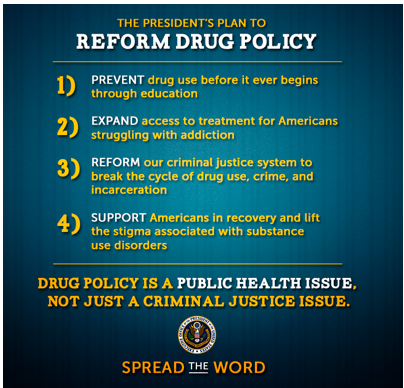
The Washington Post notes that the Drug Czar plans to outline the drug control strategy today at Johns Hopkins. Nation’s drug czar to outline drug policy reform emphasizing public health
“Drug policy reform.”
ANNAPOLIS, Md. — President Barack Obama’s new strategy for fighting the nation’s drug problem will include a greater emphasis on using public health tools to battle addiction and diverting non-violent drug offenders into treatment instead of prisons, under reforms scheduled to be outlined by the nation’s drug czar Wednesday.
Well, the strategy is available online now: 2013 National Drug Control Strategy
And right there on the front page: Reform!

And all throughout, you see the standard buzzwords
“an approach that rejects the false choice between an enforcement-centric “war on drugs†and drug legalization.”
“evidence-based public health and safety initiatives”
“collaborative, balanced, and science-based approach”
“emphasizing prevention and access to treatment over incarceration, pursing “smart on crime” rather than “tough on crime” approaches to drug-related offenses”
“While law enforcement will always play a vital role in protecting our communities from drug-related crime and violence, we simply cannot incarcerate our way out of the drug problem. Put simply, an enforcement-centric “war on drugs†approach to drug policy is counterproductive, inefficient, and costly.”
Yes, it all sounds good unless you actually look at the budget and see that we’re spending just as much on enforcement and supply-side interdiction as we ever have, and we’re spending more on those than on treatment and prevention. (We spent 9.4 billion on domestic enforcement in 2012 and they’re asking for 9.5 billion in 2014. The FY 14 budget devotes 58% of drug-control spending to punishment and interdiction, compared with 42% for treatment and prevention. Link)
The administration wants to pretend to be drug policy reformers because they know full well that the public doesn’t like the drug war.
But all this administration can do is pretend, because apparently the drug war is too valuable to them (politically and/or financially) to even cut a little bit.
I’m reminded again of the line in “Oh Brother, Where Art Thou”:
Junior: A lot of people like that reform. Maybe we should get us some.
Yes, maybe you should. But this isn’t it.
A truly outstanding piece by Tony O’Neill: Why Good Parents Should Support Drug Legalization
As an ex-junkie, I know how harmful addiction is. As a father, I want to protect my daughter from harm. Making all drugs legal will help.
It’s a powerful piece that’s direct and to the point. It’s not only a message to parents, but to the community that deals with addiction and that has too often lined up on the side of harm. And he has no patience for the nonsense that comes from the Drug Czar and SAM.
The addiction community’s number one priority has to be convincing the powers that be to end drug prohibition. Only when drug use is classified as a medical rather than a legal issue can resources finally be focused on helping to solve, not worsen, our problems.
Drugs are either illegal or they’re not. Drug users are either criminals or they’re not. There is no “third way,“ and “compassionate prohibition†is an oxymoron. We have a moral imperative to speak out.
… or at least I hope not.
I have for you another ridiculous OpEd, this one from USC Annenberg. Against Marijuana Legalization
This particular OpEd focuses mostly on concerns regarding the inevitable commercialization of marijuana.
As with alcohol, the government will then have a vested interest in its continued distribution and sale in order to maintain the influx of revenue that it will provide. This means that intensive advertising will likely be permitted, leading to the commercialization of the drug and commodification of the culture around it in order to have more mass appeal.
Advertising agencies do not try to promote the consumer’s well being; their job requires them to use all means available to convince people to purchase their product. Just walk around any major city and you will see billboards telling you how drinking will make you cooler and more likeable. I doubt advertisers would have much trouble figuring out ways to make smoking weed seem like a necessary component to enjoy life and have fun.
When did this start being a real argument in this country?
And we’re not just hearing it in student newspaper OpEds.
The essence of this argument is:
Oh, we’re so sorry, but we’re stuck with this horrible First Amendment that lets people try to convince you to do things, so to make it better, we’re going to take away a lot of your other freedoms so you won’t accidentally be convinced to do something that might not be good for you.
When did we vote to make our country some kind of Benign Receivership? And who decided what busybodies were given our custodial responsibility?
I seem to recall that our country was founded on the premise of establishing a government that would secure for us the rights of Life, Liberty, and the Pursuit of Happiness, not one that would paternalistically fit us with a protective coccoon.
It’s bad enough that as a society we’ve become pathetically afraid of terrorists. Are we also going to live life in fear of… advertisers?
Tweet from Transform Drug Policy
Trying to blame the Denver 420 shootings on marijuana is like trying to blame the Boston bombings on running #growup
Sorry to subject you to reporting from The Mail (if you follow the link), but they’ve got the quotes from Susan Sarandon’s Huffington Post video.
[Susan Sarandon] said in a new interview that making the plant illegal is ‘racist’ and a ‘waste of money.’ […]
‘I believe in individual rights, I mean, I would like to see everybody be able to smoke pot. That’s a waste of our money to incarcerate all those people. I’m totally a libertarian in that sense,’ the actress said in a HuffPost Live interview on Wednesday. […]
‘It’s completely racist, you’re picking up everybody at the lower level because the mandatory drug laws let you trade in to get off,’ she said. ‘People at the bottom are filling up our jails, mostly people of colour… you’re wasting taxpayers money and allowing drug cartels to make money.’ […]
‘You never hear of anybody robbing stores when they’re too high, they don’t drive cars, alcohol causes more damage to your body, so it’s just a hangup from ignorance that’s become politicised.’
Sarandon is a fairly powerful very liberal celebrity activist, and her voice actively behind legalization could be good to help liberals stop putting legalization on the back burner.
I got to meet with Susan once — we both had some time to kill at LaGuardia airport and chatted for awhile. She was on her way to open her newest ping-pong social club (SPiN) – this one in Milwaukee. Quite delightfully personable.
I’ve been busy helping students who are holding a four-square marathon to raise money. They do it every year (last year was 69 straight hours). So I’m there through the nights and cook grilled cheese and breakfast sandwiches for them. It’s been a rough one with storms, high winds, and a cold front bringing it down to 27 degrees at one point.
I hope you’re all having a wonderful and safe 4/20.
I may have shared this with you before, but it’s worth doing again… I have a group of very talented friends who have an improv comedy group called Octavarius. One of the things they have worked on is a tran-media project called “I Made America,” which is an internet TV series, plus live events, viral videos and so forth, about some of our founding fathers who were brought through time to present-day Chicago, and are now forced to make a living.
Here’s one of the video shorts they made just for fun.
http://www.youtube.com/watch?v=4j2TPZGpBC0&sns=em
Gil Kerlikowske, Drug Czar, Opposes Marijuana Legalization
Really? That’s news?
It did get Kevin excited…
Kevin Sabet tweet: Today: Gil Kerlikowske, Obama’s Drug Czar, Opposes Marijuana Legalization http://t.co/UbFX09Za5V
Today. Like it was breaking news.
Of course, we know it’s no surprise. It’s not like he has a choice:
Responsibilities. –The Director– […]
(12) shall ensure that no Federal funds appropriated to the Office of National Drug Control Policy shall be expended for any study or contract relating to the legalization (for a medical use or any other use) of a substance listed in schedule I of section 202 of the Controlled Substances Act (21 U.S.C. 812) and take such actions as necessary to oppose any attempt to legalize the use of a substance (in any form) that–
- is listed in schedule I of section 202 of the Controlled Substances Act (21 U.S.C. 812); and
- has not been approved for use for medical purposes by the Food and Drug Administration;
Kevin, however, sees it differently.
Tweet: @TransformDrugs That reading of ONDCP’s authorization is 2nd biggest “mountain out of a molehill” instance/mistake made by reformers.
Again, really?
How else can you possible read it? If there’s another way to read it, then maybe we can just read the drug laws to say that marijuana isn’t really illegal.
From the Pew Trust: Report: No Easy Options for Feds in Legal Marijuana States
The federal government may not have much choice but to continue its mellow attitude toward legal marijuana in Washington and Colorado.
New laws legalizing recreational marijuana use in Washington and Colorado probably fall under the states’ “power to decide what is criminal and what is not,” according to a new report from the Congressional Research Service (CRS). The report analyzes court precedent and lays out what the Justice Department and the Obama administration might do to enforce federal law now that several states have passed marijuana laws that contradict it.
The agency’s conclusion: The feds face an array of unappealing options.
Here’s the report: State Legalization of Recreational Marijuana: Selected Legal Issues (pdf)
As you may know, the Congressional Research Service is the entity that Congress turns to for detailed policy and legal analysis.
Here’s the key:
In Section 708 of the CSA (21 U.S.C. §903), Congress specifically articulated the degree to which federal law was to preempt state controlled substances laws. This express preemption61
provision recites language that evokes the principles of conflict preemption, stating,No provision of this subchapter shall be construed as indicating an intent on the part of the Congress to occupy the field in which that provision operates, including criminal penalties, to the exclusion of any State law on the same subject matter which would otherwise be within the authority of the State, unless there is a positive conflict between that provision of this subchapter and that State law so that the two cannot consistently stand together.62
Notably, the provision clarifies that Congress did not intend to entirely occupy the regulatory field concerning controlled substances or wholly supplant traditional state authority in the area. Indeed, Congress expressly declined to assert field preemption as grounds for preempting state law under the CSA. The Supreme Court has stated that this provision suggests that Congress “explicitly contemplate[d] a role for the States in regulating controlled substances.â€63 As such, the preemptive effect of the CSA is not as broad as congressional authority could have allowed. States remain free to pass laws relating to marijuana, or other controlled substances, so long as they do not create a “positive conflict†with federal law, such that the two laws “cannot consistently stand together.â€
This is crucial, and why the Feds can’t simply overturn the Colorado and Washington laws, for example (or any of the medical marijuana laws, either). The states, of course, have to dance a bit of a fine line to make sure they don’t implement laws in a way that conflict with federal law, but the mere notion of the state having a different way of dealing with marijuana than the federal government is not a problem. In this instance, the CRS actually mentioned an Amendment that you rarely hear having any power:
Under both Tenth Amendment and preemption principles, federal and state courts have previously held that a state’s decision to simply permit what the federal government prohibits does not create a “positive conflict†with federal law.85 As discussed above, under the impossibility prong of conflict preemption, the Supreme Court has specifically held that so long as an individual is not compelled by state law to engage in conduct prohibited by federal law, then simultaneous compliance with both laws is not “impossible.â€86
The CRS also explains why international treaties do not overturn state legalization laws.
It is well established that treaties, like federal statutes, may preempt conflicting state laws. The Supremacy Clause expressly provides that in addition to federal law, “all treaties made … under the authority of the United States, shall be the supreme law of the land.â€138 Therefore, a state law is generally preempted to the same degree whether it is in conflict with a federal statute or an international treaty obligation. However, not all treaties are accorded “automatic†preemptive effect.139 Only where a treaty “constitute[s] binding federal law,†without the “aid of any [implementing] legislative provision,†does it qualify as the “Supreme law of the land†for preemption purposes.140 Such treaties are known as “self-executing†treaties—meaning an international agreement with “automatic domestic effect as federal law upon ratification.â€141 […]
…neither the Single Convention nor the other international drug control treaties appear to be “self-executing.†Each treaty requires the signatory nation to give legal effect to the goals of the treaty through domestic implementing legislation. The provisions of the treaties do not themselves establish binding domestic law. The United
States, for example, implemented the obligations of these treaties through the CSA.145 Because these treaties do not create binding law “of [their] own force,†it would appear unlikely that a U.S. court would accord the treaties direct preemptive effect.146
So where does this leave the feds? They can use their limited resources to arrest and seize whomever they can get their hands on. They can tie marijuana to other federal laws — gun possession, public housing occupancy, employment drug testing, etc.
None of these options will achieve the overturning of state laws. And their pettiness will turn individuals further against the federal government.
Or… the federal government could listen to the states, and to the people.
Just a thought.