Another great column

Wow! In today’s Chicago Sun Times, by Neil Steinberg: We’ve Lost War on Drugs, Must We Lose Our
Rights?

Next week in Washington, D.C., opening arguments begin in a federal lawsuit that you might not have heard about. A few months back, a new
law tucked discreetly into a government spending bill cut off federal
funds to any public transit system that accepts advertising that
advocates certain changes in the nation’s drug laws. If the Chicago
Transit Authority accepts an ad from a group trying to improve the
terminally ill’s access to medical marijuana, the CTA will lose its
federal funding.

Whatever you think of U.S. drug policy — words like “failed” and
“Draconian” automatically leap to my mind, but you might think first
of “expensive” and “futile” — you probably, one hopes, feel the
matter should at least be discussed, and that people have the right to
air their views and buy ads to disseminate them.

We’ve lost that right, another collateral victim of our lost drug
war. The warm glow associated with being “tough on drugs” has caused
politicians to fall over themselves passing inane and excessive laws,
such as this law, or the one cutting off college grants to anyone with
a drug conviction — which means you can murder someone and get a Pell
grant to go to college, but that ounce of pot will bar you for life.
Your tax dollars at work.

Posted in Uncategorized | Comments Off on Another great column

Is that a metabolite in your hair?

Excellent OpEd in yesterday’s Cincinnati Post by Paul Armentano:

Imagine if it was against the law to drive home after consuming a single glass of wine at dinner.æ Now imagine it was against the law to do so after having consumed a single glass of wine two weeks ago.æ

Sound absurd? No more so than newly proposed Congressional legislation by Ohio Rep.æ Rob Portman mandating that each state enact laws sanctioning anyone who operates a motor vehicle “while any detectable amount of a controlled substance is present in the person’s body, as measured in the person’s blood, urine, saliva, or other bodily substance.”

While the expressed purpose of this legislation, the “Drug Impaired Driving Enforcement Act of 2004,” is to target and remove drug-impaired drivers from our nation’s roadways, the reality is that this poorly worded proposal would do little to improve public safety.æ Rather, it would falsely categorize sober drivers as “intoxicated” simply if they had consumed an illicit substance, particularly marijuana, some days or weeks earlier.

This is bad law. It is also improper at the federal level (it’s actually closer to federal blackmail against the states).
Get active!

  1. Go to MAP’s Focus Alert and write some letters to the media. Letters that get published are worth more than advertising, and MAP will help you do it.
  2. Tell your Congressman about this. It’s quick and easy.
Posted in Uncategorized | Comments Off on Is that a metabolite in your hair?

Economics for Dummies

This one cracked me up. Last One Speaks was covering the fact that Jamaica and Cuba have apparently been hoodwinked by our government into thinking asset forfeiture is smart government (!), and one of the quotes included:

As the US President’s National Drug Control Strategy for 2004 states, “The drug trade is not an unstoppable form of nature but rather a profit-making enterprise that can be stopped.

How is it that everyone in our government managed to sleep through basic economic theory?

[Note: Also check out LastOneSpeaks on our other quagmire in Columbia.]
Posted in Uncategorized | Comments Off on Economics for Dummies

More important incremental medical marijuana victories

I just received this from Americans for Safe Access:

San Jose, CA.  Eighteen months after a brutal DEA raid on a medical marijuana collective in Santa Cruz, California, the seriously ill collective members finally got the protection from future raids and harassment they have sought since filing suit against the federal government one year ago.  After reconsidering his earlier decision in the high profile case County of Santa Cruz et al. v. Ashcroft, Judge Jeremy Fogel of the Northern District of California has granted Plaintiffs a preliminary injunction and denied the government’s motion to dismiss Plaintiffs’ complaint.  Today’s ruling will protect the Wo/Men’s Alliance for Medical Marijuana (WAMM) while the lawsuit is pending, and allow the collective to resume cultivation.

The Drug Policy Alliance, along with the law firm Bingham McCutchen LLP, the Santa Cruz City Attorney and co-counsel Prof. Gerald Uelmen and Ben Rice, represent Plaintiffs in this case.  “In the face of overzealous federal law enforcement, for the first time a court has applied the law in a way that protects the right of a group of sick people to grow and share their medicine without fear,” said Judy Appel, Director of Legal Affairs for the Drug Policy Alliance. “Today’s decision affirms the right of WAMM’s members to cultivate and use marijuana for medicinal purposes free from federal interference,” stated Neha Shah Nissen, an attorney with Bingham McCutchen.  “The federal government can no longer ignore the will of the people of the State of California and the City and County of Santa Cruz to protect the health and welfare of terminally and chronically ill individuals.” 

“We applaud the Court’s decision and we are profoundly pleased as we prepare to replant our garden,” said Valerie Corral, co-founder of WAMM. “But we also steady ourselves for a tug of war with the present administration’s unwillingness to honor the democratic process.”

This is yet another example of the reach of the 9th Circuit decision in Raich v. Ashcroft. Clearly, because of that case, the Judge re-evaluated and determined that WAMM had a good chance of winning their case against the government.
One more little step in the move in the courts toward reigning in the illegal actions of the feds and their harrassment of medical marijuana in the states.
æ

Posted in Uncategorized | Comments Off on More important incremental medical marijuana victories

Happy 420

Today might be a day to read something fun, so I thought I’d point out one of my older satire articles — if you’re a recent visitor to Drug WarRant, you may not have seen this before.
So move ahead to the year 2043 and the government’s war on burgers.

Posted in Uncategorized | Comments Off on Happy 420

Stupid DEA tricks

From the Sun News in Myrtle Beach, SC:

You have to admire the gumption of the U.S.æ Drug Enforcement Administration and its associates in the Horry County, Atlantic Beach and North Myrtle Beach police departments.æ Officers from the agencies came up dry Thursday in their drug-paraphernalia raid on the 4:20 Superstore in Atlantic Beach, having apparently been given bum information.æ At that point, most other government folks ( a line of work not known for creativity ) would have said, “Well, that didn’t work out,” and left the scene.

Instead, the drug agents said, “Hey, we have those drug-sniffing dogs from the NMB canine unit with us.æ As long as we’re here, why not search some cars at random?” Not even the knowledge that the U.S.æ Supreme Court is considering a case with potential to ban warrantless, no-probable-cause random canine searches of motor vehicles could deter these intrepid law enforcers from seeking something to show for their efforts.

The random searching of cars netted the DEA three arrests (and hopefully three lawsuits) as a result of this clearly illegal fishing expedition. [Note to DEA. Add “reading the constitution” to the training of DEA agents.]

Posted in Uncategorized | Comments Off on Stupid DEA tricks

Potpourri

Sorry about the light posting the past few days. I went to see Dana Beal speak at the University on Friday (I’ll be posting some about his talk later this week) and I spent the weekend in Chicago without internet access.
For those who are in my area, please note that Mobilizing Activists and Students for Hemp (M.A.S.H.) is having their Spring Hempfest this Friday, April 23 on the Illinois State University Quad. There will be tiedying, and hemp activities, and speakers, and hemp educational materials. I’ll be speaking around 3 pm. (Unfortunately, I’ll have to speak through a bullhorn — the only amplification allowed on the quad on school days — I hate those things, but I like speaking, so…) Stop by if you’re in the area, and be sure to introduce yourself to me. I love meeting my readers.
Posting will be hit and miss this week, but here’s a few things to read:
“bullet” There’s a great article in yesterday’s Chicago Tribune: On Streets, Drug Trade the Only Game in Town by Rex W. Huppke. It’s a powerful look at the economic structure of the poor inner city, and why simple drug enforcement not only fails the city, but actually makes inner city problems worse.
“bullet” Debra Saunders at The SFGate notes that murderers are not only treated better than pot smokers when it comes to student financial aid, but also food stamps. Yep, another inane federal regulation lets murderers get food stamps, but not felony drug offenders who have done their time. Assemblyman Mark Leno is trying to pass a bill to allow California to opt out of that federal stupidity.
“bullet” Doug with MapTalk noticed this little gem in an article about Iraq plans:

The parties also agreed that coalition and Iraqi security forces, supported by the residents, “must move to eliminate remaining foreign fighters, criminals and drug users from Fallujah.”

Remove the drug users? Yeah, that’s good use of resources when soldiers and citizens are getting killed. Or maybe “removing” means executing?
“bullet” Marlana sent me this article about the fact that Springfield, Missouri does not have a law against posession of marijuana, a pesky situation that they’re working on resolving so they can help out the county with prosecutions. (Important note for those living in Springfield, MO — it’s still illegal in the county and the state, which includes the city). So they’re working on passing a law. I’d like someone to ask them the important question (even if the law is a technicality): Why should it be made illegal?
“bullet” Scott sent me this article that takes my indictment of the connection between the war on drugs and failure in the war on terror, and goes a step further.
“bullet” TalkLeft has all the info on KDrink the one that puts the coca back into the soda.
“bullet” Also check out TalkLeft’s coverage of DTAP, an innovative new treatment program.

Posted in Uncategorized | Comments Off on Potpourri

Apologies to my loyal readers

A picture named czar.jpg
I have a confession to make. I have paid all my federal taxes. I realize that this action was unforgivable, since part of it went toward the Drug Czar’s six-figure salary and his $11 billion drug control budget.
Because of this, I am failing my duty to the constitution of the United States and am helping to fund lies, deception and violence perpetrated against the American people.
Vice Squad has coverage of the Drug Czar’s latest in Ridiculous Quote of the Year and Last one Speaks has more on the Czar’s lies here and here.
Again, I apologize.

Posted in Uncategorized | Comments Off on Apologies to my loyal readers

Drug War Family Values

Stupid government. Bad government. No supper for you. Go to your room and think about what you’ve done.

“bullet” US Drug Law Keeps Married Couple from Living Together
Via Drug Policy Alliance:

A pair of middle-aged newlyweds cannot live together in North Carolina or anywhere else in the U.S. because the husband smoked marijuana as a teenager and was convicted three times of simple possession — in Canada. Terry VanDuzee, 48, says one of the three convictions was expunged and he’s been pardoned for all three. Nonetheless, American law bars anyone from immigrating to the United States if convicted of drug offenses more than twice….

The couple has asked for help from elected officials and government agencies on both sides of the US-Canada border, including President Bush, Sen. John Edwards (D-NC) and Canadian immigration. They’ve also set up a website to document their quest to live together and ask visitors to petition the US government on their behalf.

“If you had to be punished continually over all your [life] for things we did as teenagers, we’d all be up a creek,” Debbie told the Herald-Sun newspaper. “Terry deserves to be forgiven. Why should he have to suffer the rest of his life for something he did when he was a teenager?”

“bullet” Update on that Terrorist Cell from Norway
If you recall my post in January: From the Oregon Register-Guard:

[Kari] Rein, 42, and her husband James Jungwirth, 41, a U.S. citizen, have lived in Williams, near Grants Pass, for 15 years. They run an herb and seaweed harvesting business and have a 14-year-old daughter and a 7-year-old son.

11 years ago, Rein was convicted of growing six marijuana plants for personal use and received probation and community service. Kari Rein is an immigrant, and immigration officials now want to send her back to Norway.

According to Rein’s attorney, immigration officials say the conviction qualifies as an aggravated felony and mandates deportation under 1990s immigration rules that have received souped-up enforcement since the Sept. 11, 2001, terrorist attacks on the United States.

Well, Kari has now officially applied for a pardon from Governor Ted Kulongoski. It will take 30 days for the pardon to be considered. Even if granted, the family will be out over $26,000 in legal fees.

Posted in Uncategorized | Comments Off on Drug War Family Values

Something for the 911 Commission

or How the War on Drugs has Undermined our Domestic and International Security
All the talk recently about the 911 Commission, and who knew what/when, and what the priorities were, and on and on… It got my mind wandering about the relationship of the War on Drugs in all of this. It’s clear to me that the commission should be asking more questions.
I don’t know if 911 could have been prevented. Could the Bush/Clinton administration done something different? Sure. Would it have mattered? Who knows. However, I do know that the War on Drugs has been a major player —
This drug war has clearly

  • Distracted federal effort, focus, and resources from more important issues like terrorism
  • Actually provided funding for terrorism, through prohibition profits and corruption
  • Created conditions of instability that encourage terrorist growth

The War on Drugs and Afghanistan
Robert Scheer wrote Tuesday in the Los Angeles Times:

But what is perhaps even more astonishing is that, because the Bush administration’s attention was focused on the “war on drugs,” it praised Afghanistan’s Taliban regime even though it was harboring Bin Laden and his terror camps. The Taliban refused to extradite the avowed terrorist even after he admitted responsibility for a series of deadly assaults against American diplomatic and military sites in Africa and the Middle East.æ

On May 15, 2001, I blasted the Bush administration for rewarding the Taliban for “controlling” the opium crop with $43 million in U.S. aid to Afghanistan, to be distributed by an arm of the United Nations. Secretary of State Colin L. Powell announced the gift, specifically mentioning the opium suppression as the rationale and assuring that the U.S. would “continue to look for ways to provide more assistance to the Afghans.”

What Scheer leaves out is the fact that while we were subsidizing the Taliban as a reward for suppressing poppy growers, the Taliban appeared to be using the ban to increase the value of their stockpiles.

The UN suspects Afghanistan’s fundamentalist rulers of selling their vast opium stockpiles to pay for the war effort against rebel leader Ahmed Shah Masood.æ The order to destroy the poppies — a vain attempt to gain international recognition — was announced last July by Taliban leader Mohammad Omar.æ He declared opium-growing un-Islamic, and the ban was ruthlessly enforced…. The UN Drug Control Program says the ban has created a shortage of heroin, driving up prices locally from the equivalent of $55 a kilo to about $500.

The prices stayed high until the Taliban lifted the ban shortly after 9/11/01:

In a dramatic and little-noticed reversal of policy, the Taliban have told farmers in Afghanistan that they are free to start planting poppy seeds again if the Americans decide to launch a military attack….

Last night one Afghan trader, who had just fled from Afghanistan, said the price of opium per kilo had now fallen from 50,000 Pakistani rupees (£525) to 10,000 rupees (£105). Everybody was trying to offload existing stocks, he said.

“Almost all Afghans will be cultivating poppy as it was their only cash crop. They can’t cultivate other crops as the soil is fit only for poppy cultivation,” he claimed.

A picture named opium.jpg
Now, of course, after the liberation of Afghanistan, came the headache of re-building, once again directly tied to the poppy, as this outstanding New York Times article – Afghan Route to Prosperity: Grow Poppies – points out:

But as opium production underpins ever more of Afghanistan’s economic life, from new business growth to home construction, officials also fear that the economic and political risks of uprooting it will only increase. To the chagrin of Afghan and international officials, the narcotics industry has far outpaced the legal reconstruction of Afghanistan, with a capitalist intensity they would otherwise applaud.

It has lured private capital for investment and created a free-market system. With Thuraya satellite phones, farmers in distant Kandahar, a rival source of poppy in the south, know almost in real time about changing weather conditions here in this northeastern province, Badakshan, and adjust prices accordingly.

Landowners and traffickers offer credit to farmers willing to grow poppy. Trafficking has linked Afghanistan to the global economy. It even brought the first real industry here, a heroin processing laboratory that villagers estimated had operated for six months to a year before it was destroyed by Afghan and British forces in January. One local referred to it as “the company.”

So here we are trying to re-build the country, and we spend our time destroying the only industry that has a chance of assisting with that rebuilding.
Our own officials could do to read the Times article, because it appears (as I reported last week) they do not understand the dynamics:

Robert Charles, the assistant secretary of state for international narcotics and law enforcement, said Britain was being too squeamish about eradicating poppy fields before Afghan farmers had found an alternative source of crops and income.

“Our point of disagreement, and I put it very directly,” said Mr Charles, “is that we believe that if there is a heroin poppy that needs to be eradicated, we shouldn’t be picking and choosing, we shouldn’t be delaying, waiting for an alternative revenue stream to become available.”

He said: “Our priority should not be some kind of misplaced sympathy for someone who will have to do a little bit more work [to grow other, less-lucrative crops, such as wheat or barley].”

We could, of course, support a legal poppy industry in Afghanistan. This would help rebuild the country and increase stability in the region while cutting offf funding and recruitment to terrorists. Or, we would attempt to destroy the poppy industry, cause poverty and instability giving rise to terrorism, while the poppy crops grow anyway controlled by criminal enterprise and providing funding to terrorists.
Of course, in the idiocy of our drug war blindness, the choice is simple. Support terrorism.
The War on Drugs and Terrorism at Home
Let’s take a look a little closer to home. Was the War on Drugs affecting our preparedness here? Yep.
As I mentioned last month, Newsweek’s Investigative Correspondent Michael Isikoff and Assistant Managing Editor Evan Thomas, noted that in the first few months of the administration:

Attorney General John Ashcroft downgraded terrorism as a priority, choosing to place more emphasis on drug trafficking and gun violence…

This June, 2002 colunmn in Alternet noted:

While Osama bin Laden and his al-Qaida minions were diligently preparing for their murderous mission, the FBI was looking the other way with equal determination. More than twice as many FBI agents were assigned to fighting drugs (2,500) than fighting terrorism (1,151). And a far greater amount of the FBI’s financial resources was dedicated to the war on drugs….

In Phoenix, where the now infamous Ken Williams memo originated, counterterrorism agents complained bitterly about their efforts being given “the lowest investigative priority” by a supervisor who preferred glamorous drug-fighting investigations.

Clearly, by focusing resources on the war on drugs, we dropped the ball on preparedness for 9/11. After 9/11, however, we corrected that problem, right? Wrong.
The federal government already had this nice little war going on in California.

Federal agents had been harassing other pot clubs before September 11, but the attacks forced them to suspend their campaign — for two weeks.æ On September 28, DEA agents took thousands of records from a medical research center in El Dorado County.

Then, on October 25, they hit the Los Angeles Cannabis Resource Co-op, a hotbed of… sick people:

Around 5 P.M., an officer from the Drug Enforcement Administration rang the bell at the co-op.æ Behind him stood 29 other agents, most armed with pistols.æ Their unmarked sedans clogged the street.æ Anyone passing by the nondescript building on Santa Monica Boulevard might have assumed a drug kingpin lived inside.
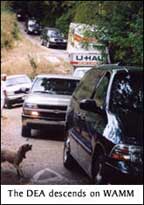
A picture named wamm.jpgThen, one year after 9/11, the feds breached the enemy stronghold of the Wo/Men’s Alliance for Medical Marijuana garden:

Suzanne Pfeil, an alliance member staying at the Corral’s, said she was awakened by two-dozen camouflage-clad agents in helmets who pointed automatic weapons at her.

“They told me to stand up,” said Pfeil, who suffers from post-polio syndrome and uses a wheelchair.æ “I told them I’m sorry.æ I can’t stand up.”

In 2002, the Seattle Times reported:

Although nine states have approved the use of medical marijuana, Ashcroft has concentrated the weight of the anti-drug bureaucracy on California.æ His agents have busted marijuana clubs in West Hollywood, Oakland, San Francisco, Sebastapol and, most recently, Santa Cruz.æ California Attorney General Bill Lockyer characterized the raids as “punitive expeditions.”

Some of you might think that federal law enforcement would have its hands full chasing down terrorists bent on mass destruction.æ Stoned Californians can wait for another day.æ Well, Ashcroft says he’s on to both.æ He is perfectly capable of flicking on the orange terrorism alert then sending federal agents to weed out marijuana plants in hostile California territory.

A picture named mmjkevin.jpg
and San Francisco’s district attorney said:

I hope the DEA, the Justice Department and the entire Bush administration will heed the “Cease and Desist” orders delivered by yesterday’s protesters.æ Surely at a time when we face so many real threats — like the senders of anthrax-laced letters who still have not been caught — the federal government has better things to do than to deprive sick people of their medicine.

During this time, the administration found other ways to go after terrorists. Well, that is assuming that terrorists toke up and watch the Superbowl:

“Where do terrorists get their money?” asks one of the ads, which portrays a terrorist buying explosives, weapons and fake passports. “If you buy drugs, some of it might come from you.

Yep, to avoid their own complicity in funding terrorism through drug prohibition profits, the feds tried to blame pot smokers.
And while, to this date, Osama bin Laden has not been found, John Ashcroft can be proud of the fact that, at a cost of a mere $12 million, they were able to capture noted bong entrepreneur Tommy Chong.
I feel so much safer.


Thanks to Chris, Scott, and David. For more on Afghanistan, be sure to check out LastOneSpeaks
Posted in Uncategorized | Comments Off on Something for the 911 Commission