Constitutional Shenanigans

You’ve heard me rail about Ernest Istook’s bizarre spending provision that would actually prevent metro systems from accepting advertising that promotes legalization of marijuana (despite what Istook says, it doesn’t prevent advertising illegal activites, but only advertising advocacy for a particular political position). It’s very hard to get any more unconstitutional than preventing the expression of a particular political viewpoint.
Well, a little over a week ago, the ACLU, Change the Climate, Drug Policy Alliance, and the Marijuana Policy Project
argued their case in court. I wasn’t able to report on it in detail at the time, but I’ve enjoyed reading the court filings and wanted to share a little with you.
Of course, Section 177 is so bad, it’s amazing the government lawyers are even able to mount a defense. In fact, their defense has depended on misdirection and outright inapplicable legal references. Embarrassing.
It makes the ACLU’s response (pdf) to the government’s defense (pdf) quite delightful to read. The ACLU realizes how absolutely consitutionally indefensible the government’s position is and they can’t help getting in some digs. (Of course, these sarcastic passages are in addition to detailed, strong constitutional arguments by the ACLU — the Memorandum of Plaintiffs (pdf) is a thing of beauty.)
Opening statement in the reply brief:

It is disappointing that the Government decided to attempt to defend the
indefensible – a statute designed, and already operating, to restrain one side of an active
political debate. Justice would better have been served had the Justice Department not
imposed the entire burden of defending the Constitution on the plaintiffs and the Court.

Ouch! Nice score. But wait, it gets better. The government had tried to argue that they weren’t regulating content since the metro system could, on their own, decide to eliminate all speech.

For example, a transit system could bar all advocacy statements relating to
marijuana use from any point of view. Of course that would unconstitutionally
discriminate against marijuana policy as a topic, so maybe the transit system could bar all
advocacy of legal change, or maybe all advocacy altogether, or maybe all advertising
altogether.

The Government might as well argue that a statute withholding federal funds from
transit systems that permit black women to sit in the front of the bus would be
constitutional because a transit system could comply in an even-handed manner by
removing all seats.

Oooh! Two points. But there’s more:

As the Court will recall from the conference setting the briefing schedule, the
filing of the opposition brief was delayed for some weeks to permit ample time for “coordination” among various unidentified organs of Government. In the brief’s closing peroration, however, we see exactly what that coordination has yielded:

An order enjoining enforcement of Section 177 would
undermine Congress’ legitimate interest in not promoting
or providing the means for the expression of ideas that run
contrary to and may serve to undermine federal policy
adopted to protect the public’s well-being.

Gov’t Opp’n Mem. at 22. This passage is followed by a “cf.” site to two cases that do not
support it, because the only direct support is to be found in the likes of Brave New World
and 1984.

There is no government interest, none at all, in suppressing ideas that run contrary to federal policy. There is rather an interest in robust free debate and expression, and in preventing government efforts to suppress ideas that run “contrary to federal policy.” That is exactly why Section 177 should be enjoined without further delay.

Game. Set. Match.
Now all we have to do is wait for the court decision.

Posted in Uncategorized | Comments Off on Constitutional Shenanigans

Marijuana shown not addictive, not gateway

The recent study comparing marijuana use in San Francisco and Amsterdam is a real blow to the drug warriors. Not only did it show that prohibition does not reduce marijuana use, there were a couple of other very interesting things in the study.
The full report is now available online as text and as a pdf with graphs.
I’ve had a little time to look at the study, and I’d like to share two particular tables with you, that go beyond the main reported results of the study.
The first one fairly effectively debunks the myth of marijuana as an addictive drug.

TABLE 1—Trajectories of Overall Career Use:

Pattern Amsterdam
No. (%)
San Francisco
No. (%)
1: declining 17 (7.9) 18 (6.8)
2: escalating 13 (6.0) 17 (6.4)
3: stable 24 (11.1) 5 (1.9)
4: increase/decline 104 (48.1) 133 (50.4)
5: intermittent 7 (3.2) 25 (9.5)
6: variable 51 (23.6) 66 (25.0)
Total 216 (100.0) 264 (100.0)
Claims that cannabis produces addiction or
dependence lead one to expect that many experienced users would report Pattern
2—escalation of use over time. But this pattern was reported by only 6% in both
cities, which means that 94% of respondents had overall career use patterns that did not entail escalation across careers.

This is something that is common sense to those who are familiar with how marijuana works, but it’s an important refutation to the drug warriors’ claims. It also shows the most common way cannabis is used — an increase followed by a decline. People use it for a while and then stop or reduce their use voluntarily — certainly not the trend of a dangerous drug.
Here’s another interesting table from the study. This one focuses on regular cannabis users in the two cities and the degree to which they experiment with other drugs.

TABLE 2—Prevalence of Other Illicit Drug Use, Lifetime and During the Past 3 Months:

  Amsterdam (n = 216) San Francisco (n = 264)
  LTP P3MP LTP P3MP
Cocaine 48.1 9.3 73.2 7.5
Crack 3.7 0.5 18.1 1.1
Amphetamines 37.5 1.9 60.4 4.5
Ecstasy 25.5 9.3 40.0 6.4
Opiates 21.8 0.5 35.5 2.7
LTP=Lifetime Prevalence, P3MP=Past 3 Months Prevalence

Note that in the city where prohibition is the rule, there is significantly higher rates of experimentation with other drugs. As opposed to the gateway theory, this indicates that prohibition actually increases the likelihood of using other illicit drugs.
As the study notes:

The “separation of markets,”
in which lawfully regulated cannabis
distribution reduces the likelihood that people
seeking cannabis will be drawn into deviant
subcultures where “hard drugs” also are sold
is one public health objective of Dutch decriminalization.

Looks like their idea works better than ours.
Good stuff. Would like to see the media run with this more, though.

Posted in Uncategorized | Comments Off on Marijuana shown not addictive, not gateway

Alternet has a big week

AlterNet.org’s Drug Reporter is a good source of articles, although usually spotty, with some long gaps between them. However, this past week has seen a burst of articles worth reading. Check these out:
“bullet” Hooray for Bruce Mirken’s Lies and the Lazy Reporters Who Repeat Them, where he takes to task the media that carry the government’s alarmist stories about pot potency without doing their job as reporters.

For shame.

Way to go, Bruce! We need more people keeping the mainstream media honest (particularly when the government is not).
“bullet” Erik Davis, in Don’t Get High Without It gives us a nice, detailed feature about the Vaults of Erowid, which may be the most comprehensive source of useful information about the wide range of drugs which are used.
Davis notes that the mainstream science channels have become less useful (particularly with all the biased research) and more people are turning to Erowid for information (including health professionals).

Though it largely ignores policy debates, Erowid is a striking example of guerrilla information war. Millions of people, particularly young people, regularly access a repository of data whose very accessibility erodes the coercive exaggerations, hysteria and outright lies common to government and mainstream-media discussion of drugs. In addition, the very form of Erowid, which presents a model of an honest and open-minded psychoactive culture, encourages intelligent decision making.

“bullet” Particularly appropriate on Mother’s Day is Martha Rosenbaum’s Personal Voices: A Mother’s Advice about Drugs. This is a great letter to any child who will be facing difficult choices.
“bullet” Ann Harrison in Counting the Costs of the Drug War, discusses an Independent Institute forum held this week, where analysts tried to quantify the real costs of the drug war.
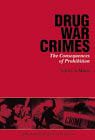
A picture named DrugWarCrimes.jpg
The forum included Boston University economist Jeffrey A. Miron, who is author of the new book Drug War Crimes.

“There is no reason to think that the benefits of reducing myopic drug use balances the costs that prohibition places on society,” says Miron. “The best policy is to legalize drugs and do it sooner rather than later.”

It’s nice to see economists and analysts putting an additional legitimate voice to this issue that those of us in the drug reform community have known for years.

Posted in Uncategorized | Comments Off on Alternet has a big week

Guest Drug WarRant

Just a reminder that guest rants are welcome here. Check out Terry Scott’s latest entry — a fascinating series of connections.

Posted in Uncategorized | Comments Off on Guest Drug WarRant

Commencement

Last night was our commencement ceremony. It was a blast, and I can’t say how much I enjoyed greeting our students as they crossed the stage.
For those students who read this blog regularly, please keep in touch and keep reading DrugWarRant. The responsibility is yours to make something happen in this drug war. Vote. Get involved. Tell people. Don’t worry about what people will think if you speak up — in many cases, they feel the same way, but are too frightened to say so. Others can be taught, and if you take the time to learn some basic facts, they’ll appreciate that you are speaking from a position of strength.
And thanks for your inspiration. The response to my talks about the Drug War at Theatre of Ted and the enthusiasm of those of you who came to me for material for papers and speeches provoked me to start this blog.
To my other readers: Thanks for your patience the past couple of weeks. Some interesting things have happened in the drug war, and I’ll be trying to do a little catch-up.

Posted in Uncategorized | Comments Off on Commencement

Temporary Hiatus

It’s the end of the school year at Illinois State and I’ve been a bit too busy to post this past week — a week that included sponsoring a 60 hour four-square marathon to raise money for student scholarships, plus visiting artists, a final theatre party, and lots of fun (so I can’t complain). Except for about 4 hours sleep, I was at the theatre building from 10 am Wednesday until 5 am Saturday.
Thanks to friends like Patrick, who have continued to send me tidbits while I’ve been too busy to post, such as:
“bullet” Riedy taken off SWAT team

Joseph Riedy, the Bethlehem police officer who shot John Hirko Jr. to death, has been removed from the squad that raided Hirko’s home because of concerns that Riedy’s participation would make the city vulnerable in future lawsuits.

Wrong move on the part of the city. Should just eliminate the team.
“bullet” Last One Speaks has the big news:
The Limited Relevance of Drug Policy: Cannabis in Amsterdam and in San Francisco by Craig Reinarman, PhD, Peter D. A. Cohen, PhD and Hendrien L. Kaal, PhD., published this month in the American Journal of Public Health.

Results. With the exception of higher drug use in San Francisco, we found strong similarities across both cities. We found no evidence to support claims that criminalization reduces use or that decriminalization increases use.

Conclusions. Drug policies may have less impact on cannabis use than is currently thought.

No surprise there. But it is yet another scientific study that lays waste to the arguments of the drug warriors.
I’ve still got finishing up to do with the semester, so posting may be light for a few more days. Continue to check the sites on the left, and take a moment to write some letters to the editor over at MAP.

Posted in Uncategorized | Comments Off on Temporary Hiatus

Today’s must-reads

“bullet” Eric Schlosser’s Make Peace with Pot, in the New York Times today.

The current war on marijuana is a monumental waste of money and a source of pointless misery.æ America’s drug warriors, much like its marijuana smokers, seem under the spell of a powerful intoxicant.æ They are not thinking clearly.æ

“bullet” Daniel Forbes’ The Drug War Includes Fixing Elections, today at LewRockwell.com

With two federal watchdog agencies freeing the White House drug czar to overtly influence state ballot initiatives, the Senate is poised to reauthorize this anti-democratic exercise for the next five years — the wheels greased by a ten-year total of $4 billion in taxpayer-funded advertising designed to sway the votes of those who pay for it.
Posted in Uncategorized | Comments Off on Today’s must-reads

War on Drugs hurting U.S. asparagus farmers

Thanks to T Chris at TalkLeft and a tip of the hat to Jeff:
This
New York Times Article points out:

To reduce the flow of cocaine into this country by encouraging farmers in Peru to grow food instead of coca, the United States in the early 1990’s started to subsidize a year-round Peruvian asparagus industry, and since then American processing plants have closed and hundreds of farmers have gone out of business. …

“We’ve created this booming asparagus industry in Peru, resulting in the demise of a century-old industry in America,” said Alan Schreiber, director of the Washington Asparagus Commission. “And I’ve yet to hear anyone from the government tell me with a straight face that it has reduced the amount of cocaine coming into this country.” …

“We’re a victim of the drug war,” said Mr. McKay, 73. “It seems like we still got plenty of cocaine coming into this country, but now we got cheap asparagus as well.”

So, we’re using our taxpayer money to pay farmers in another country to undercut our own farmers, in an effort to prevent them from growing…

“The irony is that they didn’t plow under the coke to plant asparagus in Peru,” said John Bakker, executive director of the Michigan Asparagus Advisory Board. “If you look at that industry in Peru and where it’s growing, it has nothing to do with coca leaf growers becoming normal farmers. Coca leaf is grown in the highlands. The asparagus is near sea level.”

Oh yeah, that policy makes about as much sense as all our drug war policies.

Posted in Uncategorized | Comments Off on War on Drugs hurting U.S. asparagus farmers

Life on the Outside

Check out this Mother Jones review by Debra J. Dickerson of Jennifer Gonnerman’s book, Life on the Outside: The Prison Odyssey of Elaine Bartlett (Thanks to David for the tip).
A picture named bartlett.jpg

Because of New York’s Rockefeller drug laws, Elaine’s childish irresponsibility cost her 20 to life, Nathan’s defeatist chivalry a minimum 25. These two self-destructive fools were treated like drug kingpins, yet they couldn’t even afford lawyers. (Meanwhile, George Deets, the insatiable addict whose drug ring was responsible for a biweekly kilo of cocaine on New York’s streets, remained not only free but well paid by the police and with his inventory restocked.)

Sixteen years later, as a result of ever-increasing calls to overturn mandatory minimums for low-level offenders, Bartlett experiences the only stroke of luck in her benighted life: She receives clemency from Governor George Pataki, leaves Bedford Hills prison, and returns home to New York City as a poster child for sentencing reform.

It’s all downhill from there. Gonnerman wryly subtitled this book about life after long-term incarceration a “prison odyssey” because, as Bartlett soon realizes, she’s simply “left one prison to come home to another.” One in the flood of 600,000 prisoners released each year from our 30-year incarceration boom, Bartlett returns to an overcrowded, filthy project apartment and the four children who have grown up in her absence.

TalkLeft points out another review by Elaine Cassel.
Both reviews are good, and the book itself is going on my must-read list.

Posted in Uncategorized | Comments Off on Life on the Outside

Tommy Chong Bong Song

Thanks to Scott for pointing out this delightful ditty (mp3 file), which includes the lyrics:


We can’t find Bin Laden and we’re stuck in Iraq
but we got Tommy Chong under key and lock.
Tommy Chong.
Serving 9 months in prison for selling bongs.
To you i sing this song.
Tommy Chong. …
Gotta turn around this world of hate
and educate instead of incarcerate

Posted in Uncategorized | 1 Comment