*Luize Altenhofen*

Luize Altenhofen
I want to give a warm welcome and thanks to the folks from FSU’s Warchant, where there were some very nice comments about this blog (including my favorite: “That blog is definitely most excellent, dude.”).
I have never gotten a review that was displayed in such an appealing way (see screenshot). Sorry, guys, Luize isn’t here.

Posted in Uncategorized | Comments Off on *Luize Altenhofen*

*The battle continues…*

The battle continues…
Judges Seek Repeal of Law on Sentencing. The 27 judges who make policy for the federal courts voted unanimously to ask Congress to repeal a new law that curbs judges’ discretion over criminal sentences. By Linda Greenhouse. [New York Times: Politics]

Posted in Uncategorized | Comments Off on *The battle continues…*

*Education and Drugs*

Education and Drugs
A picture named schoolbooks.jpgIt’s worth checking out: “In Search of the Anti-Drug” by Elizabeth Armstrong of the Christian Science Monitor. This is probably the most honest mainstream article on the subject of drug education I’ve seen.
While I don’t agree with everything in the article, Armstrong understands the problems with the traditional “Just say no” approach to teaching children about drugs. She discusses the failure of everything from “Reefer Madness” to “Brain on Drugs” to D.A.R.E. And she points out:

But what happens when they don’t want to say no? What happens when the reason isn’t peer pressure or what they have or haven’t learned, but curiosity?…Just when many children are beginning to wonder what drugs feel like, they are learning little more than how to avoid them.

Kids also are smarter than most drug education programs credit, and become very skeptical when burned with misinformation, lies, or exaggerations.

“Teenage disbelief and suspicion of drug prevention programs is rooted in scare tactics,” [Meredith Maran] says.æ “When I was 16 and started reading stories about drugs I was taking, and compared my reality to that, I said ‘that’s that.’ To this day I don’t trust anything from those sources.”

While I am firmly in favor of legalization and ending the costly and failed prohibition policies, I recognize the importance of limiting drug use by children. There will, of course, always be curiosity and experimentation by young people. Having some drugs illegal does not change that (when I was a kid, I knew two boys who died from sniffing gasoline). So what are some good approaches?

  1. Legalization. It is now easier for most kids to get illegal drugs than alcohol. (When’s the last time you heard about a Bacardi or Philip Morris salesman pushing his drug in the schoolyard?) The fact that some drugs are illegal can also add to the allure. Legalize and regulate.
  2. Reality-based and science-based education. No more lies. It will take a while to get kids to believe anything you say again, but work at it. Discuss the difference between use and abuse (acknowledge that there is a distinction).
  3. Positive alternatives. Encourage and fund extra-curricular activities (sports, music, theatre, chess club, etc.). Job opportunities.
  4. Respect. Kids won’t trust the message if you’re making them pee in a cup or sending drug dogs through their classrooms.

Of course, this won’t be easy. The failed methods have too much momentum and investment. As Armstrong notes, even though its failures are well documented, “D.A.R.E. remains the program of choice in 80 percent of US public school systems – and the curriculum has yet to be replaced or improved upon.”

Posted in Uncategorized | Comments Off on *Education and Drugs*

*Phone Slam!*

Phone Slam!
A picture named phone.jpgMake a telephone call today for medical marijuana.
Today is the Cheryl Miller Memorial Project phone slam.

On Tuesday, September 23, 2003, as patients and supporters visit congressional offices in Washington, medical marijuana supporters across the U.S. will be calling those same offices to thank supporters and lobby others to cosponsor HR 2233, the States’ Rights to Medical Marijuana Act.

Follow the link above for more information and strategies of what to do when you call. But if you don’t have time for that, simply go to the U.S. House site to find out who your rep is, or get a complete list of phone numbers. Take a moment today to make a phone call. Tell the staff person who answers that you support HR 2233, the States’ Rights to Medical Marijuana Act.
Update: Even though the day is over, you can still make the call. It’s valuable anytime.

Posted in Uncategorized | Comments Off on *Phone Slam!*

*This just makes me mad*

This just makes me mad
A picture named ashcroft.gifJohn Ashcroft is at it again.
Ashcroft not only wants to be your Attorney General. He wants to be your prosecutor, judge, jury, and executioner. The latest is a memo to all federal prosecutors requiring them to seek the greatest possible sentence in all cases, including any sentencing enhancements that might apply, reducing any discretion related to the individual case. This means that the small fish who has no information to give prosecutors gets the book thrown at him or her.
Keep in mind that this will cost a lot of money. Prison time. Trials instead of plea bargains. Lots of money.
Ashcroft is continuing his attempts to make the judiciary branch irrelevant. He has been working steadily to tie the hands of judges. Yesterday, Supreme Court Justice
Breyer spoke out against mandatory minimums (something Justice Kennedy did last month).
All above links from the fabulous TalkLeft, which is all over this today.

Posted in Uncategorized | Comments Off on *This just makes me mad*

*Pot doesn’t kill*

Pot doesn’t kill
A picture named leaf.gifAn editorial in September 20th British Medical Journal: “Comparing cannabis with tobacco — again: Link between cannabis and mortality is still not established”
This editorial examined two large studies in the United States and Sweden, and determined:

“…published data do not support the characterisation of cannabis as a risk factor for mortality”

The editorial then went on to examine the use of marijuana as it relates to mortality factors:

No acute lethal overdoses of cannabis are known, in contrast to several of its illegal (for example, cocaine) and legal (for example, alcohol, aspirin, acetaminophen) counterparts. Deaths due to chronic diseases resulting from substance misuse generally result from the use of that substance (for example, tobacco and alcohol) over a long time. Importantly, and in contrast to users of tobacco and alcohol, most cannabis users generally quit using cannabis relatively early in their adult lives.

After analyzing the differences between tobacco and marijuana in both ingredients and use, the article concludes:

Although the use of cannabis is not harmless, the current knowledge base does not support the assertion that it has any notable adverse public health impact in relation to mortality. Common sense should dictate a variety of measures to minimise adverse effects of cannabis. These include discouraging the use by teenagers, who seem to be most at risk of future problems from drug use, not using before or during the operation of automobiles or machinery, not using excessively, and cautioning in people with known coronary heart disease.

So far, this editorial has been picked up in The Age in Australia, and The Independent in England, but has not seemed to reach much of the mainstream press (other than as a footnote in an AP story on bad Canadian pot).
So, to recap…
You literally cannot overdose from marijuana. Marijuana seems to have little or no affect on mortality, and is certainly safer than many legal products. It’s safer to drive while high than to drive while tired. Marijuana use does not cause use of harder drugs. Marijuana is an effective medicine, pain reliever and nausea suppressant for a variety of illnesses and treatments. Hemp is an environmentally-friendly crop which can be used for paper, rope, clothing, fuel, construction products, and has nutritional value that exceeds soy. And it makes you feel good.
So why is it illegal? Must be that last point.

Posted in Uncategorized | Comments Off on *Pot doesn’t kill*

*Around the Web*

Around the Web
bullet imageA nice OpEd in the Harvard Crimson, by Dr. Lester Grinspoon:

I was concerned that so many young people were using the terribly dangerous drug marijuana, so I decided to review the medical and scientific literature on the substance and write a reasonably objective and scientifically sound paper on its dangers.æ Young people were ignoring the warnings of the government, but perhaps some would seriously consider a well-documented review of the available data.æ As I began to explore the literature, I discovered, to my astonishment, that I had to seriously question my own understanding.æ What I thought I knew was based largely on myths, old and new.æ I realized how little my training in science and medicine had protected me against this misinformation.æ I had become not just a victim of a disinformation campaign, but because I am a physician, one of its agents as well.

bullet imageYou thought we had it bad? Singapore is relenting to pressure and is decriminalizing chewing gum (as long as you have a doctor’s prescription).

Until recently, the penalty for being caught with a stick of gum in Singapore was $6,000 and 12 months in jail.

Singapore is a great example of the kind of society you get with law and order taken to the extreme.
bullet imageThis week’s Drug War Chronicle has some good stuff. Check out the corrupt cop of the week and current action alerts.
bullet imageSpeaking of corrupt cops, nine Illinois officers arrested for ripping off drug dealers, via TalkLeft, which also notes that Tommy Chong may appeal his sentence on the grounds that the judge based the sentence on “the character he played and not the person he is.” TalkLeft also points out this interesting item which indicates that MADD may have stepped beyond its original mission into prohibition activities (Walter in Denver has more.)
bullet imageLast One Speaks continues with some nice pieces on bad science, bad economics, and bad foreign policy in the drug war.
bullet imageDesert Cat explains how an evangelical Christian can be against marijuana prohibition.
bullet imageMatrix Masters gives us more on the ecstasy study retractions. Also, be sure to check out this comprehensive page on the issue at MAPS, which provides tons of articles and letters and a full chronology.
bullet imageDrugSense has a wonderful opportunity to have your donation to their cause matched dollar for dollar. This would be a great way to give a little in the cause against the drug war. DrugSense and MAP provide an extraordinarily important service — the MAP archives themselves are an indispensable tool for those of us fighting the drug war cheerleaders.
bullet imageDrug Policy Alliance releases a new State of the States report detailing drug reform activities in the states, including over 150 changes in state legislation from 1996-2002.

Posted in Uncategorized | Comments Off on *Around the Web*

*Dare to Suck!* Had a…

Dare to Suck! Had a great time last night delivering one of my drug war rants at Theatre of Ted, and I’d like to welcome the Ted fans to Drug WarRant.
One of the issues that came up from another participant was the potential loss of financial aid due to a marijuana conviction. If you’re in that horrible position, there may be hope: fill out an appliication for the John W. Perry Fund scholarship.
The soft hemp seeds I brought that many of you got to try are available from Ruth’s Hemp Foods. Lots of great food to buy there! And the Tommy Chong story I mentioned is here.

Posted in Uncategorized | Comments Off on *Dare to Suck!* Had a…

*Bad Pot, courtesy of the…

Bad Pot, courtesy of the Government
Government Grass Turns Off Users

Some of the first patients to smoke Health Canada’s government-approved marijuana say it’s “disgusting” and want their money back.
“It’s totally unsuitable for human consumption,” said Jim Wakeford, 58, an AIDS patient in Gibsons, B.C.

So let’s get this straight. The marijuana is so bad, sick people want their money back! Now that’s some pretty bad pot.
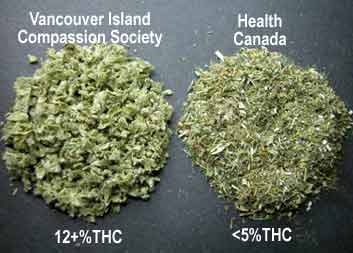
Let’s take a look.

A picture named govpot.jpg
More pictures and test results available at Canadians for Safe Access. Pictures courtesy Vancouver Island Compassion Society (Marius, photographer)

You see, the Canadian government was forced by the courts to insure that medical marijuana patients had a legal means to obtain pot, so they grew some deep in a secure mine, chopped it up (including seeds and stems), and so far have made it availble for sale to ten patients. The marijuana was supposed to have 10% THC, but, according to Canadians for Safe Access, tests at around 4%, which requires much more smoking to get any medical effect.
Now, since U.S. citizens are flocking to Canada for prescription drugs, maybe Canadian patients can try the U.S. for medical marijuana? (see cartoon) Nope.
The United States government also grows marijuana. It’s a monopoly under the direction of the National Institute on Drug Abuse (NIDA) which has no interest in helping medical marijuana studies. In fact, they tend to insure that any “scientific” studies reflect their point of view (as the recent ecstasy debacle shows). They grow the only pot which can legally be used for research.

At present, the National Institute on Drug Abuse (NIDA) contracts to Dr. ElSohly at the University of Mississippi to grow marijuana at an outdoor, fenced facility with 24-hour armed guards. The product that is grown is seeded, leafy, low-potency material with stems included. The product is sent to Research Triangle Institute in North Carolina for rolling into standardized cigarettes, usually with about 4% THC

More lousy pot.

The pot is unsmokeable, they say, full of sticks, stems and seeds.æ The leaves have gone stale after at least a year of storage, freezing and then thawing.

Too bad governments couldn’t get someone good at growing medical marijuana like Steve Kubby to grow it for them. Unfortunately, the feds keep arresting them. Or someone like Peter McWilliams to provide his wealth of knowledge. Unfortunately, they killed him.
Now, however, Prof. Lyle Craker, Director, Medicinal Plant Program, UMass Amherst Department of Plant and Soil Sciences, is in the midst of the process of seeking DEA permission to establish a medical marijuana production facility to grow high-potency marijuana for FDA-approved research (tons of info at MAPS).
The DEA will probably reject the application. They don’t want anyone to really research medical marijuana, because they know that medical marijuana is sound science and they’re afraid of losing their stranglehold.
The public comments time period of the application ends September 22. You can add your voice.
Go to either the Drug Policy Alliance action alert or the NORML action alert and send your message. It’s quick and easy. Do it now.

Posted in Uncategorized | Comments Off on *Bad Pot, courtesy of the…

*Medical Marijuana returns to the…

Medical Marijuana returns to the 9th Circuit
“Lawyers Want Court To Consider Medical Marijuana: Four Clubs Say Pot Consitutional”
Oral arguments were heard yesterday morning by the 9th U.S. Circuit Court of Appeals panel in a combined series of cases which challenges the constitutional right of the federal government to interfere in medical marijuana cases.

Santa Clara University professor Gerald Uelmen urged a panel of three judges to find that “Americans have a fundamental constitutional right to relieve their pain.”

Back in May, 2001, the Supreme Court ruled 8-0 (United States v. Oakland Cannabis Buyers’ Cooperative, No.æ 00-151) that medical necessity is not an allowable defense in federal marijuana cases, due to the specific language used in the Controlled Substances Act. This was a narrowly tailored ruling, which left the door open to challenges on other grounds.
The Oakland Cannabis Buyers’ Cooperative has now joined with the Marin Alliance for Medical Marijuana, the Ukiah Cannabis Buyer’s club, and Wo/Men’s Alliance for Medical Marijuana to expand the argument in the hopes of working back up to the Supreme Court.
Some of the court documents are available here. In brief, this case deals with several points:

  • Commerce Clause issues
    • The groups’ activities are wholly intrastate and the government has not shown justification for using the commerce clause for intrastate activity under the necessary and proper clause.
    • Some of the activities are non-economic and so cannot be prohibited under either clause
  • The federal government’s actions encroach upon the sovereign powers of the state of California
  • Patients’ 5th and 9th amendment rights are violated
    • The right to bodily integrity, to ameliorate pain, and to prolong life
    • Physician-patient relationship rights
    • Government has failed to offer any legitimate, much less compelling justification for infringement on these rights

There are also some technical issues involved.
Just as the Truth in Trials Act which will be considered in Congress is the best hope for medical marijuana from the legislative branch, this combined case seems to be the best hope for judicial relief. It’s a tough battle, and the Supreme Court may be wary of dealing with this case (if it gets there) due to the fact that commerce clause and state sovereignty issues are potentially a problem in much of the federal government’s activities, and the court may not wish to open that can of worms.
I’ll let you know about the progress of this case as it develops.

Posted in Uncategorized | Comments Off on *Medical Marijuana returns to the…