
Businessman shot in botched raid

In Wednesday’s Gazette:

58 year-old Streamwood man Robert Kennigil was shot four times Tuesday night by federal agents serving an internal revenue service audit at his home office. He was pronounced dead at Mercy Hospital two hours later. Mr. Kennigil was the owner of a mail-order sports clothing company.
Treasury spokesman Mark Connell said the agents were following up on an informant’s tip that Robert Kennigil had falsified deductions on his tax returns and only fired when they saw Kennigil reach for an eraser.
Julie Sechrist, accountant for Kennigil Sportswear angrily denied the charges. “I’ve been doing Robert’s books for 25 years,” she said, “and every deduction has been legitimate. He was fanatical about accuracy.” And she scoffed at the notion that he was reaching for an eraser. “He does his taxes on the computer. What good’s an eraser?” She also questioned the need for agents to handcuff his wife and 10-year-old daughter for almost an hour while they searched the office files. “They were legitimate dependents,” she said.
Connell expressed sympathy for the family, but defended the agents’ actions. “This is certainly a tragedy,” he said, “but unfortunately we live in a dangerous world, and IRS agents are put in time-sensitive situations every day from those who would defy the nation’s tax laws. This was an unavoidable incident that simply points out the need for stronger laws and stiffer penalties for tax fraud.”

It’s a pretty ridiculous story that I invented, isn’t it? Now, take a look at the true stories of Drug War Victims. If it wasn’t for the actual tragedies of their deaths, wouldn’t those stories be just as ridiculous? Think about it. Do something about it.


Note: I’d like to give a big thanks to homunculus. I don’t know who you are, but I appreciate the work you’ve done to help raise awareness of the drug war victims. Everytime you post the link on metafilter, hundreds of new people find out, are rightly outraged, and spread the word further on their own web pages and discussion groups. Thanks again.

Posted in Uncategorized | Comments Off on Businessman shot in botched raid

Worth its weight in gold

Disgusted Vet wrote and pointed out that the price of gold has dropped to $406.70 an ounce. At this rate, gold may soon be cheaper than marijuana. (23% of those polled at Marijuana Prices Directory claim to have paid over $300 for a good ounce)

Posted in Uncategorized | Comments Off on Worth its weight in gold

Comment on Drug Court and the War on Drugs

Over at What happens when you tell a lie? (Marijo Cook’s Salonblog), there is an interesting post: Drug Court and the War on Drugs, about a pretty amazing judge named Seth Norman.

Judge Norman, along with probably every other criminal court judge in the country, was fed up with the War on Drugs by 1995. From his point of view, the War was causing overcrowding in the jails, a massive increase in the number of cases on his docket, and little in the way of improvements in the situation on the streets. Statistics showed that 80% of the cases he was hearing involved drugs or alcohol in some way, and 60% of the people in those cases had a chemical dependency. Most of them were repeat offenders.

The piece goes on to explain how the judge set up a valuable and unique treatment program despite enormous obstacles.
However, Marijo then talks about some of the “necessary” coercive elements of the program, including “fall in love — go to jail” rules, and other methods of force to get the addicts to focus on their treatment.

This may sound heartless or patronizing, but remember that if the addicts were left to do what they wanted, they would eventually die.

And she concludes:

So, the War on Drugs may not be a total loss after all, if more Judges around the country can follow Judge Norman‰s example with DC4. Providing treatment instead of simply locking addicts up is showing good early results in managing the drug problem and proving to be cost effective as well. The DC4 treatment program is only a part of a Drug Court system which includes education for first-time offenders and outpatient treatment for those on probation, but for the hardest addicts, this residential program sponsored by a judge and the jails is providing the best chance out there for a return to normal life.

Here I have to take major exception.
The War on Drugs is a total loss.
Coerced treatment is only positive to the extent that you view it as a lesser evil within the failed drug war.
I know there is a lot of support in portions of the drug reform community for coerced treatment, but once you take away the drug war (which we need to), then coerced treatment makes no sense, whether for drugs, alcohol, cigarettes, or obesity.
Take away the black market — the dealers looking to hook someone, the fear of admitting addiction, the legal consequences, the full time occupation of the addict to find the money for their next fix, and you can handle treatment of those addicts who need it through a combination of voluntary methods ranging from counseling to maintenance programs without coercion (see Free Heroin).
I admire the fact that Judge Norman cares. That he’s trying to do something for addicts. But I don’t accept coerced treatment as even a partial justification for the war on drugs.
In his North Carolina Law Review article, Judge Morris Hoffman wrote

“The moral authority of our most cherished institutions comes from their voluntary nature: the value of advice from a priest, a teacher or a loved one depends in large part on the fact that we are free to ignore it. But judges’ pieces of ‘advice’ are court orders, enforceable ultimately by the raw physical power of imprisonment. It is precisely because of the awesomely enforceable nature of our powers that we must be so circumspect in exercising them. It is one thing for a co-worker, family member, doctor, or clergyman to confront someone about a perceived drug problem; it is quite another thing for a judge to compel drug treatment. Drug courts not only fail to recognize this important institutional distinction, but their very purpose is to obliterate it.”

[More from Judge Hoffman at Unitarian Universalists for Drug Policy Reform]

Update: Corrected Marijo’s gender. Sorry about that!

Posted in Uncategorized | Comments Off on Comment on Drug Court and the War on Drugs

Drugs and Alcohol

ONDCP to link drugs and drinking in new ads that debut in the Superbowl.
The beer and liquor industries are not amused.
Of course, these ads as usual will probably not work. Oddly enough, the ONDCP will be allowed to experiment with high priced controversial issue ads on the Superbowl using our tax money, but PETA and MoveOn will not be allowed to do the same thing using their own donated funds.

Posted in Uncategorized | Comments Off on Drugs and Alcohol

Federal Tyranny

Libby at Last One Speaks points out a good article at alternet: States Rights vs. Federal Tyranny by David Morris

So here we are. Conservatives dominate all three branches of government. They are using their control of the legislative and executive branches to assert their authority to police individual behavior.

Read through the recent posts at Last One Speaks for some excellent coverage on the prison industry.

Posted in Uncategorized | Comments Off on Federal Tyranny

Free Heroin

If you’re going to read one article this week to gain a new perspective on the drug war, you must read this one by Dan Gardner in today’s Edmonton Journal.
It’s about one of those notions in the drug war that has been so ingrained into our consciousness by the drug warriors that we have a hard time wrapping our minds around the most effective reform.
My friends will tell me, “OK, I can see what you’re saying regarding legalizing marijuana, but what about the hard drugs? What are you going to do about heroin?” My response: “Give it away for free” is meant to shock them. However, it’s also the truth. It is, in fact, the only approach for some heroin addicts that has historically been shown to be effective. In some cases, it is the best approach to reduce crime, increase the life-span of addicts, reduce new addictions, and eliminate the profit incentive for dealers.

Conservative Switzerland set up the first modern experiment with heroin prescription in the mid-1990s, producing results so promising the Swiss expanded the program and made it a permanent facet of health care. Holland followed with a more rigorous study that ended in 2001 — again producing positive outcomes and government approval to continue the research. Germany, Spain, Italy and Australia have planned or launched their own projects. The United Kingdom is working on a scheme to expand the prescription of heroin by individual doctors, even general practitioners.

Whether courageous or outrageous, the idea of prescribing illicit drugs to addicts has spread with astonishing speed, leading the media and the public to assume it’s a revolutionary new idea. It’s not.

The continuing prescription of drugs such as heroin to addicts — or “maintenance” as the practice is often called — is actually a very old medical technique that was dropped in North America when drugs were criminalized early in the 20th century. The story of how this medical technique met its demise is the story of how law enforcement snatched the issue of drugs away from medicine, turning what had been a health issue into a crime problem. It’s the story of how the cops beat the doctors.

This article gives an amazing detailed history of heroin maintenance efforts and the political pressures that have often forced governments to scrap effective programs.

By 1920, as historian David Musto wrote in The American Disease, “advocacy of maintenance was repressed as sternly as socialism” in the U.S. Doctors and pharmacists were arrested. Clinics doing the same work the Swiss and Dutch would experiment with 70 years later were raided and shut down. A total ban on heroin in medicine followed.

Desperate addicts looked elsewhere for drugs, and a criminal black market in narcotics blossomed.

Finally, in recent years, some countries have again been gradually looking at maintenance for extreme cases, and finding phenomenal success. Of course, people like our drug czar have never let facts stand in their way.

Opposition to such clinics has been fearsome. John Walters, the White House’s top anti-drug official, wrote in the Wall Street Journal that patients at these clinics, far from being “productive citizens,” are “demoralized zombies seeking a daily fix.”

In response, Barends points through the window of a meeting room where a seemingly ordinary woman in her late 30s talks with a counsellor. “Does that look like a zombie to you?” he asks, grinning.

Heroin use is an odd thing. Most people who take the drug do so for a short time, or sporadically, and never become addicted. Of those who get hooked, most stop using the drug without any formal treatment within a few years. Of the rest, most can ultimately be helped off the drug with treatment or at least be stabilized with regular doses of heroin’s chemical cousin, methadone.

Just a small fraction of users ultimately falls into the classic profile of a broken-down junkie whose addiction keeps a fierce grip as years and decades crawl by. Unfortunately, that fraction tends to be made up of the addicts who are most damaged and alienated. They tend also to be the heaviest users of heroin and the likeliest to commit crimes to pay for their drugs. They are the wretched of the inner cities, the junkies who populate the ghettoes, prisons and morgues.

Dr. Martin Schechter, chair of epidemiology at the University of British Columbia and some of his colleagues, are pushing to add clinics in Toronto, Montreal, and Vancouver.

“In Canada, we are discussing trying things, like safe injection sites, like medically prescribed heroin trials, that we would never have dreamed of talking about five or 10 years ago. And I will predict this will continue, and we will eventually, I don’t know when, but the issue of decriminalization and the conversion of drugs into a public health and medical situation will be on the front burner in this country in the future.

“That debate will occur. There is just no escaping it.”

Read the article.

Posted in Uncategorized | Comments Off on Free Heroin

The case of the marijuana stolen by DEA agents continues.

Walter in Denver has been continuing his great coverage on the bizarre case in Colorado that’s pitting a judge against DEA agents.
The latest: The U.S. Attorney’s office went to a federal judge to get the charges dropped.
To recap again:

  1. GRAMNET – the Grand, Routt and Moffat Narcotics Enforcement Team (which included a DEA agent) raided a Hayden, Colorado home in mid-October.
  2. They seize some marijuana and some pipes.
  3. It turns out Don Nord is a medical marijuana user and that was his medicine (legal in Colorado).
  4. No charges are filed against Nord, and the judge orders the pipes and 2 ounces of marijuana returned for his medical use.
  5. The officers had given the marijuana to the DEA, and the DEA refused to return it.
  6. The judge cited the officers for contempt and directed them to appear in court at 1:30 pm February 2 “to show why they should not be punished for defying the court order.”
  7. The U.S. Attorney’s office is using taxpayer money and sending lawyers to defend the DEA agent against the contempt citation… and now
  8. The U.S. Attorney’s office is trying to get the case moved to federal court and contempt charges dropped.

TalkLeft has also commented on the case, including:

In a society based on the rule of law, the proper response to a court order the government considers to be flawed is to appeal the order, not to disobey it.
Posted in Uncategorized | Comments Off on The case of the marijuana stolen by DEA agents continues.

More Silly Season in the UK

One of the nice things about MAP is the ability to see such a large number of articles on the same subject, and Oh boy, are they coming out of the woodwork regarding the re-classification of marijuana in England. In addition to what I’ve already given you:
Neil McKeganey is Professor of Drug Misuse Research at the University
of Glasgow (or was that Professor of Drug Research Misuse?) has a bizarre notion that completely ignores established science on gateway effects:

It is not simply the reclassification of cannabis, though, which might cause concern.æ Mr Blunkett’s stated intention of focusing on heroin and cocaine might also engender a sense of gloom on the part of those working in the drug prevention field.æ Why is this? For the simple reason that hardly anybody starts their drug-using career with heroin or cocaine.æ What they start with, even if they don’t progress to these harder drugs, is cannabis.

Huh? (And I read it twice!)
Tory leader Michael Howard got in some hot water by calling the decision to downgrade marijuana “absurd,” while refusing to say whether he had smoked pot himself. Oops.
Alice Thompson, writing for the Telegraph suddenly sees psychotics and schizophrenics behind every joint (Is that perhaps a factor of British pot? Or just perhaps related to the conflict between the English reserve and pot’s relaxation? Because there’s no science that really supports this, yet this week you can find a British psychotic anecdote at every turn!)
Simon Jenkins with The Times sets things straight a bit with his Drugs Turn the Brains of Politicians into Marzipan, where he lampoons the political waffling and posturing and ends up noting.

My parents were appalled at the thought of a betting shop on every corner.æ It would surely lead to “addiction”.æ Somehow they got over it. The same must be done with drugs, all drugs.æ They must be removed from criminal distribution and their sale controlled and taxed like nicotine and alcohol.æ Such a proposal is not ideal, merely vital.

The Guardian gave a strong positive editorial:

[The independent commission in 2000] rightly concluded that the decision to place cannabis in the middle category of harmfulness 30 years ago did not reflect current scientific, medical or sociological findings.æ They did not say it was risk free.æ There is a danger with all drugs.æ But they concluded: “When cannabis is systematically compared with other drugs against the main criteria of harm ( mortality, morbidity, toxicity, addictiveness and relationship with crime ), it is less harmful to the individual and society than any of the other major illicit drugs, or than alcohol and tobacco.” The policing of the old law – 300,000 stop and searches a year – has done far more harm than the drug.

And finally, John O’Farrell in the Guardian decides to just laugh at all of this with his entertaining article: Just Say No To Echinacea

Yesterday, before the world’s media, a peace treaty was signed between the British government and cannabis.æ Hardliners had insisted that there should have been no talks with cannabis supporters until all joints had been put beyond use, until they had laid down their bongs and stopped giggling. …

Now cannabis will be placed on the same level as prescription drugs, with the result that hundreds of people will rush to their doctor’s surgery saying: “I’m going to the Glastonbury festival at the weekend, and I wondered if you could prescribe me something to help me relax?” …
Until recently, 90% of all arrests for possession of drugs were for cannabis.æ At last our bobbies will have time for more important tasks, such as using their highly sophisticated methods for searching out drug dealers by pulling over any black man driving a nice car. …

It is the more pernicious drugs that the police should be concentrating on.æ I don’t mean heroin or cocaine or ecstasy, I mean the real social menace: echinacea and arnica and all the herbal remedies that are sold at great expense and don’t do anything whatsoever.

All over Britain traumatised children are being forced to take fish oil while the callous pushers in the health food shop buy another gold-studded collar for their rottweilers and laugh at the gullibility of the liberal middle classes.æ “Wanna score some more St John’s wort man? It’ll cost you, brother, this is good shit, I ain’t cutting in no low-grade marigold.” Armed police burst in.æ “This is a raid! Hand over your royal jelly!”

Delightful.

Posted in Uncategorized | Comments Off on More Silly Season in the UK

$23 million for children’s piss

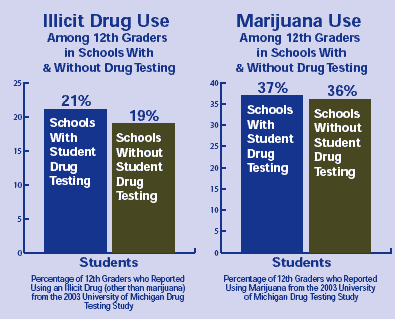
Sound like some kind of perverse pedophiliac pecuniary pursuit? No, it’s the President of the United States, putting forth the notion that the world will be a better place if we spend $23 million to force children to pee in a cup.
Stupid.
If you really feel you have to spend that money, you’d be better off giving each state $460,000 to put into after-school programs. It may not seem like much, but heck, the way budgets are today, some schools would be happy with $20 to buy a couple of basketballs.
But the President has spoken, and you can be sure there will be a push for drug testing in schools across the country. After all, there’s federal money to be had! Who cares if drug testing doesn’t work?
A picture named drugtestbooklet.gif
Fortunately, Drug Policy Alliance and the ACLU have stepped up to the plate with Making Sense of Student Drug Testing: Why Educators Are Saying No (pdf — also available here), written by Fatema Gunja, Alexandra Cox,
Marsha Rosenbaum, PhD and Judith Appel, JD
Here’s a segment:

Comprehensive, rigorous, and respected research shows that there
are many reasons why random student drug testing is not good
policy:

  • Drug testing is not effective in deterring drug use among young people;
  • Drug testing is expensive, taking away scarce dollars from other, more effective programs that keep young people out of trouble with drugs;
  • Drug testing can be legally risky, exposing schools to potentially costly litigation;
  • Drug testing may drive students away from extracurricular activities, which are a proven means of helping students stay out of trouble with drugs;
  • Drug testing can undermine relationships of trust between students and teachers and between parents and their children;
  • Drug testing can result in false positives, leading to the punishment of innocent students;
  • Drug testing does not effectively identify students who have serious problems with drugs; and
  • Drug testing may lead to unintended consequences, such as students using drugs that are more dangerous but less detectable by a drug test, and learning the wrong lessons about their constitutional rights.

There are alternatives to drug testing which emphasize education,
discussion, counseling, extracurricular activities, and
build trust between students and adults.

The pamphlet then goes on to explain each of these points in detail, with facts, studies, quotes from educators and much more.
Read the whole thing, and then pass it on to your K-12 teachers, bring it to the PTA, send it to the school board, offer it to your newspaper, involve your city council.
If we aren’t proactive, very soon we will be teaching our children a bad lesson: that their rights don’t matter. And for what? An expensive program that doesn’t work.
A picture named drugtesting.gif

Posted in Uncategorized | Comments Off on $23 million for children’s piss

I guess we’ve found that terrorist cell from Norway

From the Oregon Register-Guard:

[Kari] Rein, 42, and her husband James Jungwirth, 41, a U.S. citizen, have lived in Williams, near Grants Pass, for 15 years. They run an herb and seaweed
harvesting business and have a 14-year-old daughter and a 7-year-old son.

11 years ago, Rein was convicted of growing six marijuana plants for personal use and received probation and community service. The judge at the time said he was confident it was for personal use,

“And I’m also satisfied that the two of you are people who are capable of
being productive and are being productive in society,” the judge continued,
“and I don’t think at this point that jail really serves any benefit to
anyone.”

Here’s the tragedy —
Kari Rein is an immigrant, and immigration officials now (11 years later) want to send her back to Norway.

According to Rein’s attorney, immigration officials say the conviction
qualifies as an aggravated felony and mandates deportation under 1990s
immigration rules that have received souped-up enforcement since the Sept.
11, 2001, terrorist attacks on the United States.

Six pot plants over a decade ago, and you send a wife and mother away from her home? Does this government have ANY sense of morality?

Posted in Uncategorized | Comments Off on I guess we’ve found that terrorist cell from Norway