
National Review and an End to Marijuana Prohibition

Marijuana prohibition is unique among American criminal laws. No
other law is both enforced so widely and harshly and yet deemed
unnecessary by such a substantial portion of the populace.

This quote is from the cover story in the new issue of National Review, featuring drug reform figure Ethan Nadelmann titled “An End to Marijuana Prohibition: The drive to legalize picks up.”
Later in the piece, Ethan Nadelman shows the disconnect in the government with the issue that is having the largest effect on promoting change.

The drug czar and DEA spokespersons recite the mantra that
“there is no such thing as medical marijuana,” but the claim is so
specious on its face that it clearly undermines federal credibility. The
federal government currently provides marijuana-from its own production
site in Mississippi-to a few patients who years ago were recognized by
the courts as bona fide patients. No one wants to debate those who have
used marijuana for medical purposes, be it Santa Cruz medical-marijuana
hospice founder Valerie Corral or NATIONAL REVIEW’s Richard Brookhiser.
Even many federal officials quietly regret the assault on medical
marijuana. When the DEA raided Corral’s hospice in September 2002, one
agent was heard to say, “Maybe I’m going to think about getting another
job sometime soon.”

Nadelman also touches on the comparisons with the original prohibition and includes one of my favorite ditties:

In 1931, with public support for alcohol Prohibition rapidly
waning, President Hoover released the report of the Wickersham
Commission. The report included a devastating critique of Prohibition’s
failures and costly consequences, but the commissioners, apparently
fearful of getting out too far ahead of public opinion, opposed repeal.
Franklin P. Adams of the New York World neatly summed up their findings:

Prohibition is an awful flop.
  We like it.
It can’t stop what it’s meant to stop.
  We like it.
It’s left a trail of graft and slime
It don’t prohibit worth a dime
It’s filled our land with vice and crime,
  Nevertheless, we’re for it.

Two years later, federal alcohol Prohibition was history.

The whole article is worth reading.
Interestingly, William Buckley Jr (whose quote about marijuana prohibition is on the left side of my page). has announced his retirement from runing the magazine. He was responsible for earlier issues of the National Review which have analyzed the drug war failures. And now, yesterday he wrote another article about the stupidity of marijuana prohibition: Free Weeds.

Today we have illegal marijuana for whoever wants it. An estimated 100 million Americans have smoked marijuana at least once, the great majority abandoning its use after a few highs. But to stop using it does not close off its availability. A Boston commentator observed years ago that it is easier for an 18-year-old to get marijuana in Cambridge than to get beer. Vendors who sell beer to minors can forfeit their valuable licenses. It requires less effort for the college student to find marijuana than for a sailor to find a brothel. Still, there is the danger of arrest (as 700,000 people a year will tell you), of possible imprisonment, of blemish on one’s record. The obverse of this is increased cynicism about the law.

We’re not going to find someone running for president who advocates reform of those laws. What is required is a genuine republican groundswell. It is happening, but ever so gradually. Two of every five Americans, according to a 2003 Zogby poll cited by Dr. Nadelmann, believe “the government should treat marijuana more or less the same way it treats alcohol: It should regulate it, control it, tax it, and make it illegal only for children.”

Such reforms would hugely increase the use of the drug? Why? It is de facto legal in the Netherlands, and the percentage of users there is the same as here. The Dutch do odd things, but here they teach us a lesson.

Posted in Uncategorized | Comments Off on National Review and an End to Marijuana Prohibition

Shameful!

This story in the Miami Herald:

Two years after approving the use of drug-sniffing dogs, Broward County schools may have another narcotic-fighting weapon: an aerosol spray that detects residue on school desks or backpacks, similar to bomb-detection equipment used in airports.

Despite research that shows drug use is down among high school seniors since the early 1980s, school systems nationwide are becoming more aggressive at trying to curtail the problem. And the federal government is helping, with grants to more than 20 school systems that want to try the new spray.

If the Broward School Board approves the kits this fall, a principal could rub sticky paper on a locker or desk — or anything else that might have been touched by a drug user — and then spray it with a chemical to find traces of marijuana, cocaine, heroin, speed and Ecstasy.

The paper may display one of a rainbow of colors, depending on the illicit substance: reddish-brown for marijuana, purple for heroin, canary yellow for amphetamines.

Yes, the Federal government is helping. They’re so helpful in removing any possible self-esteem from young people.
“Stop. Pee in a cup. Get sniffed by a dog. Hold still while we test your jacket. Stay in home room while we search your locker. No extra-curricular activities wiithout supplying urine. It’s for your own good.”

“It just seems like another encroachment of the police state,” said Alan Schieb, a member of the Broward ACLU. “I would be really worried about false positives.”

Griffiths [a program executive for Mistral, which manufactures the kits] said that won’t happen.

“If Johnny rides a school bus and touches a seat of someone who has used drugs, that’s not going to show up,” Griffiths said. “We try to assure parents that if it’s accidental we aren’t going to catch it.”

Oh, well, that’s OK, then. It’ll catch residue on anything that a person touches, but not give false positives. Must be true, because the company that’s making millions selling these tests says so!

Posted in Uncategorized | Comments Off on Shameful!

Odds and Ends

“bullet” TalkLeft points us to Volunteer Committee of Lawyers (VCL):

Co-founded by former Attorney General Elliott Richardson, “the VCL seeks to promote, within and by the legal profession, informed discussion about the objectives of the drug war and its costs to our cherished institutions of liberty and justice.”

“bullet” Also see TalkLeft for more on Sentencing Guidelines
“bullet” Last One Speaks has the story of a judge busted for purchasing pot.
“bullet” Also see Last One Speaks for an excellent piece on the neo-prohibitionis efforts to outlaw cigarettes.
“bullet” You want to see the direction tough on drugs leads you? Check out this story in China Daily.

Posted in Uncategorized | Comments Off on Odds and Ends

The Supreme Court, Medical Marijuana and the Commerce Clause

The Supreme Court has decided to consider Ashcroft v. Raich.
For details on the case, see my original post on the victory in the 9th Circuit. Basically this boils down to a challenge of the federal government’s ability to interfere in the states using their authority under the interstate commerce clause, when no commerce or interstate is involved.
The commerce clause in the Constitution, which gives the feds their power:

The Congress shall have power… To regulate commerce with foreign nations, and among the several states, and with the Indian tribes;

The particular case involved medical a marijuana cooperative in California and operating legally under state law, where patients grew their own medicine and it was not sold. A perfect and clean test of the erosion of the commerce clause (and boy, has it eroded since the Constitution was written).
The 9th circuit saw the group’s activities as “the intrastate, noncommercial cultivation and possession of cannabis for personal medical purposes as recommended by a patient’s physician pursuant to valid California state law” and therefore not subject to the commerce clause.
The case is so basic and so clear that I don’t see how the Supreme Court can rule in favor of the government without completely eliminating any meaning to the commerce clause. It would then, in effect, read:

The Congress shall have power… To regulate commerce with foreign nations, and among the several states, and with the Indian tribes; and to regulate anything else they wish within the several states.

I’m certainly not the only one who feels this way. Randy Barnett, one of the principal attorneys representing Angel Raich and Diane Monson, writes at the Volokh Conspiracy:

A ruling for the government in Raich would, in my view, represent the effective repudiation of Lopez and Morrison, for the government’s reasoning would allow Congress it to reach whatever activity it chooses provided that its statutory scheme was sufficiently large enough. In other words, by the government’s theory, the more power that Congress claims, the more justified is its claim of power. Therefore, if the Court reaches the merits, whatever it decides in Raich v. Ashcroft will be a landmark decision with enormous importance for the future of federalism.

Since I cannot imagine that the Supreme Court would be willing to eliminate federalism and states’ rights (as a ruling in favor of the government would effectively do), I can only believe that the Supreme Court will uphold the 9th circuit, effectively ending the federal government’s harrassment of medical marijuana patients.
The only question will be what limits are placed. For example, Circuit Judge Harry Pregerson wrote that states are free to adopt medical marijuana laws so long as the marijuana is not sold, transported across state lines or used for non-medicinal purposes. I guess that in the Supreme Court case, questions will be raised regarding whether growers of medical marijuana can be compensated, whether the marijuana can use seeds obtained from out-of-state, etc.
It’ll be an interesting ride.
Oh, and you know why federalism is a good thing?

“It is one of the happy incidents of the federal system that a single courageous state may, if its citizens choose, serve as a laboratory; and try novel social and economic experiments without risk to the rest of the country.” – Justice Brandeis

What better way to test drug policy changes than through the states?

Posted in Uncategorized | 1 Comment

Blessing Marijuana

In Saturday’s Washington Post:
Blessing Marijuana for Mercy’s Sake

The United Methodist Church, the Union for Reform Judaism, the Progressive National Baptist Convention, the Episcopal Church, the Unitarian Universalist Association, the Presbyterian Church (USA), the Evangelical Lutheran Church in America and the United Church of Christ have made statements supporting the controlled use of marijuana for medical reasons.

“According to our tradition, a physician is obligated to heal the sick,” begins a resolution adopted in November by the Union for Reform Judaism. The statement acknowledges the medical use of marijuana as a 5,000-year-old tradition and encourages the federal government to change marijuana’s status from a prohibited substance to a prescription drug.

The denominations have called for a reassessment of penalties for marijuana users trying to increase their appetites during chemotherapy or alleviate chronic pain. “We believe that seriously ill people should not be subject to arrest and imprisonment for using medical marijuana with their doctors’ approval,” asserted a Coalition for Compassionate Access statement endorsed in 2002 by the United Church of Christ.

I understand just how big this is, considering I was raised in the home of a United Methodist minister. My dad’s has always been strongly against any mind-altering substance, including marijuana, alcohol, and other drugs. Not all Methodist ministers have felt as strongly, but that sense has still been a strong part of the church (Historically, the Methodist church was heavily involved with the temperance movement.) Yet, at the same time, my dad and the church have always emphasized compassion, and current drug laws simply do not work with core church values. So it’s perhaps not such a surprise that the United Methodist delegates voted a whopping 877 to 19 in favor of an amendment to drug-use guidelines that supports the drug’s medical use in states that allow it.
Now the churches are doing more than just voting on resolutions within their own confines:

Religious activism on Capitol Hill began heating up in November with the founding of the Silver Spring-based Interfaith Drug Policy Initiative, whose purpose is to advocate “more just and compassionate drug policies,” according to executive director Charles Thomas.

This week, the initiative faxed letters to members of the House of Representatives asking support for an appropriations bill amendment coming up for a House vote after the Fourth of July break.

The amendment, introduced by Rep. Maurice D. Hinchey (D-N.Y.) and co-sponsored by Rep. Dana Rohrabacher (R-Calif.), would prohibit federal funds from being used to arrest and prosecute approved medical marijuana users and caregivers in states that allow such use. A similar amendment introduced last summer was rejected by a vote of 273 to 152.

…Hinchey welcomes the support of the Interfaith Drug Policy Initiative and the denominations whose leaders have signed a statement endorsing the House amendment — the United Methodist Church, the National Progressive Baptist Convention, the Union of Reform Judaism and the Unitarian Universalist Association.

The statement reads: “Licensed medical doctors should not be punished for recommending the medical use of marijuana to seriously ill people, and seriously ill people should not be subject to criminal actions for using marijuana if the patient’s physician has told the patient that such use is likely to be beneficial.”

In its letter-writing campaign, the initiative targeted members of Congress who are members of those and other religious groups that have taken a supportive position on medical marijuana. Letters included a subject line that began with the name of the denomination, as in: “United Methodist Church supports medical marijuana; please vote accordingly.”

General letters were sent to other House members, listing the organizations that support medical marijuana use. “No denominations have opposed medical marijuana,” the letters assert.

I’d like to see our drug czar face the United Methodist Church delegates and proclaim (as he so often has done) that medical marijuana is a fraud that’s only used by groups looking to legalize drugs.
Folks, If you haven’t yet told your Representatives to support the Hinchey amendment, do so now.

[Tip of the hat to David at What Would Dick Think]
Posted in Uncategorized | 1 Comment

A letter

Dear Michael Moore,
Congratulations on breaking all sorts of records with the opening weekend of your film Fahrenheit 9/11.
You’re opinionated and controversial, and you’ve clearly found out how to make that combination work. Not everyone likes you or agrees with you, but even their criticism turns into heightened attention to the issues you promote. I’m excited to have had over 100,000 page views this year, but you reached millions with your message in one weekend.
I’d like to suggest a topic for your next film: The War on Drugs.
It’s perfect for you — tailor-made for your style of moviemaking. It’s got pathetic government officials, worthy of ridicule. It’s an issue where the government is out of step with the majority of Americans, yet the public has not gotten motivated enough to apply pressure on leglislators. It’s a story with strong elements of racism and the destruction of families and inner cities. (In fact, about the only problem with you doing the film is that it’s a story that also includes conservative values.)
You can interview the families of innocent victims of the drug war. You can go to Washington and ask Congressmen who have sick relatives if you can take away their medicine. You can follow John Walters around and see how often he repeats the same lies.
Those of us on the side of drug policy reform have the facts and the truth with us. But, to be perfectly honest, we have an uphill battle to convince the general population of the critical and urgent need for reform. You could change that with a strong and controversial movie.
If you need some help, I could get some people to picket the theatres, or create some “Michael Moore’s Drug War movie is un-American” web sites to help ratchet up the controversy — but you’re already a genius at getting the controversy marketing machine going.
Please, please make a movie on the war on drugs. I don’t care if you piss people off. I’d just like a boisterous national argument about drug policy reform.
Thanks.

Posted in Uncategorized | Comments Off on A letter

US nabs the Drug Pirates of the Caribbean; completely stops some smuggling

All the celebrities were out to celebrate the big bust — the culmination of 29 months of work in six countries and the arrest of 50 people. The celebrities included Attorney General John Ashcroft, Drug Czar John Walters, and DEA head Karen Tandy.

“These are the modern-day ‘Pirates of the Caribbean,'” Tandy said. “Today their piracy comes to an end.”

…In Washington, Attorney General John Ashcroft said that was enough to supply one dose each month to every American high school student and adult. White House Drug czar John Walters said dismantling the two groups would produce the first drop in cocaine supplies on American streets in more than a decade

Various reports credited this group for supplying 10% of the United States’ cocaine, and the drug warriors were touting the fact that this will reduce drug availability in the U.S. by 10%. We’ll see.
Now since historically the drug warriors stop 10% of drugs from entering the country (leaving 90% to get through), does this count as the 10% which has been stopped this year? (which would mean no change in availability) Or is this a reduction by 10% of the amount that normally would get through? (which would mean that only 81% would make it to the streets) If so, what’s to stop the other distributors from simply increasing the amount they ship to about 110% of normal, which gets us back close to the average amount (although the math is starting to hurt my head).
All of this reduction, of course, assumes that there’s nobody in Columbia, Panama and the other countries that would like to make millions of dollars by stepping in to replace the arrested traffickers. I suppose everyone is probably happy farming land which has been poisoned by our eradication program, and has no need for drug profits. Otherwise, the reduction could be no more than a slight hiccup.
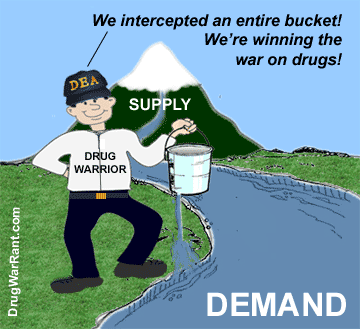
But go ahead and brag, drug warriors. You’ve dipped another bucket out of the river of supply and demand.
Oh, the name of this operation? Operation Double Talk.
Yep.

Oh, why not. Let’s show the cartoon again…
A Drug War Cartoon
Posted in Uncategorized | Comments Off on US nabs the Drug Pirates of the Caribbean; completely stops some smuggling

Odds and Ends

“bullet” Check out this week’s Drug War Chronicle for disappointing updates on the Rockefeller Drug Laws and lots more. Also a good review of the week’s news in today’s Drug Sense Newsletter.
“bullet” Speaking of the Rockefeller Drug Laws, check out The Reluctant Activist in the Village Voice (Thanks, MzOuiser)

When it was Cheri’s turn, she stepped forward, clutching Ashley’s poster in front of her. “I just want to say that the Rockefeller drug laws need to be changed,” she said, her voice strong and confident. “When you send someone to prison, you send their entire family to prison, in a sense. This is a young man who has a lot of potential. He doesn’t deserve this.”

The reporters scribbled down her words. Cheri felt a little better, and a little more hopeful, than she had felt in months.

“bullet” For something completely different, check out The Drug Czar’s blog.

Posted in Uncategorized | Comments Off on Odds and Ends

Supreme Court Justice Kennedy’s call for investigation into mandatory minimums bears fruit

In the Chicago Tribune: ABA urges new look at sentencing:

Many get-tough approaches to crime don’t work and some, such as mandatory minimum sentences for small-time drug offenders, are unfair and should be abolished, a report from the American Bar Association said Wednesday.

Laws requiring mandatory minimum prison terms leave little room to consider differences among crimes and criminals, an ABA commission concluded in its study of problems in the criminal justice system. More people are behind bars for longer terms, but it is unclear whether the country is safer as a result, the ABA said.

The report and recommendations for changes follow criticism of the criminal justice system last year from Supreme Court Justice Anthony Kennedy.

Listen to the report on NPR today.
Report information is available here, and won’t be acted on by the ABA until August, but here’s part of the summary:

The resolution urges states, territories and the federal government to ensure that sentencing systems provide appropriate punishment without over-reliance on incarceration. Lengthy periods of incarceration should be reserved for offenders who pose the greatest danger to the community and who commit the most serious offenses. Alternatives to incarceration should be provided when offenders pose minimal risk to the community and appear likely to benefit from rehabilitation efforts.
The resolution sets out a series of recommended actions, including:

  • Repealing mandatory minimum sentences;
  • Allowing courts to consider the unique characteristics of offenses and offenders that may warrant an increase or decrease in a sentence;
  • Requiring sentencing courts to state the reason for increasing or reducing a sentence, and allowing appellate review of such sentences;
  • Considering diversion programs for less serious offenses, and studying the cost effectiveness of treatment programs for substance abuse and mental illness;
  • Giving greater authority and resources to an agency responsible for monitoring the sentencing system;
  • Adopting risk-based criteria as a basis for determining whether an offender should be released to community custody, parole or probation; and
  • Developing graduated sanctions for violations of probation and parole.

In addition, the resolution urges Congress to give greater latitude to the United States Sentencing Commission and the federal courts in exercising authority related to criminal sentencing, and to reinstate a more deferential standard of appellate review of sentences.

I have often talked about the need to change the rhetoric from “tough on crime” to “smart on crime,” so it was good to see this in the release:

“For more than 20 years, we have gotten tougher on crime,” said ABA President Dennis W. Archer. “Now we need to get smarter. We can no longer sit by as more and more people-particularly in minority communities-are sent away for longer and longer periods of time while we make it more and more difficult for them to return to society after they serve their time. The system is broken. We need to fix it.”

Bravo.

Posted in Uncategorized | Comments Off on Supreme Court Justice Kennedy’s call for investigation into mandatory minimums bears fruit

Student Drug Testing – not the same as TB tests

A bill in California has bi-partisan support and would ban universal random drug testing of students, and only allow drug testing if administrators have “reasonable suspicions.” A companion bill would allow for testing of athletes specifically for performance enhancing drugs.
Naturally, this reasonable approach doesn’t sit well with the Drug Czar’s office, which is trying to boost the income of testing companies, so they sent their resident quack Andrea Barthwell, who testified that universal random drug testing of students was like testing for tuberculosis, and urged testing all students to “stop the spread.”
I hear there’s an epidemic of lying in government. We’d better institute random lie detector tests to stop the spread.

Posted in Uncategorized | Comments Off on Student Drug Testing – not the same as TB tests