Let me clear something up, part 2

One of the arguments I often hear against legalization is that legalization would result in vast numbers of people who would then suddenly develop dangerous drug abuse problems.
Here’s the problem with that argument (in addition to the fact that they have absolutely no evidence to back it up):
It appears that there are three main possible types of people in terms of their relationship with recreational drugs:

  1. People who are likely to have no interest in using them.
  2. People who are likely to use them with discretion and responsibility.
  3. People who are likely to abuse them.

Yes, this is a generalization, and there are undoubtedly shades and intersections, but follow me for a minute…
OK, clearly groups 1 and 2 are not a problem to society, right? So all we have to worry about is group 3. Group 3 is likely to abuse drugs. Now, between legal drugs (such as alcohol) and the easy ability to get illegal drugs despite the drug war, what could possibly be preventing these people from abusing drugs now?
In other words, just who are these people who are both likely to abuse drugs and yet would wait until additional drugs are legalized to do so? Is this a large group? Do you know of anyone who would qualify? Is there any way that an overblown concern for the welfare of this imaginary and miniscule population can justify all the excesses of the drug war?
Now perhaps the drug warrior will say that legalizing drugs will cause people to abuse “harder” drugs. If that’s the case then it’s an argument for the immediate and unconditional legalization of marijuana, since marijuana is less of a concern than any other drug (and we should then encourage people to move to it from “harder” drugs like alcohol).
Or maybe the drug warrior believes that there are huge portions of the population who use alcohol responsibly, but will become raging marijuana addicts if it is legalized. Right.
To recap:
Can anyone identify the millions of people in the United States who are likely to become drug abusers if drugs are legalized and regulated, but are not already abusing illegal drugs or alcohol? How many of them would there have to be to justify the death of Alberto Sepulveda?

Posted in Uncategorized | Comments Off on Let me clear something up, part 2

Let me clear something up, part 1

The drug czar has a particularly heinous post in approvingly linking to an ignorant article in the Scotsman.

Yuppies’ ‹Cocaine Soaked with Innocent BloodŠ […]

Wood accused thousands of middle-class cocaine users of being ‹morally and politically irresponsible,Š and spoke of plans for a new anti-drug campaign.

The article in the Scotsman talks about trying to educate people about how their drug use fuels violence, etc., etc., and suggests a bold new strategy of encouraging socially aware young people to choose not to use drugs in order to save the world.
The problem with this strategy, of course, is that those young people actually have a brain in their heads. They instinctively know (because they are not complete morons) that the real problem is the drug war.
Now, let me say this clearly for the idiot drug warriors out there…

  1. Yes, if everyone stopped using all illicit drugs, then the violence associated with the drug trade would stop. However, this is not even a theoretical possibility. This is like saying that if everyone in the world gave up sex, there would be no STDs. True, but completely irrelevant, because it is not humanly achievable.
  2. The drug war and its associated violence, on the other hand, can be eliminated through legalization. This is not only theoretically possible, but we’ve even done it in the past (with alcohol).
  3. Seeing those who propagate the drug war and its violence claim the moral high ground is offensive.

So to recap:
Ending drug war violence by eliminating drug use: Not possible.
Ending drug war violence by eliminating the drug war: Possible.

Posted in Uncategorized | Comments Off on Let me clear something up, part 1

Maybe we should invade the U.S….

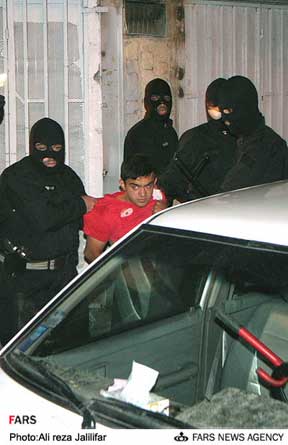
A picture named iranpolice.jpgRadley Balko catches this sadly hilarious insanity from neocon Michael Ledeen lamenting the terrible state of the justice system in Iran:

Terrifying pictures, to be sure. For me, the most revealing thing about them is that the police feel obliged to wear masks while conducting a drug bust in the capital. tells you something about the relationship between the people and the state.

The relationship between the people and the state. Oh Michael. Have you visited the United States? Have you met these people? For many of them, the very last thing they saw in their too-short lives were police wearing masks. Will you care about them? Will you call for military intervention to save them from tyranny?
Radley has more pictures for Michael to check out.

Posted in Uncategorized | Comments Off on Maybe we should invade the U.S….

Lou Dobbs and the Mexican Attorney General’s office just can’t understand why there is violence in the drug war.

Sigh.
From Lou Dobbs’ show on Friday (unofficial transcript)…

Lou Dobbs: “You’ve gotta hand it to Philipe Calderon, the President of Mexico. He’s trying, and trying very hard to deal with an out-of-control drug industry in his country. Illegal drugs. The war between the drug cartels and Mexican troops escalating the toll from what has been an especially violent week […]
Casey Wian: “Just 20 miles south of the Arizona border, the deadliest battle so far in Mexico’s war against the drug cartels that control much of the country. 22 people in the Sonoran town of Cananea are dead after federal troops stormed a ranch Wednesday. 15 drug cartel members, 5 policemen and 2 civilians.” […]
Ricardo Najera (Mexican Atty. General’s Office): “We’re working very hard to find out what’s caused this violence. And we hope to have a quick response to the situation.”
Casey Wian: “The Mexican Government’s response has been to deploy 24,000 federal troops to battle drug traffickers nationwide. Still, violence has been escalating.

2+2= …
Come on, you can do it… 2+2=…
Or as the dimwitted fireman once said to me:

I don’t understand it. I threw a grenade at the burning building to put out the fire, but for some unknown reason the fire actually kept getting worse and spread to another house. I’m going to have to get some more grenades.

Posted in Uncategorized | Comments Off on Lou Dobbs and the Mexican Attorney General’s office just can’t understand why there is violence in the drug war.

School drug testing gets thoughtful criticism

Drug testing in schools is one of the many aspects of the drug war that has a visceral appeal to those looking for quick prohibition-style solutions to the “drug problem.” Quite frankly, they are generally able to see it in only one dimension and therefore dismiss, in amazement, any criticism of mandatory random suspicion-less testing as the ravings of people who somehow want children to abuse drugs. (This is often more simply framed using the fascist phrase that always makes my skin crawl: “If you don’t have anything to hide, you have no reason to be concerned.”)
And with the full weight of the federal government pushing mandatory random suspicion-less drug testing in schools as being nothing more intrusive than a health inoculation, it’s almost surprising that anyone is willing to step up and discuss the real facts about student drug testing.
So it’s heartening that, despite the losses, there are school districts all over the country who are standing up to the drug czar, that are listening to SSDP and DPA and NORML representatives at drug testing summits, and that there are newspapers willing to editorialize (even if not perfectly) against a massive testing regime.
In New Jersey:

THERE’S no doubt that drinking and drug use are significant problems in some — if not many — North Jersey high schools. But sweeping random drug tests are not just an overreaction, they are a frightening violation of students’ privacy. […]
We […] support testing any students who display signs of drug or alcohol abuse and clearly need help.
But random testing, with no prior evidence of a problem, is an invasion of privacy. Schools should offer extensive education and counseling on substance abuse issues. They should not, in effect, be in the business of spying on students.

In Indiana:

It seems that punishing students and preventing them from taking advantage of school activities would exacerbate the problem by pushing students the wrong way. If they are shut out from school activities, it would follow that they would be more vulnerable to the behavior that got them in trouble in the first place.
We can understand schools wanting to take a proactive approach to drug prevention. We take issue with the punishment and the selectivity of the students. In the long run, this could harm students by ostracizing them from the student body.
We’d like to see the counseling as the main part of the policy, not as an amnesty afterthought. The punishment should come only after continued drug-testing failures. We don’t want to see the policy do more harm than good, and unless school officials sharply curtail the punishment and concentrate on counseling, that is what will happen.

And the Los Angeles Times has an article in tomorrow’s paper which gives full coverage to the Walters nonsense, but also counters it:

But health officials, by and large, oppose school-based drug testing. NAADAC, the Assn. for Addiction Professionals, has released a statement critical of such programs. And in March, the American Academy of Pediatrics cautioned against random school-based drug testing until more research is completed. The two groups are among those who say testing is not reliable enough, violates trust between adults and teens and is not set up to deal effectively with students who have positive results. […]
“If you look on the surface, drug testing seems like a good idea; a simple thing to do,” says Dr. Sharon Levy, director of the Adolescent Substance Abuse Program at Children’s Hospital Boston. “It’s only when you sit down and look at it closely that it really starts to unravel a bit.”
Chief among the pediatricians’ complaints is the reliability of testing.
A study published in April in the journal Pediatrics found a substantial risk of error even when drug testing was performed as part of an established adolescent substance abuse program. In the study, Levy and her colleagues reviewed 710 random urine tests from 110 teens and compared the results with confirmatory lab tests. (Initial screening samples should be confirmed with a second, more rigorous, analysis Ö something most school programs say they do.) They found 12% of the tests were subject to misinterpretation. For example, some of the urine samples were diluted (despite rigorous collection procedures designed to prevent kids from cheating) and could not be interpreted properly.
Further, of the samples, 21% were positive due to legitimate prescription drug use, Levy says. And several samples that were found in confirmatory testing to be positive for the painkiller OxyContin Ö a popular drug of abuse among teens Ö were identified as negative in the initial screen.
“Drug testing is premature policy,” says Levy. “We need to understand the combination of risks and costs compared to the benefits. That hasn’t been done at all.”
Further, critics say, the drug testing panels used by schools are typically those used in the workplace Ö screens for marijuana, amphetamines, cocaine, opiates and PCP. The panels usually do not assess alcohol or other drugs kids may be likely to use, such as inhalants, OxyContin and Ecstasy. Standard urine tests only detect use that has occurred in the last 48 to 72 hours.
Negative screens may mislead parents, school personnel and the community from searching for a truer picture of adolescent drug and alcohol use, Kern says.
“Parents can say ‘OK, the schools are doing testing, we’ll know what is going on,’ ” she says. “But drug testing gives you very little information. It can give parents a false sense of security.”
Even the belief that testing deters kids from using drugs or gives them a peer-worthy reason to say no has not been proven, Kern says. A 2003 study by the University of Michigan surveying 76,000 students found no difference in marijuana or other illicit drug use in schools with testing compared with those without programs. […]
Others critics of the program say school drug testing can make teens feel guilty before being proven innocent. While many programs Ö such as several in Orange County Ö only test students if they and their parents consent, kids may feel that adults distrust them, Kern says.
“There may be unintended consequences to drug testing,” says Dr. Howard Taras, a pediatrics professor at UC San Diego, who studies school health issues. “Kids may be deterred from joining a sport or extracurricular activity because they will be tested. Those are the kids that most need extracurricular activities. They may not get engaged in math or science but they may get engaged by a sport or dance class.”

Side note: In the LA Times article, one of the old stand-bys gets dragged out once again.

Even if testing programs aren’t perfect, recent research on the effect of drug use on adolescent brains warrants an aggressive approach to the problem, Walters says. Studies show that heavy drug use during adolescence may permanently damage parts of the brain related to learning and memory. People who avoid drinking and using drugs before age 21 are far less likely to abuse drugs or develop an addiction later.

What does that last sentence mean? It sounds important, but is it? Age 21? There is a certain small portion of the population who never tries alcohol or other drugs before age 21. These are people who, for the most part, have pretty much made the decision for personal reasons having nothing to do with drug testing or the drug war, and it’s true — they’re unlikely to become addicts or abuse alcohol or other drugs (or even use them, for that matter). But that has absolutely no connection to, nor does it provide any support for, drug testing in schools (in fact, it provides no useful guidance at all).
Now it would be interesting and potentially useful information to learn whether those who use specific drugs in early adolescence (12-16, say) would be more likely to abuse (rather than recreationally use) specific drugs during late adolescence. That still would not support a suspicion-less testing regime, but it would perhaps point to the need for regulation.
But as usual, the drug czar brings up unreferenced data which means nothing, in order to support unsupportable policies.

[Thanks, Tom]

Posted in Uncategorized | Comments Off on School drug testing gets thoughtful criticism

Sunday afternoon reading

“bullet” Remember the time I single-handedly ended the war against marijuana? — a fun fantasy with which many of you will closely identify, I suspect.

Posted in Uncategorized | Comments Off on Sunday afternoon reading

Ron Paul delivers disturbing reality check

The recent explosion and fallout from Ron Paul’s appearance in the Republican debate (see here, here, here, here for just a taste) has been instructive, and, I think, useful.
While some may argue that Paul’s points were delivered inelegantly and that he lacked political astuteness, there’s no doubt that he has provoked discussion within a political sphere that has actively worked to avoid discussion, thought, or knowledge. And that’s a good thing.
The dust-up has given him visibility, and that’s also a good thing. It’s possible, just possible, that his presence in the race will help to underscore the fact that the authoritarian cabal that has been running the Republican party of late has very little connection to conservative principles of liberty and limited government, and has, in fact, completely repudiated them. There are a lot of conservatives out there who believe in these principles but have been in denial regarding the massive betrayal perpetrated by Republican leadership in cahoots with opportunistic special interests.
Hearing a Republican in the race say the things Paul is saying is unsettling. And that’s a good thing.

Posted in Uncategorized | Comments Off on Ron Paul delivers disturbing reality check

Open Thread

I’m off to Chicago to perform in a murder mystery tonight.
“bullet” Gravel: Bush should be jailed, all drugs legalized
“bullet” Both the Los Angeles Times and Chicago Tribune have interesting articles about the dangers of the use of the army in the drug war in Mexico.
“bullet”

Posted in Uncategorized | Comments Off on Open Thread

Green Party steps up

From a Green Party Press Release

Green Party leaders called for a national discussion on how the US’s ‘war on drugs’ has turned into a war on young people, the poor, and African Americans, Latinos, and other people of color.
“The human and economic devastation caused by the war on drugs is missing from the range of debate among both Democratic and Republican presidential candidates. Politicians from these parties, when asked about drug policies, prefer to posture about law and order and endorse failed measures. These politicians don’t realize that going along to get along makes one complicit said Cliff Thornton, Green candidate for Governor of Connecticut in 2006 […]
Green leaders also strongly criticized the punitive denial of financial aid to students with drug convictions, and supported Students for a Sensible Drug Policy in their effort to persuade Congress to reinstate such aid.
“The war on drugs is an excuse to ignore the US Constitution’s prohibition on cruel and unusual punishment, with long prison sentences for minor and nonviolent offenses. The drug war is meant to be waged, not won,” added Mr. Thornton. “This is in part a result of pressure on elected officials from the private prison industry lobby, which seeks to build new prisons and fill up cells in order to win government giveaways and increase corporate profits. The Green Party calls for a public debate that challenges the rhetoric of Democratic and Republican politicians who are under influence of these companies, and that recognizes how the war on drugs has only resulted in more crime and violence.” […]
The Green Party’s national platform endorses decriminalization of victimless crimes, such as the possession of small amounts of marijuana; an end to the war on drugs; expanded drug counseling and treatment; and an end to ‘medical marijuana’ arrests and prosecution.

Posted in Uncategorized | Comments Off on Green Party steps up

Open Thread

“bullet” Poppy Fields are Now a Front Line in Afghan War” in the New York Times. What a bizarre article. Rebecca Ogle at DARE Generation Diary comments. Scott Morgan comments on another article on the same topic.
Oh yeah, Colombia is such a fine model for Afghanistan to folow! …. Colombia Orders The Arrest Of 19 Politicians
“bullet” Officers find a half-ounce of pot and a water pipe, but in the process somehow collide with the suspect’s house. With their vehicle. They seized personal and professional property from the guy with the pot who apparently had not driven into anything. Isn’t that backwards? Shouldn’t we be taking away the vehicle of the out-of-control officer who drives into houses?
“bullet” Making a federal case out of an obscure leaf” — fascinating article about the huge lengths the feds are going to to go after khat

Courts to decide if khat is an illicit drug or more like a double espresso

When you read this entire article, it gives you a chilling look at the intensely stupid single-mindedness of the drug warrior.
“bullet” Bud Bundy smokes pot? Big surprise.

Posted in Uncategorized | Comments Off on Open Thread