Help make the Senate pay attention

You’ve certainly heard me talk about Michele Leonhart enough here.

Now that President Obama has nominated her to stay on officially as Director of the DEA, we do have the opportunity to educate the Senate before her confirmation.

Someone at Change.org has put together an action item — a petition to sign and send letters to your Senators.

Check it out here. Only 23 people have acted so far on this item — would be nice to see that go up a bit.


Posted in Uncategorized | 12 Comments

Not Serious

From Tech Insider: An Expert Blog on the State of Federal Technology by Emily Long

While many people had serious policy concerns, others wanted to know about marijuana legalization, a mandated national bedtime and the president’s World of Warcraft skills. One even asked, “Why does God hate the Vikings?” [emphasis added]

[Thanks, Logan]
Posted in Uncategorized | 22 Comments

An Opportunity

The release of the new Drug Policy Budget Request isn’t just a time for us to moan about the lack of change, the power of the entrenched interests, or the failure of the system.

It’s an opportunity to write letters to the editor.

Everybody knows that we’re out of money, that states are scraping to find ways to pay for critical services, that towns can’t afford to fix potholes, and that the federal government has sold our mortgage to China. This is a great opportunity to ask people why we’re actually increasing the budget for programs that have been demonstrated (by the government) to be failures and do nothing but make drug kingpins rich at taxpayer expense.

Get enough of these letters printed around the country and the Representatives in Congress are going to start noticing (you can also, of course, write your Representative directly, but don’t ignore the power of the LTE). Here are some tips.

Posted in Uncategorized | 8 Comments

Put your money where your mouth is

Well, the Drug Czar has come out with the proposed FY 2011 drug policy budget, and now we get to see Director Kerlikowske’s new focus on treatment. Remember…

March 12, 2009

The White House said yesterday that it will push for treatment, rather than incarceration, of people arrested for drug-related crimes as it announced the nomination of Seattle Police Chief R. Gil Kerlikowske to oversee the nation’s effort to control illegal drugs.

The choice of drug czar and the emphasis on alternative drug courts, announced by Vice President Biden, signal a sharp departure from Bush administration policies, gravitating away from cutting the supply of illicit drugs from foreign countries and toward curbing drug use in communities across the United States.

April 2, 2009

The Obama administration’s nominee for director of National Drug Control Policy said he will take a balanced approach to drug policy with a renewed focus on the prevention and treatment of addiction, if he is confirmed as the nation’s new drug czar.

May 14, 2009

The Obama administration’s new drug czar says he wants to banish the idea that the U.S. is fighting “a war on drugs,” a move that would underscore a shift favoring treatment over incarceration in trying to reduce illicit drug use.

August 29, 2009

“People,” [Kerlikowske] says, “want a different conversation” about drug policies. With his first report to the president early next year, he could increase the quotient of realism.

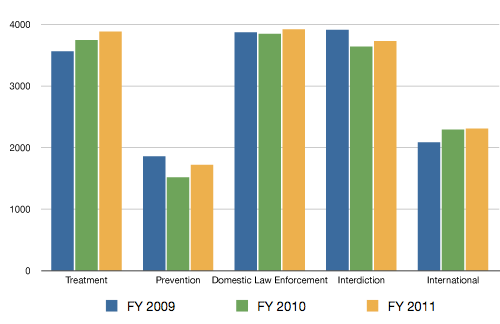
So now… (drum roll, please)… the new realism… the focus on treatment… the new 2011 Drug Policy Budget!

Press Release

Administration’s FY 2011 Budget Proposal Demonstrates Balanced Approach to Drug Control

The Fiscal Year 2011 National Drug Control Budget proposed by the Obama Administration would devote significant new resources to the prevention and treatment of drug abuse, National Drug Control Policy Director Gil Kerlikowske said today….

He did it! Wonderful. Finally, a real shift in national priorities over the drug policy budget. I can’t wait to compare… dig into the numbers, create a chart and….

Oh.

... in millions of dollars

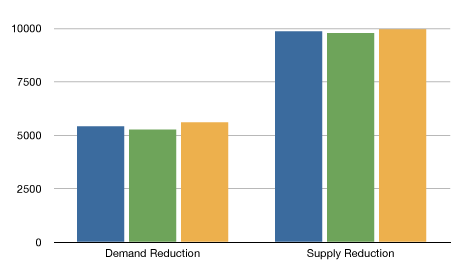
They even break it down into supply side and demand side budgets just to show how inept they are in putting together a “balanced” budget.

Every public policy expert will tell you that supply side drug war funding is, well, more of a waste of money than demand side. And even back in Walters’ day, he used to talk about how treatment is more cost-effective than enforcement. Kerlikowske upped the ante on that in every speech, and yet, the budgets are virtually indistinguishable. Except, of course, that in 2011, the drug war budget actually increases. [Note, also, that some years back they decided to eliminate the cost of prosecuting and incarcerating federal drug war prisoners from the tracked cost of drug policy in a blatant effort to make the treatment side look better in comparison.]

So why is there no real change?

Because there are so many entrenched interests in law enforcement, well organized interests with lobbyists and guns, that nothing can ever be cut. The only question when this bill reaches Congress is how much they try to increase the law enforcement/supply side numbers.

More on the drug policy budget:

[Thanks Tom, Tom]
Posted in Uncategorized | 58 Comments

Remembering the Golden Age of Propaganda

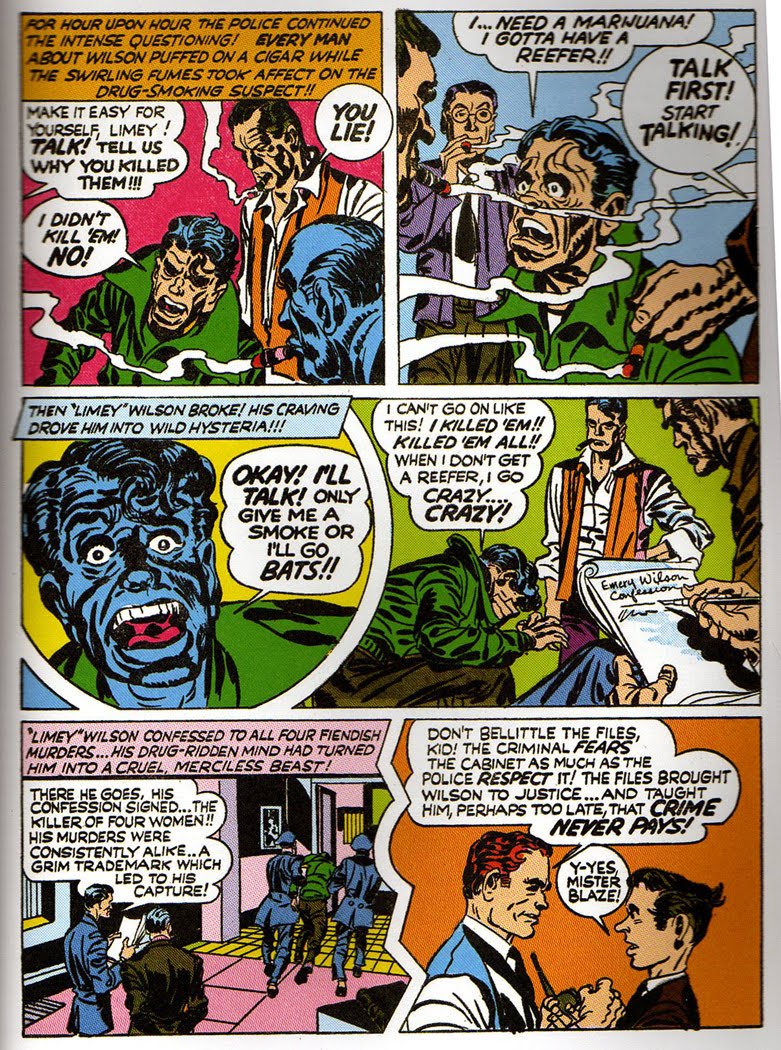
Simon Kirby comics include this reference to reeferVia Project Child Murdering Robot comes a recommendation for what looks like a pretty good book: The Best of Simon and Kirby.

What makes it really delightful is this page (part of the comic industry’s failed attempt to stay on the good side of government).

Click on the image for the larger, readable version.

“I killed ’em all!! When I don’t get a reefer, I go crazy…. crazy!

Posted in Uncategorized | 17 Comments

Once again, marijuana is a non-issue

From MPP

YouTube’s CitizenTube forum concluded today with questions about ending marijuana prohibition receiving the most votes, by far. Yet, the questions about marijuana prohibition were not presented to the president this afternoon.

So many people wasting their time asking questions about marijuana policy. Don’t they know that it has no importance? That they should just shut up and follow what the government tells them?

Why should anyone expect that a President should be required to answer questions about marijuana? It’s not like it affects anybody’s life.

Posted in Uncategorized | 26 Comments

What feds might do to counter states legalizing pot

We are now in the position where marijuana legalization has been discussed in state legislatures, and California is seriously likely to be voting on legalization this year.

And the federal government, with all it has invested in the drug war, can do little about it. California has the full and absolute right to eliminate any of its criminal laws or penalties that it wishes, as does every other state. Sure, federal law trumps state law, but that only means that the separate federal prohibition against marijuana remains — a prohibition that the state is in no way obligated to enforce.

Sure, the federal government could, in this day of massive federal police power (something anathema to our founders), enforce federal marijuana laws on their own, but such an act would be extraordinarily costly (financially and politically) and quite futile.

So if states start falling to legalization and the feds want to sabotage it, what are they likely to do?

Let’s take a look back in history.

In 1984, the federal government wanted to institute a 21-year-old minimum drinking age, despite the fact that states were all over the place on the minimum age. They couldn’t require the states to do it. So they bribed them.

The National Minimum Drinking Age Act of 1984 used a tricky little device: “a state not enforcing the minimum age would be subjected to a ten percent decrease in its annual federal highway apportionment.”

By the way, the Supreme Court upheld the power of the feds to bribe states this way in South Dakota v. Dole.

And it wasn’t the first time this was done.

10 years earlier, Congress passed the Emergency Highway Energy Conservation Act requiring a national 55 mile per hour speed limit. Again, they didn’t have the power to do it, so the way the pulled it off was to make it a requirement for a state to receive highway funds (that was later repealed).

And in 1998, the exact same technique was used to make .08 blood alcohol a national standard for determining drunk driving.

So what might we see in the future? My guess is an attempt to pass a national Per Se Drugged Driving Standard and enforce it through (you guessed it), withholding highway funds to states who don’t play along.

What is a “Per Se” drugged driving standard?

“Per se” is a latin phrase meaning “by itself” or “inherently.” In drugged driving law, it means that any detectable amount of a controlled substance is automatically evidence of “drugged driving,” which can result in fines, loss of driver’s license or prison. It is a despicable, dishonest law, particularly as it relates to marijuana, since detectable amounts of marijuana remain in your system for quite some time.

You end up punishing people for non-existent offenses, and create a perverse system of incentives. For example, if someone smoked pot yesterday and wants to drive today, from a legal perspective they might as well toke up right before driving. Either way, if caught, it’s considered drugged driving. The people most likely to be deterred by “per se” standards are those who would have been responsible anyway. It’s touted as a way to increase driving safety, but it does no such thing.

Current drug czar Kerlikowske has jumped on the drugged driving bandwagon big time, particularly with his repeated dishonest use of National Highway Traffic Safety Administration (NHTSA) data. He’s willing to buck his administration’s own scientists in order to promote the idea that drugged driving is some kind of epidemic.

Robert DuPontAnd in December, Kerlikowske gave a special Guest Blog spot to Robert DuPont. DuPont is a long-time prohibitionist who has made a fortune off drug testing. He is also, through his Orwellian-named Institute for Behavior and Health, one of the primary advocates of “per se” drugged driving laws, touted at his StopDruggedDriving.org website [Side note: that site was originally DruggedDriving.org, but they must have decided that might be misinterpreted, so they added the StopDruggedDriving url and pointed it to the original site.]

Their description of the advantages of “per se” is priceless.

The benefit of a per se standard is that prosecutors do not have to meet more complex standards of guilt.

Yeah, don’t you hate it when you actually have to prove a crime in order to jail someone. It’s so much easier when you can just per se so that everyone’s automatically guilty. There must be some other creative ways we can help prosecutors out. Maybe we could make it so that if you’re black, you’re per se guilty of murder. Think of all the work we could save!

In addition, with the per se standard drivers know that they must abstain from use of illegal drugs before getting behind the wheel of a car or face the risk of a Driving While Intoxicated (DWI) conviction.

No. With the per se standard drivers have no idea how long they must have abstained from marijuana use prior to driving, and since the time is likely to be longer than any normal person could go without driving, the law will be ignored by most, leading to the outcome of being able to selectively prosecute certain “types” of people using per se laws to pile on charges.

So what is the likelihood of a nationally persuaded “per se” drugged driving law? Hard to say. The Drug War Chronicle in 2004 noted an attempt to do so then in Congress, but it got some significant opposition (states can be unhappy when given mandates like this). Maybe it wouldn’t fly, and yet DuPont’s website claims that almost 1/3 of states have already adopted such laws on their own.

But if some states start legalizing pot, this could easily come up again. The feds wouldn’t be able to use the bribery approach to stop the states from legalizing pot, because potential tax revenue from legal pot would likely be more than any lost highway funds. But with states legalizing pot, the feds could easily raise the fear of a sudden epidemic of drugged drivers. (When raising the minimum drinking age to 21, all the arguments were about road safety, even though non-drivers under 21 were prohibited from drinking as well.)

All they’d need is some poster child — little Timmy and his mother, on their way to see Timmy’s father returning from Afghanistan, are killed in an auto accident and the driver of the other car tests positive for drugs (it won’t matter that the driver was also drunk). From that point on, facts, statistics, and science will no longer matter.

This is why it is important for us to counter drugged driving stories whenever we can (especially including the lazy, incompetent reporting of the Ashley III Halseys out there), and point out the dishonesty and lack of practical value inherent in “per se” laws.

And if all else fails, we’ll just have to join them.

Perhaps we can push for the introduction of per se cellphone driving laws. Makes as much sense. It’s tough now for law enforcement to know if the driver was actually talking on their cellphone when driving through that school zone, or if they were texting while driving. Let’s make it easy. Possession or ownership of a cellphone is per se evidence of driving while texting (enhanced penalties for possession of a Blackberry).

See how that flies.

Posted in Uncategorized | 45 Comments

Deviant

I found this article mildly amusing: Tattoos linked to deviance?

Texas Tech University’s study, which will be published in March in the Social Science Journal, says that people with two or more piercings or tattoos are more prone to deviant behaviour, which includes excess drinking, smoking pot, being promiscuous and being willing to cheat.

Ah, yes. Deviant behaviour. Of course, even today, where tattoos and piercings have become quite mainstream, those young people who are willing to commit to body modification are naturally more likely to be open to trying other experiences as well, so the study results are not surprising. But… deviant?

And yes, I understand that the textbook definition of deviance as a sociological study includes breaking the law, yet it seems oddly strange to call smoking pot “deviant” when 42% of the population have tried it, including Presidents and people in every walk of life, 14 states have legalized it for medical purposes, and multiple states are considering legalizing it for recreational purposes.

Just sayin’.

Posted in Uncategorized | 12 Comments

Open Thread

I’ve made a slight advertising change on the site. I was really unhappy with Google ads since the move to the new URL. It seemed that they were feeding the site almost nothing but drug rehab ads, which aren’t of much interest to public policy activists, and the ad revenue dropped by over 60%.

I’ve started working with AdBrite, which will hopefully deliver some more interesting ads. Additionally, if AdBrite doesn’t have any ads for me, it’ll go ahead and let the Google ads run, which is useful.

It’s now possible to purchase ads specifically for this site, and reach a politically active, motivated group of readers.

By the way, thanks for all the well-wishes. I’m making progress on the cold and have the weekend to keep making chicken soup (I make an outstanding homemade chicken soup), drink liquids and rest.

bullet image Some excellent detailed features on President Obama’s decision to keep Michele Leonhart on officially as Director of the DEA over at Drug War Chronicle and Sterling on Justice and Drugs. It’s nice to see some of the things I reported about her past back in 2003 surfacing again.

There’s no way I can see that this nomination will be derailed. It will go through without much of a hitch. But, if we’re thinking that it’s at least an opportunity to air a few things in a Judiciary Committee hearing, then it seems to me that Senator Durbin is the one to reach.

Durbin is, after all, the only one to take on Karen Tandy during her confirmation hearing. Check out his questioning of her here. It was one of our better days (of course, she still was confirmed unanimously).

bullet image IAEE Says No to Drugs

The Intl. Assn. of Exhibitions and Events has adopted a policy aimed at achieving drug-free workplaces in the exhibitions and events industry. Its first step: random drug testing for all IAEE employees.

Really? Exhibition and events employees? Cause like, there’s so much satisfaction in such a job that you shouldn’t care that they’re invading your privacy and punishing you for what you do on the weekend?

bullet image In A New Jim Crow? in Newsweek, Ellis Cose says that Obama should tackle the jails.

Given that, now (as midterm panic has broken out in Democratic quarters in the wake of the Massachusetts Senate defeat) may not be the best moment for Obama to tackle the matter head-on. But at some point any president aiming for greatness must grapple with a set of policies that have forced us to build prisons instead of schools. And ultimately even the most hardheaded critics must concede that rethinking a failed policy is not weakness but the only wise way to proceed.

bullet image DrugSense Weekly – a weekly review of the most interesting or relevant articles in the press and on the web related to drug policy reform.

bullet imageDrug War Chronicle – weekly update of drug war news and analysis from Stop the Drug War.org.

Posted in Uncategorized | 20 Comments

UNODC promotes human rights abuse

I’ve always been fed up with the United Nations Office of Drugs and Crime as the international arm of the prohibitionist movement. But there’s a deeper concern.

Supposedly, being part of the United Nations, they are bound to the Universal Declaration of Human Rights. And Director Costa often talks a good game in speeches about how important it is that human rights not be abused in the name of drug control. And yet, when abuse occurs, who is not out front condemning it? You guessed it. Countries know that they can commit atrocities of any kind in the name of the drug war and they won’t hear a peep from the U.N.

The UNODC also goes around the world and offers its “expertise” in setting up drug control offices and drafting drug control legislation — always with the mindset of promoting prohibition, and rarely with promoting human rights.

Cambodia is a prime example.

Here’s a country where there have been significant incidents of “drug treatment patients” (read “prisoners”) being abused, raped, and tortured.

Now the UNODC comes in and helps them draft new legislation. Take a look at what’s included…

The right to drug treatment

Article 67(5) “Officers who implement drug treatment and rehabilitation measures in accordance with the right to drug treatment shall not be prosecuted for their activities.”

Compulsory drug treatment

Article 71(4) “If a person is drug dependent to any substance as specified … a guardian, relative or authority can refer, or arrest and refer, the person to drug treatment at a hospital, public drug treatment facility, or any drug treatment facility.”

Now does that look like a way to reduce human rights abuse? No, it looks like a way you can get any relative you don’t like committed and then officials there can’t be prosecuted for what they do.

The UNODC should be condemning this, not helping write it.

Posted in Uncategorized | 15 Comments