Heigh-Ho, Heigh-Ho

I think most of you are aware that I have a day job (I don’t actually make any money blogging) that I really enjoy. Sometimes that intrudes on my ability to do much blogging.

Now is one of those times.

I am Executive Producer of a formal Gala being done in a 20,000 square-foot ballroom, with 600 attendees paying $75 each, and over 300 performers, two stages, a sword-fight going down the center aisle between the tables, two dance numbers (one with live accompaniment), two vocal ensembles, actors, a jazz band, a string quartet, a brass quintet, a guitarist, a pianist, live video feeds, a live projected data visualization, video collage, art exhibits, art sales… and a complete marching band. It’s this Saturday.

Additionally, I’m programming all the content for an interactive touch-screen Hall of Fame that will have pictures, text, video, and audio clips for 23 inductees in the inaugural class. That will be unveiled Friday.

So I might be a little bit slow in updating this blog.

Just sayin’


This is an open thread.

Posted in Uncategorized | 23 Comments

Must Read

Mary Anastasia O’Grady is one of the bright lights in the media in actually understanding and discussing the economics of prohibition. She has an outstanding OpEd today in the Wall Street Journal: The Economics of Drug Violence: Competition in the narcotics trade is preferable to monopolistic syndicates.

It’s a very insightful article about the drug violence in Mexico and how it relates to policies in the U.S., as well as our new understanding of Colombia (she nails former DEA head Bonner).

I also enjoyed her apt description of the challenges of Prop 19:

The combination of conservatives who fear that legalization would transform us into a hash-happy heap of hippies, drug warriors who make a living off of the criminalization of pot smoking, and gangsters whose profits are tied up in prohibition could be enough to defeat it by a narrow margin.

Posted in Uncategorized | 13 Comments

Post Prop

We’ve been talking a lot about Proposition 19 here recently. That certainly doesn’t mean that it’s all we care about. It’s just particularly timely, and has real significance.

I don’t know if Prop 19 will pass or not. I feel quite optimistic about it (although that feeling certainly has failed me before). And I’m going to do what I can to try to help it along in these final days. In 23 days, we’ll know.

And just in case you weren’t sure how this would affect Drug WarRant…

  • If Proposition 19 passes…
    … the drug war will still be going on, and we’ll have work to do here.
  • If Proposition 19 doesn’t pass…
    … the drug war will still be going on, and we’ll have work to do here.
Posted in Uncategorized | 23 Comments

Sights and Sounds

bullet image Via David Borden, an animated Taiwanese news report on Prop 19 with English subtitles, illustrating some of the arguments on both sides.

As Borden notes, if you’re not a west-coaster, you may need to be reminded that the bear is a symbol of California.


bullet image A good Sunday read: How to profit by expanding freedom by Steve Chapman in the Chicago Tribune.

Substance abuse is known to impair clear thinking and good judgment. But it’s the people pushing harsh drug laws who seem to be lost in a fog.


bullet image A frustrating article from the People’s Daily Online. Int’l community urged to join hands in addressing drugs problem

Consider the source, of course, but still — it’s a bit depressing reading this article and seeing the representatives of country after country, under the guidance of the UNODC, essentially come out and say: “The drug war is a destructive failure, so we all need to band together and have more drug war!”


bullet image Mid-Coast Forum on Foreign Relations has guest speaker Ira Glasser: The War on the War on Drugs. We don’t as often get to hear extended talks on this subject, so this is a nice opportunity.

You can listen to the entire one hour presentation. (I haven’t heard it all yet)

Ira is former Executive Director of the ACLU, and is now Board President of the Drug Policy Alliance.

He nicely starts out the talk by going over the lessons of alcohol prohibition.

[Thanks, Tom, for most of these…]

bullet image ICSDP Report on US Government Data on Cannabis Prohibition, set to music.

http://www.youtube.com/watch?v=FORm4aq9dzU


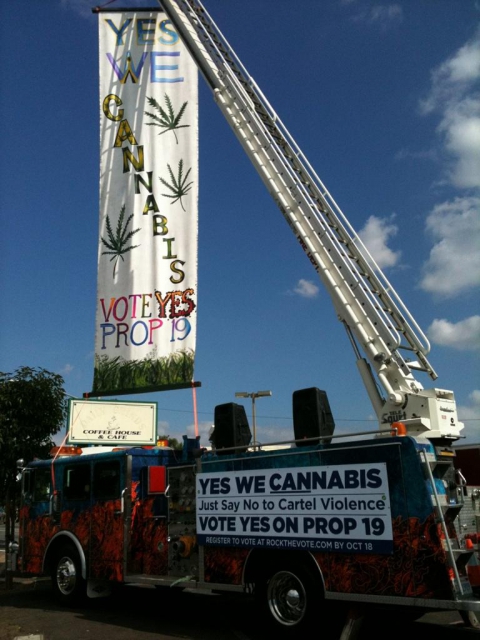
bullet image Oh, this looks like fun. Students to Rally with Yes We Cannabis Fire Truck to Sound Alarm For Prop 19


This is an Open Thread

Posted in Uncategorized | 13 Comments

Science by anecdote and false balance

A rather strange article by Shari Roan in the Health section of the Los Angeles Times titled A bit of tarnish on marijuana’s benign reputation

Ooh, I wondered, what dire medical study has been misinterpreted just in time for the final weeks before Prop 19? What is this “bit of tarnish,” then?

But, with a $5,000-a-year habit and chronic bronchitis, she tried repeatedly to quit. About a dozen times over the years she checked in alone to a hotel in Desert Hot Springs to white-knuckle herself through nausea, sweats and tremors.

Yep. They found some crazy lady with a $5,000-a-year pot habit. That’s not tarnish, that anecdote. Guess what? I found a crazy lady who has 130 cats. Doesn’t really say much useful about whether people should be allowed to own cats.

The meat of the article, if you can call it that, was another re-hash of the litany of health concerns while trying to strike a false balance in most instances.

Even Keith Humphreys made a cameo appearance as he chucked a random straw man into the article’s murky depths.

One particularly solid bit of research was the part about cannabis and driving:

The science of marijuana becomes murky when one steps beyond addiction statistics to examine effects on health.

A series of studies conducted by the National Highway Traffic Safety Administration published in 1998 found that the effects of marijuana alone on driving were small or moderate, but severe when combined with alcohol.

But other studies show little impairment from a moderate dose: A 2004 study in the journal Accident, Analysis and Prevention found no increased risk of motor vehicle accidents causing traumatic injury among drivers using marijuana.

“Even after smoking, there aren’t any real deficits in driving ability that we can detect in the laboratory,” said Mitch Earleywine, an associate professor of psychology at the State University of New York at Albany who serves as an advisory board member at the National Organization for the Reform of Marijuana Laws.

Exactly. Other than the part about driving after drinking alcohol, it’s pretty much unanimous that marijuana and driving is not a serious issue.

Except the next line is:

The data on lung damage and smoking-related cancers are similarly mixed…

Wait. Similarly mixed? As in… not at all? Where was the mixed data on drugged driving in the article?

And then…

The data on lung damage and smoking-related cancers are similarly mixed, in part because a large portion of heavy marijuana users also smoke tobacco, which muddies the picture of marijuana’s effects.

No, the data on lung damage and smoking-related cancers are not mixed. Not unless you ignore the definitive study of its kind conducted by Tashkin at UCLA and funded by the National Institute on Drug Abuse. That study accounted for tobacco use, unlike the tiny study in New Zealand that the drug prohibitionists like to quote, since their own big definitive study failed to produce the cancer they hoped for.

Like I said. A strange article. Not an all bad one, as there are plenty of good points in it. But to hang it on one woman’s addiction, and then use the false balancing technique, for each point (whether there existed balance or not).

Posted in Uncategorized | 16 Comments

Thought it was gang

It was.

“I hear bad noise, I thought somebody breaks in,” Jakymek told NBCChicago.com. “In that time, about 20 guys came in, and they said they were looking for guns and narcotics. They tell me to go into the bathroom. … They search everything. … I was scared. I thought it was gang.”

The men who burst into the home reportedly were members of the Cook County Sheriff’s Police Gang Crimes Unit, executing a search warrant for guns and narcotics.

The raid was based on information from a confidential informant.

Yep. That’s the level of police investigation required to have 20 men invade your home.

Just another day.

According to the sheriff’s office:

“Over the last four years, our gangs and narcotics unit has served more than 500 search warrants, and it is incredibly rare that those searches have resulted in this sort of outcome.”

“Incredibly rare” is still too much. And 500 search warrants in four years is about 1 every three days. That’s too much. It’s a broken system. If you served 5,000 narcotics search warrants or 5 in the same time period, it would have no difference on the availability of drugs. All you’re doing is pushing the odds. When you reduce the amount of investigation and, in mass numbers, use violent tactics for situations that shouldn’t even be situations, it doesn’t even matter how good you are. You’re playing Russian Roulette with peoples’ lives.

[Thanks to a reader]
Posted in Uncategorized | 11 Comments

Colbert on Prop 19

Colbert discusses Prop 19 with Joseph Califano and Gary Johnson

The Colbert Report Mon – Thurs 11:30pm / 10:30c
Proposition 19 – Joseph Califano & Gary Johnson<a>
www.colbertnation.com
Colbert Report Full Episodes 2010 Election March to Keep Fear Alive
Posted in Uncategorized | 11 Comments

League of United Latin American Citizens endorses Prop 19

Via Stop the Drug War. League of United Latin American Citizens (LULAC) of California supports Prop 19. Another good endorsement to go along with the California NAACP, the National Black Police Association, and the Latino Voters League.

“The current prohibition laws are not working for Latinos, nor for society as a whole,” said Argentina Dávila-Luévano, California LULAC State Director. “Far too many of our brothers and sisters are getting caught in the cross-fire of gang wars here in California and the cartel wars south of our border. It’s time to end prohibition, put violent, organized criminals out of business and bring marijuana under the control of the law.”

For an ugly and ignorant reaction to this news, read Dennis Romero.

Posted in Uncategorized | 7 Comments

Programming Note: Saturday morning

Check out C-Span at 9:15 am Eastern on Saturday, October 9

Allen St. Pierre of NORML vs. former DEA head Asa Hutchinson

I’ve been invited back to C-Span to debate and discuss the topics of cannabis legalization, and specifically California’s upcoming vote on Prop. 19, a measure that if approved by the voters will effectively
legalize cannabis in America’s most important state politically and
economically.

Former Drug Enforcement Administration chief and Republican congressman from Arkansas Asa Hutchinson has stepped up to argue in favor of the status quo and continuing into a ninth decade of Cannabis Prohibition.

The live interview is scheduled to broadcast Saturday morning (10/9/10) on C-Span TV, 9:15am – 10:00am (eastern…sorry west coasters!). Like most C-Span shows, the public is invited to ask questions or make short
commentary.

To watch online, go to: http://www.c-span.org/Watch/C-SPAN.aspx

This C-Span interview is likely the result of the Wall Street Journal
publishing an unprecedented jointly signed letter earlier this week by
every previous DEA administrator predictably calling for the Obama
administration to actively oppose politically viable cannabis legalization
voter initiatives in places like California (just the way they did).

Is the body politic (and the mainstream media that has so aptly aided and
abetted these technocrats’ blatant disregard for democracy, science,
compassion and common sense) really, really nervous about the cataclysmic blow that California voters are about to level on a self-evidently failed federal government public policy—another ‘war’ lost by government?

What do you think?

See you on the TV and kind regards,

-Allen St. Pierre
Executive Director
NORML

Posted in Uncategorized | 12 Comments

Fears of a 10 percent tax

Some of the stuff that comes out in the circus of the upcoming Prop 19 vote is just amazing.

Scott Erickson writes in the Daily Caller: If pot is legalized, government will distort the market for it

What many in the drug legalization crowd fail to recognize is that government, in its infinite wisdom, will ultimately distort this newly legitimate marketplace to such a degree that it will render the perceived benefits of its creation insignificant. In its zeal to capitalize on what it sees as a major new source of revenue, government will popularize marijuana use among the general public and, through overzealous taxation and regulation, fail to reduce the aforementioned black market and all of its attendant criminality.

Case in point: California’s Proposition 19, while not setting a uniform standard for taxation of marijuana across the state, will allow individual localities the leeway to set their own standards of taxation on the sale and cultivation of marijuana. If Proposition 19 and Measure C — a related measure linked to the passage of Prop 19 — pass, localities will be able to tax marijuana at rates upwards of ten percent.

While Proposition 19 would make the possession and recreational use of marijuana legal in California, levying a ten percent tax on those selling it lawfully, coupled with a host of other fees related to its cultivation, will increase its cost to such a degree that many pot smokers will simply continue to buy their weed from sources unencumbered by the state’s regulations, e.g. drug dealers.

This does not bode well for the proposition that legalizing “harmless” drugs such as marijuana will lessen the prevalence of illicit drug dealers.

Upwards of 10 percent? You’re kidding. California’s sales tax is 8.25%. 10 percent is nothing. At a 10 percent tax, there’s no way that the black market could compete. Plus, the fact is, consumers prefer to purchase legally and are willing to pay quite a significant premium to do so.

So localities would have quite a bit of leeway in adding taxes. Their biggest concern will be competition from other localities. If one town raises taxes too high, the neighboring town with lower cannabis taxes will benefit from greater sales.

Posted in Uncategorized | 17 Comments