A Tale of Two Wars on Drugs

Dusty Nix in the Ledger Enquirer (GA)

Consider two “drug wars” — one a highly and expensively hyped crusade, the other quieter; but both of tremendous social, economic, legal and cultural significance over the last few decades.

One, waged principally against opiates, cannabis and cocaine by state and federal governments for more than 20 years, has cost billions, perhaps trillions of dollars in taxpayer money; taxed the resources of already overworked law enforcement agencies; sustained a criminal empire the size and riches of which would dwarf the booze kingpins of the 1920s and ’30s; created, with the help of “mandatory sentencing” politics, an unprecedented corrections crisis by stuffing prisons to bursting with drug offenders; and provided the dubious rationale for abrogating the Bill of Rights to an extent even the Patriot Act hasn’t approached.æ And even the front-line troops in this war have acknowledged it’s a losing campaign.

“Drug war” No.æ 2, which hasn’t generated nearly as much attention — which, in fact, few people have thought of as a “drug war” at all — has involved relatively little public money, no prison space, little or no effort on the part of law enforcement.æ Nobody’s been randomly summoned away from a desk or work site to urinate into a cup.æ And it has been waged against a drug that every year claims more lives than all illegal substances combined.

But the vast differences in expense and approach aren’t the most dramatic distinction here.æ The biggest difference is that one of them has worked.

The Centers for Disease Control and Prevention in Atlanta reported last week that smoking among American teens is at its lowest level in almost 30 years.

This is a point that more people need to notice. The editorial is a strong one, and ends:

So providing people with education and information has proven dramatically effective in curbing use of a drug some experts have said is as addictive as heroin; while draconian laws and sentences and self-incrimination policies have created more problems than they have solved.

Surely there’s a lesson in there somewhere.

Posted in Uncategorized | Comments Off on A Tale of Two Wars on Drugs

Brazil to shoot down drug planes

From BBC News:

Brazil is close to adopting a plan to shoot down aircraft suspected of carrying narcotics over the Amazon jungle, the government has said.

Colombia and Peru called a halt to the controversial practice in 2001 after the Peruvian air force mistakenly shot down a plane carrying missionaries.

… Colombia resumed shooting down suspected drug trafficking planes in 2003 and has shot down almost a dozen planes this year alone with intelligence assistance from Washington, AP news agency reported.

Peru is seeking to restart the policy.æ

Sad.
Why can’t we force planes down, or, failing that, use our technology to follow them, and arrest them after they land?
Perhaps the better question is… “Why do we continue policies that make smuggling so profitable that they’re willing to chance being shot down?”

Posted in Uncategorized | Comments Off on Brazil to shoot down drug planes

Sue ’em for False Advertising

Reported in Now Magazine

Our friendly neighbourhood pot promoters, Canadians for Safe Access ( CSA ), are calling for an immediate moratorium on the distribution of medical pot after independent testing of the feds’ bud revealed that THC levels are nowhere near the 10.2 per cent claimed by Health Canada.

According to two tests conducted by the Quebec National Institute of Public Health, Health Canada’s cannabis contains only 5 per cent THC, barely enough to catch a buzz, let alone have any real therapeutic effect.

For all their talk about health care, the feds seem content to toy with the health of thousands of chronically ill Canadians.

Government has to be dragged kicking and screaming into doing the right thing.

Posted in Uncategorized | Comments Off on Sue ’em for False Advertising

THC Delays Progression of Lou Gehrig’s Disease

Via NORML

Seattle, WA: The administration of the cannabinoid THC in mice
delayed disease progression of an animal model of amyotrophic lateral
sclerosis (ALS), according to clinical findings published in the journal
Amyotrophic Lateral Sclerosis & Other Motor Neuron Disorders. Also known
as Lou Gehrig’s disease, ALS is a chronic, often fatal condition marked by
a gradual degeneration of the nerve cells in the central nervous system
that control voluntary muscle movement.

“Treatment with Delta(9)-tetrahydrocannabinol was effective if
administered either before or after onset of [symptoms] in the ALS mouse
model,” researchers at the MDA/ALS Center at the University of Washington
determined. “Administration at the onset of tremors delayed motor
impairment and prolonged survival in Delta(9)-THC treated mice when
compared to … controls.”

Authors concluded, “As Delta(9)-THC is well tolerated, it and other
cannabinoids may prove to be novel therapeutic targets for the treatment
of ALS.”

Posted in Uncategorized | Comments Off on THC Delays Progression of Lou Gehrig’s Disease

One lady who won’t sit down and die.

Suing The Reaper by Dean Kuipers in Los Angeles City Beat
The story of a South L.A.æSickle-Cell Patient Had To Sue The LAPD To Stop Pulling Up Her Legal Pot Harvest.

Kambui, who relies on marijuana to combat debilitating pain from sickle-cell anemia, was in tears.

Then her eyes fixed on someone who turned her sorrow to rage: accompanying the federal agents was LAPD Detective Steve McArthur.

McArthur had busted Kambui at least four previous autumns, and each time there had either been no charges filed or, most important, she’d been acquitted and her grow operation approved under California’s 1996 Compassionate Use Act, better known as Proposition 215.æ Unable to get an indictment under state law, McArthur had brought in the feds, whose warrant was based solely on his testimony.æ After two hours of questioning, the DEA set Kambui free, and one of the agents even gave her a hug.

Kambui, however, had had enough of Detective McArthur.æ She filed a civil suit against McArthur, the LAPD, the City of Los Angeles, and “John Does 1-50” in January, backed by an increasingly effective medical cannabis advocacy group, Bay Area-based Americans for Safe Access.

This case is particularly important to Kambui, who was diagnosed with sickle-cell anemia at age 19 when she was in the U.S.æ Air Force. The fatal malady is usually treated with morphine and many patients die from a morphine overdose. Kambui uses marijuana, cooked into teas, tinctures and foods.

“This kind of shows you how ass-backwards all this is,” says Elford [Kambui’s attorney].æ “In the name of the drug war, they’re trying to require someone to take much more serious narcotics than relatively harmless marijuana.æ And in this case, not just much more serious narcotics in terms of toxicity and addictiveness, but in this case, narcotics that are actually extremely harmful to the person prescribed them.”
Posted in Uncategorized | Comments Off on One lady who won’t sit down and die.

Senselessbrenner proposes horrible new sentencing bill

Via TalkLeft comes word of another horrible bill with an exploitive and deceptive name: Defending America’s Most Vulnerable: Safe Access to Drug Treatment and Child Protection Act of 2004 sponsored by House Judiciary Chair Jim Sensenbrenner (R-5th district, WI). So far he’s the sole sponsor, but he has a lot of power, and it’s going to take some effort in an election year to prevent passage.
To read the bill, go to Thomas and type in HR4547. The bill makes adjustments to the Controlled Substances Act.
Here are some of the new penalties for distribution of any controlled substance (including marijuana), or attempting or conspiring to distribute (note that actual sale is not required).

  • Distribution by a person older than 18 to a person under 21 is 5 year mandatory for first offense. (would probably include two college students sharing a joint)
  • Distribution by a person older than 18 to a person under 21 is 10 years for subsequent offense.
  • Distribution by a person older than 21 to a person under 18 is 10 year mandatory for first offense.
  • Distribution by a person older than 21 to a person under 18 is life in prison for subsequent offense.

No opportunity would be given for probation or suspended sentences. Judicial involvement would be limited.
Additionally, the bill would increase “proximity penalties.” Once you add all the things together, you get:

Distributing, manufacturing, or possession with intent to distribute within one thousand feet of a public or private elementary, vocational, or secondary school or a public or private college, junior college, or university, or a playground, or a public or private youth center, public swimming pool, or video arcade facility, or public library, or public or private daycare facility would be subject to 5 years minimum for the first offense, 10 years minimum for the second offense.

Tell your Representative to oppose mandatory sentencing.
And if you live in the 5th District of Wisconsin, you might want to check out Bryan Kennedy, who is opposing Frank James Sensenbrenner, Jr. in November.
You can also buy a T-Shirt at my shop:

A picture named wecanwin.jpg
Posted in Uncategorized | Comments Off on Senselessbrenner proposes horrible new sentencing bill

Government: Some drugs are OK

Jeanne Lenzer with the British Medical Journal (with follow-ups by World Net Daily) has a strong report: Bush plans to screen whole US population for mental illness.
The sweeping mental health initiative that President Bush will unveil in July is part of the government’s New Freedom Initiative, which has some very laudable goals regarding integrating mentally ill patients into the community.
However, the plan includes a major effort to find mental illnesses that go undiagnosed by using the schools to screen the 52 million students and the 6 million adults who work there. The effort will link the screening with “state of the art treatments” using “specific medications for specific conditions” and specifically using the Texas Medication Algorithm Project (TMAP) as a model.

But the Texas project, which promotes the use of newer, more expensive antidepressants and antipsychotic drugs, sparked off controversy when Allen Jones, an employee of the Pennsylvania Office of the Inspector General, revealed that key officials with influence over the medication plan in his state received money and perks from drug companies with a stake in the medication algorithm (15 May, p1153). He was sacked this week for speaking to the BMJ and the New York Times.

The Texas project started in 1995 as an alliance of individuals from the pharmaceutical industry, the University of Texas, and the mental health and corrections systems of Texas. The project was funded by a Robert Wood Johnson grantÖand by several drug companies.

Mr Jones told the BMJ that the same “political/pharmaceutical alliance” that generated the Texas project was behind the recommendations of the New Freedom Commission, which, according to his whistleblower report, were “poised to consolidate the TMAP effort into a comprehensive national policy to treat mental illness with expensive, patented medications of questionable benefit and deadly side effects, and to force private insurers to pick up more of the tab” (http://psychrights.org/Drugs/AllenJonesTMAPJanuary20.pdf).
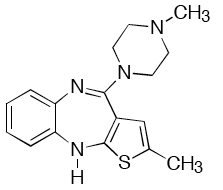
A picture named olanzapine.gif
One of the drugs that would be pushed would be Olanzapine, Eli Lilly’s top-selling drug, which grossed over $4 billion last year.

Eli Lilly, manufacturer of olanzapine, has multiple ties to the Bush administration. George Bush Sr was a member of Lilly’s board of directors and Bush Jr appointed Lilly’s chief executive officer, Sidney Taurel, to a seat on the Homeland Security Council. Lilly made $1.6m in political contributions in 2000Ö82% of which went to Bush and the Republican Party.

Jones points out that the companies that helped to start up the Texas project have been, and still are, big contributors to the election funds of George W Bush. In addition, some members of the New Freedom Commission have served on advisory boards for these same companies, while others have direct ties to the Texas Medication Algorithm Project.

Bush was the governor of Texas during the development of the Texas project, and, during his 2000 presidential campaign, he boasted of his support for the project and the fact that the legislation he passed expanded Medicaid coverage of psychotropic drugs.

Bush is the clear front runner when it comes to drug company contributions. According to the Center for Responsive Politics (CRP), manufacturers of drugs and health products have contributed $764,274 to the 2004 Bush campaign through their political action committees and employeesÖfar outstripping the $149,400 given to his chief rival, John Kerry, by 26 April.

Drug companies have fared exceedingly well under the Bush administration, according to the centre’s spokesperson, Steven Weiss.

Identifying mental illness earlier is a good idea. However, if the drug companies are running the show, then what will be the standard for the use of dangerous and expensive medication?
And what message are we sending to our children (to use the prohibitionists’ phrase) if we’re sending armed federal agents to harrass and arrest sick people using medical marijuana, and spending billions to arrest those who traffic in pot, while working with other drug traffickers to pump prozac and olanzapine into children whose behavior is slightly off “normal”?

Posted in Uncategorized | Comments Off on Government: Some drugs are OK

Judge defies sentencing rules

Via TalkLeft comes this AP report:

n a scathing criticism of the system used to punish federal crimes, a judge on Monday called the government’s sentencing guidelines unconstitutional, saying they unfairly limit the authority of judges. In a series of drug cases, U.S. District Judge William Young said the guidelines put too much power in the hands of prosecutors and give judges too little discretion in sentencing.

….In his ruling, Young said he believes the sentences handed down to five defendants were too harsh and violated their constitutional right to due process. Young asked the 1st U.S. Circuit Court of Appeals to throw out the sentences and send the cases back for new sentencing hearings.

The Judge put out an amazing supersentencing memo (pdf) — 174 pages indicting the current system, complete with graphs, charts, detailed references and some very interesting writing. Here’s one part of it, where he talks about the 5 cases that sparked the memo:

These sentencing memoranda deal with
five criminals. Three insisted on their constitutionally
guaranteed trial by jury. The two others pled guilty and
cooperated. The most evil and violent is a gang leader who had
much information to give. The least, a woman, had little to give
but went on courageously to finger a major drug lord. This is
reality.

Richard Green is a retail drug dealer preying on the
inhabitants of one of Boston’s public housing projects. On two
occasions he sold small quantities of crack cocaine (0.6 grams
and 2.4 grams respectively) to an undercover informant. The
government seeks to imprison him for 24 years.

William Olivero is a New York worker for a massive drug
conspiracy whose kingpin (and major drug activity) are located in
Massachusetts. Though not himself a dealer, Olivero has, on
occasion, delivered kilogram quantities of cocaine and associated
drug money for the kingpin. Olivero possesses a handgun. The
kingpin has been sentenced to life imprisonment for his offenses.
The government seeks to imprison Olivero for twenty-four to
thirty years.

Jason Pacheco is a marijuana dealer who knew the kingpin,
who on occassion purchased kilogram quantities of cocaine from
the kingpin for his own account, and who once accommodated the
kingpin by allowing his garage to be used for the brief storage
and transshipment of a multi-kilogram quantity of cocaine. The
government seeks to imprison him for twelve to fifteen years.
Edward K. Mills is a multiple murderer who led a vicious
street gang. Eventually apprehended, he recognized the jig was
up and cooperated with authorities. A gang leader himself, he
had much information to give and his disclosures have led to the
conviction of another murderer and the freeing of an individual
wrongfully convicted of murder. The government seeks to imprison
him for ten years.

“Jane Doe,” a pseudonym, is a young, single mother. A drug
addict, she dealt cocaine to support her habit. Eventually
apprehended, she too cooperated and testified in open court so
that the government might secure the conviction of an important
drug lord from her homeland. In light of her cooperation, the
government recommends a short sentence. As an alien, however,
the government proposes to deport her back to her homeland where,
the government admits, she will almost certainly be killed,
perhaps after torture.

To achieve its ends, the government routinely imposes a
stiff penalty upon defendants who exercise their constitutional
right to trial by jury. In the first of the instant cases, the
government’s attempts to burden a citizen’s right to a jury of
his peers exceeds all constitutional bounds. The second case
involves repeated instances of illegal fact bargaining. The
third involves enforcement of a bargain with a cold-blooded
killer that the Court characterized as evincing “a moral code
more suited to the alleys of Baghdad than the streets of Boston,”
and the fourth reveals such callous indifference to innocent
human life as would gag any fair minded observer. And this Court
–- stripped of any meaningful role in the sentencing of offenders
who come before it –- can do little more than explain what’s
going on. That, at least, I will do.

Then he goes on to do so at length.
Very interesting stuff. Nice to see more of the judiciary rebelling against the gutting of judicial discretion and the continual tipping of power to the prosecutor.

Posted in Uncategorized | Comments Off on Judge defies sentencing rules

Australian Government should be ashamed

See Last One Speaks for this travesty:

In yet another example of forfeiture run amok, 81 year old David Davies, a WWII vet and his wife Florence had their life’s worth of assets seized because their son was storing 19 kilos of cannabis in the ceiling. In an blatantly apparent miscarriage of justice, the couple received, “16-month suspended jail sentences last month after being convicted on two counts of possessing marijuana with intent to supply.” I mean really, intent? Who on earth did the prosecution contend they were intending to supply it to?

To add insult to injury, the Australian government with obvious US inspired prosecutorial greed, took possession of the family home (because they could) and intend to charge them rent.

Posted in Uncategorized | Comments Off on Australian Government should be ashamed

Gonna score some dextromethorphan

Walter in Denver notes Why The Drug War Is Doomed To Fail
He points to a Rocky Mountain News article which pretty well indicates that people will always find a drug of choice, legal or illegal:

Colorado calls to the Rocky Mountain Poison and Drug Center, and the type of drug involved, in the past two years

Drug 2002 2003
Marijuana 92 100
Heroin 14 24
Cocaine 109 137
Methamphetamine 71 82
Cough medicines/ dextromethorphan 229 275
Codeine 153 188
Painkillers/ oxycodone 602 809
Sleeping pills, tranquilizers/ benzodiazepines 1,012 1,212
Methadone 87 97
Morphine 150 208
Ethyl alcohol 270 248
Total calls 68,245 67,463

As Walter says: “Note that calls regarding cough medicine/dex each of the last two years outnumbered calls for marijuana, cocaine and heroin combined.”

Posted in Uncategorized | Comments Off on Gonna score some dextromethorphan