Prohibition Causes Crime

Posted today at Alternet, A Prohibition-Style Crime Wave, by Anthony Gregory, The Independent Institute:

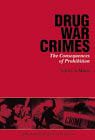
the more the government spends on the drug war, the more violent crime increases. Eliminating drug prohibition could reduce the homicide rate in the U.S. by 25 to 75 percent, according to economist Jeffrey A. Miron.

In his research for Drug War Crimes: The Consequences of Prohibition, Dr. Miron found that homicide rates and drug-law enforcement move in tandem in a variety of ways. As the drug war intensifies, the black market in drugs becomes more profitable, and those willing to risk prosecution and heavy prison time often become more willing to flout the law in other ways. Gang warfare becomes the norm, just as it did with alcohol prohibition, and innocent bystanders fall victim to the crossfire spawned by the drug laws. Dealers in the illegal drug trade have no nonviolent recourse in the courts or through legal arbitration to resolve disputes, and arguments over drug transactions or other matters fuel violent score settling within the illicit drug market.

A picture named DrugWarCrimes.jpg
I’ve mentioned Miron and his work before, but it’s always great to see this kind of analysis discussed.
This concept is something that is not a huge surprise to those of us in drug policy reform, but it can seem counter-intuitive to the lay person who has had it drilled into their head that more laws and more penalties are needed to reduce crime.

Posted in Uncategorized | Comments Off on Prohibition Causes Crime

Guide to the Supreme Court medical marijuana case

I now have a guide to the Raich v. Ashcroft case available. Check it out and let me know what you think.

Posted in Uncategorized | Comments Off on Guide to the Supreme Court medical marijuana case

Law Enforcement and Prohibition

A couple of things to talk about regarding law enforcement and prohibition.
“bullet” A fascinating article in Sunday’s Summit Daily News: The Task at Hand, by Reid Williams, comparing the approaches to the drug war in different counties in Colorado.
He starts by talking about some of the counties, like Summit, that are actively using task force money and building drug cases…

“I don’t think we’ll ever put ourselves out of work,” Woodman said.

Woodman’s statement reflects the diligence of a career law enforcement officer as much as it does the fatalism of a realist.æ He and the task force take their work seriously, but Woodman knows it’s an uphill battle.

On the one hand, Woodman said that as long as the people of the state of Colorado, and the United States, deem it appropriate that certain drugs are illegal, those laws will be enforced.

But on the other hand, Woodman said, “It’s frustrating.æ I could send my son out with $50, and in an hour he’d come back with whatever I asked for.”

…and shows the almost desperate attempts to justify the activity:

“Sure, every case we build is a success,” Woodman said.æ “It might sound clichÚ, but our success is the old adage: If we can change one person’s life, get them to where they’re no longer involved in that, we did well.æ And we’ve had that.”

(Of course, Woodman is not facing up to the fact that they’re not just changing one person’s life. They’re sending one to prison, and creating a job opening in crime for another person. Not something to be proud of.)
The article then moves on to Aspen:

For the past 17 years of his five terms as sheriff, Braudis has spoken out against undercover drug enforcement work and task forces, and his citizens have supported him.

Braudis believes the drug war was lost 30 years ago, that drug addiction is a medical issue not a legal issue and that, for his officers, it’s an expensive, dangerous and not-so-beneficial proposition.

They do enforce drug-related laws in Pitkin County.æ If a citizen calls in a complaint, deputies investigate.æ People pulled over for traffic stops with a stash in the glovebox still pout when it gets confiscated.

And if other agencies need to come in to Pitkin County to conduct a sting, Braudis gives them deputies to secure a perimeter or enhance the safety of an operation.æ But that’s where Braudis draws the line.

He doesn’t think task forces will find, much less catch, “Mr.æ Big.”

He must have some smart constituents.
And, of course, the article touches on a well-known sherriff against prohibition,

San Miguel County Sheriff Bill Masters agrees, even feels more strongly about the subject – he wrote a book called “Drug War Addiction.”


Masters likens the current attack on drugs to prohibition.æ In 1919, Congress approved the 18th Amendment to the Constitution, outlawing the manufacture, sale and transportation of intoxicating beverages.

Masters said that now, like the 1920s, the federal government is telling local governments what’s right and wrong, and the result is an increase in use of the prohibited substance and a rise in crime and violence surrounding it.

The sheriff said he just doesn’t see the sense in it.

“The year before Sept.æ 11 ( 2001 ), we busted 750,000 Americans for marijuana and one terrorist,” Masters said.æ “And ( Attorney General John ) Ashcroft is telling everyone we’ll fight the war on terror just like we fought the war on drugs.æ That’s how far from reality they are – – they’re busting bong manufacturers as if bongs cause people to use drugs.”

There are more stories, and the whole article is worth reading. Very well done and gives you a very interesting picture.
Which leads to:
“bullet” Law Enforcement Against Prohibition (LEAP)

A picture named LEAP.gif
You’ve heard me talk here before about LEAP — a really incredible organization of current and former law enforcement officials who oppose prohibition. They have a speakers bureau of qualified individuals who will talk at major events or Kiwanis club meetings. Look at their calendar. It’s amazing. And this is how you reach a very important segment of the population. As important as student reform groups are, there’s no way a college student can go in to a Rotary Club and convince them that the drug war is wrong. Get a police officer or judge with 20 years of experience telling them that war is a failure, and you’ve got their attention, big time.
Mike Smithson just let me in on LEAP’s upcoming plans, and they sound good, so I thought I’d share them with you.

  1. LEAP has begun its first ad campaign that will go for 7 months beginning in December, 2004. We are targeting talk radio show hosts and we’ll advertise in their trade magazine for 6 issues, send the radio show hosts a CD with snippets of our speakers, and then we’ll attend their annual conference in May, 2005.
  2. Retired police Captain Peter Christ tours the Quaker States eastern areas for 3 months, Jan. 24th-May 1st, 2005. In an area bordered by Scranton, Lancaster and Philadelphia, Christ will spark the debate across this area. See the website for details.
  3. Ohio Tour starring Judge Eleanor Schockett. Central and Southern Ohio will see Judge Schockett from Jan. 31st to Feb. 12th, 2005. Civic groups and colleges will get to hear the Miami-Dade County Judge explain what the criminal justice system is really like.
  4. The St. Valentine’s Day Massacre—2005. Judge Jim Gray from the Superior Court of Orange County California travels east to speak at Smith College in Northampton, MA, then Brown University in Providence, RI and then Wesleyan in Middletown, CT. Feb. 15th-17th, 2005.
  5. Judge Gray returns to take a bite out of the Big Apple. March 12th-17th, 2005. Judge Gray speaks at Columbia and John Jay College along with a great debate planned at one of the Unitarian churches. More presentations planned.

I’m particularly looking forward to the last item. I’ll be in New York that same week. Anybody want to join me? I’m a fan of Judge Jim Gray, as well as his book “Why Our Drug Laws Have Failed and What We Can Do About It: A Judicial Indictment of the War on Drugs”.

Posted in Uncategorized | Comments Off on Law Enforcement and Prohibition

Radio Host agrees with The WeedMan

Scott sent me a great sound file — it’s a very interesting clip from a radio program in Bristol, VA (WFHG FM) on November 7th. It’s a little under 11 minutes long, and I’ve reduced it to around 4.95 megs as an MP3. The radio host read a long email from The Weedman and not only agreed with the points made, but mentioned that she had researched and verified his facts. Excellent piece.
Download by right-clicking:
TheWeedMan.mp3
Alternate site: TheWeedMan.mp3

(Please let me know if you have trouble downloading it. Also, because of bandwidth issues, I will probably only leave it up for a week or so and I’ll change this message when I take it down.)
Posted in Uncategorized | Comments Off on Radio Host agrees with The WeedMan

Scientific American calls for marijuana research

In the December 1, 2004 issue, the Scientific American editorial Marijuana Research starts out with a very brief point that conclusively demonstrates the obvious logic behind a call for marijuana research.

The human brain naturally produces and processes compounds closely related to those found in Cannabis sativa, better known as marijuana [see “The Brain’s Own Marijuana,” by Roger A.æ Nicoll and Bradley E.æ Alger.æ These compounds are called endogenous cannabinoids or endocannabinoids.æ As the journal Nature Medicine put it in 2003, “the endocannabinoid system has an important role in nearly every paradigm of pain, in memory, in neurodegeneration and in inflammation.” The journal goes on to note that cannabinoids’ “clinical potential is enormous.” That potential may include treatments for pain, nerve injury, the nausea associated with chemotherapy, the wasting related to AIDS and more.

The editorial then demonstrates how marijuana research is discouraged by the federal government.

Yet outdated regulations and attitudes thwart legitimate research with marijuana.æ Indeed, American biomedical researchers can more easily acquire and investigate cocaine.æ Marijuana is classified as a so-called Schedule 1 drug, alongside LSD and heroin.æ As such, it is defined as being potentially addictive and having no medical use, which under the circumstances becomes a self-fulfilling prophecy.

Any researcher attempting to study marijuana must obtain it through the National Institute on Drug Abuse ( NIDA ).æ The U.S.æ research crop, grown at a single facility, is regarded as less potent–and therefore less medicinally interesting–than the marijuana often easily available on the street.æ Thus, the legal supply is a poor vehicle for studying the approximately 60 cannabinoids that might have medical applications.

They then show how the government not only discourages research, but actively steers the limited research that it approves.

The government may also have a stake in a certain kind of result.æ One scientist tells of a research grant application to study marijuana’s potential medical benefits.æ NIDA turned it down.æ That scientist rewrote the grant to emphasize finding marijuana’s negative effects.æ The study was funded.

The editorial concludes:

The reasonable course is to make it easier for American researchers to at least examine marijuana for possible medical benefits.æ Great Britain, no slacker in the war on drugs, takes this approach: the government has authorized a pharmaceutical firm to grow different strains of marijuana for clinical trials.

This call for marijuana research is not a closet campaign for drug legalization–easing research barriers would not require that marijuana be reclassified, nor would it have any bearing on individual states’ decisions to approve limited use of medical marijuana.æ As a 1995 editorial in the Journal of the American Medical Association said, “We are not asking readers for immediate agreement with our affirmation that marijuana is medically useful, but we hope they will do more to encourage open and legal exploration of its potential.” After almost a decade of little progress, we reiterate that sentiment.

A very nice straightforward and clear editorial from a fairly popular scientific magazine.
And it helps point out the biggest hypocrisy in the federal government’s approach to medical marijuana: It is intellectually, morally, and scientifically dishonest for the government to claim that there is insufficient evidence of the medical benefits of marijuana on one hand, while supressing research on the other. If the government actually cared about the truth, upon seeing the strong public support for medical marijuana and the number of states passing medical marijuana laws, they would immediately encourage, support and fund comprehensive research to settle it once and for all.

Posted in Uncategorized | Comments Off on Scientific American calls for marijuana research

Lots going on…

“bullet” If you live in Illinois, Drug Policy Alliance has issued an action alert regarding a bill on Gov. Rod Blagojevich’s desk that would make it easier for Illinoisans with nonviolent drug convictions to find jobs — by sealing their criminal records four years after they finish their sentences.
“bullet” Libby at Last One Speaks has a couple of articles you should check out: Bush to Visit Columbia, and Intoxication: It’s Only Natural
“bullet” Michael at Vice Squad discusses the UN report on Afghanistan’s success in producing opium and heroin. Michael notes that it probably has not only driven down prices worldwide, but also helped out law enforcement numbers in quantity of seizures. The UN report expresses the “fear that Afghanistan might degenerate into a narco-state is becoming a reality.” Well, duh.
“bullet” Donald Lay has an interesting and well-written article in Thursday’s New York Times called Rehab Justice calling for the federal government to learn from successful state drug court systems to deal with non-violent drug offenders. Gritsforbreakfast thinks he doesn’t go far enough and that the feds should transfer the cases to the state courts. I support drug courts to the degree that they provide alternatives to prison, but ultimately, I do not support criminal penalties for non-violent drug “offenders” in general. [thanks also to David on that one]
“bullet” Loretta at the US Marijuana Party Blog has Colbert King’s article today in the Washington Post about Judge Retchin’s failures in sentencing that led to the death of Jonathan Magbie. Each little detail that comes out is more damning than the last.
“bullet” While I’ve blogged about the 55 year sentence for selling pot, Martin sent me this LA Times Editorial which put it in perspective in another way:

A 25-year-old Utah man sold eight-ounce bags of marijuana on three occasions to an undercover officer. This week he was sentenced to 55 years in prison because he had a pistol strapped to his ankle during the deals.

That’s more time than he would have received if he had hijacked a plane, beaten someone to death in a fight, detonated a bomb in an aircraft and provided weapons to support a foreign terrorist organization.

“bullet” Scott is always sending me some of the best stuff. Here’s a few that you should read, and I may blog some more about them later.

Posted in Uncategorized | Comments Off on Lots going on…

Daily Show with Jon Stewart

Scheduled for Thursday, November 18: Interview with Woody Harrelson, and Ed Helms does a mock interview segment with the head of the Marijuana Reform Party.
Should be fun.

Posted in Uncategorized | Comments Off on Daily Show with Jon Stewart

Good Reads

Here’s a couple of good articles to read (thanks to Scott)
“bullet” A Failed Policy? Boston Debates the War on Drugs by Julia Steinberger.
“bullet” Colombia – a strong OpEd by Loretta Nall on the war on drugs in Colombia

Posted in Uncategorized | Comments Off on Good Reads

Retroactive punishment for $5 worth of drugs: two years of torture and deportation

NPR’s All Things Considered has a disturbing and powerful two-part investigative report that is airing today and tomorrow: Immigrant Detainees Tell of Attack Dogs and Abuse

Zwerdling’s first report looks at the case of Hemnauth Mohabir, a native of Guyana. In the spring of 2002, Mohabir returned to Guyana to visit his mother, who was ill. On his way back to New York that April, an immigration agent at Kennedy International Airport noticed Mohabir had a criminal record: Six years earlier, he’d been convicted of possessing about $5 worth of drugs. The judge fined him $250 for a misdemeanor and let him go.

Because of that past conviction, Mohabir was deported to Guyana and banned from ever coming back to the United States. But before returning to his native country, Mohabir was detained for almost two years at New Jersey’s Passaic County Jail, where he alleges that guards taunted and beat detainees and terrorized them with dogs.

The documented evidence seems pretty clear in the report that there are significant abuses going on there.
This is sick. A past conviction for a small drug possession misdemeanor does not give our government the right to imprison someone for years and subject them to intimidation and abuse. This is not about homeland security – the $5 worth of drugs didn’t make him a security threat. It’s not about punishing criminals – a judge had already given him the legal penalty – a fine. It’s not about evicting illegal immigrants – Mohabir was in the country legally and had a green card. And we, the taxpayers, had to pay lots of money to detain him for two years.
Can anyone give me a valid or logical reason in a free country for this kind of activity?

Posted in Uncategorized | Comments Off on Retroactive punishment for $5 worth of drugs: two years of torture and deportation

55 years for drug dealing

I had talked some time ago about the case of a first-time drug dealer facing a huge sentence because of mandatory minimums.
TalkLeft has the news that the sentence was finally, reluctantly given by Judge Paul Cassell — 55 years.

The judge then urged Mr. Angelos’s lawyer, Jerome H. Mooney, not only to appeal his decision but to ask President Bush for clemency once all appeals were exhausted. He also urged Congress to set aside the law that made the sentence mandatory.

What happened to the constitution’s protection against cruel and unusual punishment?

Posted in Uncategorized | Comments Off on 55 years for drug dealing