Women and Families – Invisible Victims

The ACLU, Break the Chains: Communities of Color and the War on Drugs, and the Brennan Center for Justice at NYU School of Law have released a report on the impact of the drug war on women and families.

“We’ve gone from being a nation of latchkey kids to a nation of locked-up moms, where women are the invisible prisoners of drug laws, serving hard time for someone else’s crime,” said Lenora Lapidus, Director of the ACLU Women’s Rights Project. “Family values ought to mean keeping families together. Treatment can cure drug addiction, but there’s no cure for a family destroyed.”

While women are still the minority in prison for drug crimes, their numbers are growing fast, and often the ones caught in the net with severe sentences are spouses or girlfriends who

  1. Get caught in the increased use and severity of “conspiracy” charges, when all they did was answer the phone.
  2. Don’t know enough about the information to trade with prosecutors for a reduced sentence

It’s nice to see this issue get some additional coverage — and it’s been helped in part by a very visible source who had not been particularly known as a drug policy reform advocate in the past:

“When one is incarcerated with 1,200 other inmates, it is hard
to be selfish … So many of the women here … will never have
the joy and well-being that you and I experience. Many of
them have been here for years — devoid of care, devoid of love,
devoid of family.

I beseech you all to think about these women — to encourage
the American people to ask for reforms, both in sentencing
guidelines, in length of incarceration for nonviolent first-time
offenders, and for those involved in drug-taking. They would
be much better served in a true rehabilitation center than in
prison where there is no real help, no real programs to rehabilitate,
no programs to educate, no way to be prepared for
life ‘out there’ where each person will ultimately find herself,
many with no skills and no preparation for living.”

— Martha Stewart
Posted in Uncategorized | Comments Off on Women and Families – Invisible Victims

Back from the Big Apple

I had a great (and exhausting) week in New York. Walked all over the city with my students and saw some wonderful shows (Glass Menagerie, Spamalot, Play Without Words at Brooklyn Academy of Music, Shockheaded Peter, and Upright Citizens’ Brigade) and, of course, ate a lot of fantastic food.
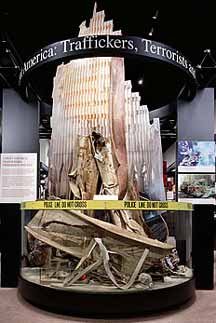
A picture named deaexhib.jpg
I’ve mentioned several times the offensive DEA museum exhibit on display in Times Square in New York: Target America: Drug Traffickers, Terrorists and You (See my earlier posts here and here).
I passed by it several times this week, but held off going in — I would have just gotten too upset, and there would probably only be some minor functionary there to debate. Several of my students went and were utterly amazed at how ridiculous the exhibits were in attempting to connect drug use to terrorism.
Oddly, the DEA Museum had one of the tougher security checks in the city. Visitors had their bags searched and were checked in detail with a metal detector wand. This was much more than the security at crowded theatres, or at museums with priceless artifacts. As fas as I saw, the only places with such tight security were the NY Stock Exchange and Liberty/Ellis Island. But why?
I heard that the DEA got embarrassed by having part of one of their exhibits stolen from under their noses (but they weren’t searching people leaving, only entering). Did they think that much of themselves that they really believed that they were a major terrorist target? Or were they afraid of their own citizens?
Fortunately, the exhibit closed yesterday.
Next stop is Detroit, where it is scheduled to be at the Detroit Science Center from April 2 through October 2. You might want to contact them and ask how a DEA propaganda exhibit fulfills their non-profit mission to educate people about science.

Posted in Uncategorized | Comments Off on Back from the Big Apple

Gone to New York

I’m off for a week of theatre in New York, and I’m taking 26 students with me to show them the city, so I won’t be posting much for awhile. I’ll still check my email and I’ll be able to post if something big happens, but I’m going to try to actually avoid it for a few days.
Consider this an open thread.

Posted in Uncategorized | Comments Off on Gone to New York

Walters at his most offensive

John Walters spewed his vile lies at our neighbors to the north:

A surge of high-potency marijuana illegally smuggled into the United States from Canada is fuelling a rise in drug dependency among young Americans, the Bush administration’s drug czar says.

A frustrated John Walters, the director of the U.S. National Drug Control office, yesterday signalled Washington’s ongoing irritation with what it sees as a lax attitude toward drug crimes north of the border, something that has forced it to redeploy drug patrols from the Mexican border to its northern flank.

Walters conceded yesterday American authorities are making no dent in the flow of Canadian pot and he said Canadian police and prosecutors have told him lenient Canadian courts are a root of the problem.

“The big new factor on the scene … is the enormous growth of high potency marijuana from Canada,” Walters said.

I get so pissed off at his lies sometimes. How is he allowed to continue to make unfounded and untrue connections between supposedly higher THC in Canadian pot and supposed increases in dependency or addiction?
Call for help
I have a personal quest. I’d like to file a challenge through the Data Quality Act — a request for correction of information disseminated by ONDCP regarding marijuana potency and dependency/addiction treatment levels.
I won’t be able to get to this right away, but I’d love some help gathering data, if anyone wants to volunteer. Check out the challenge filed by Americans for Safe Access as an example.
Then we need to gather as much information as possible:

  1. All media quotes from Walters and ONDCP staff regarding potency and treatment numbers.
  2. All government web pages that discuss these items.
  3. Actual figures regarding THC levels and potency over time and average potencies in the U.S. and Canada.
  4. Any actual studies that have looked at the connection between marijuana potency and dependency.

Shouldn’t be that hard to do. It wouldn’t make any huge changes, but it might force the government to admit that it has no proof for its claims.
Drop me a line if you’re interested in helping out.

Posted in Uncategorized | Comments Off on Walters at his most offensive

The Field Museum, Drugs, and Stupid Bureaucrats

My friend Tim sent this one: In today’s Chicago Tribune — a fairly bizarre bit of news about Chicago’s Field Museum and Peru.
Apparently the Field Museum has a program in Peru funded in part by USAID:

Field Museum has been deeply involved in the preservation of Cordillera Azul since 2000, when museum scientists first explored the uncharted rain forest in central Peru.æ Since 2001, when the region was declared a national park, the museum has been a key administrator of a complex and innovative program to involve surrounding communities in the long-term conservation of the 5,225-square-mile area.

While coca production has spiked and waned around Cordillera Azul for decades, Field Museum staff members have encouraged local residents to reject drug cultivation as damaging to the long-term health of the region and have promoted growth of legal crops.æ The museum has never been involved in the U.S.æ government’s drug interdiction efforts, however.

This is a long-term project to save the rainforest and provide alternate approaches. Well, coca paste was discovered in 3 of the 66 communities in the area, so the U.S. government was going to cut the aid. Fortunately, some cooler heads prevailed for now.
Now, I don’t know enough about the project to say how valuable it is, or whether it’s a good expenditure of tax money.
It’s the knee-jerk reaction that I find all too typical. A couple of incidents and they want to scrap a long-term program that is designed to find positive alternatives to a drug economy. So what would those communities do? Probably turn to the drug business.
[Just like the Mark Souder HEA financial aid law. Made a mistake and got arrested for pot? Well, we’ll take away your financial aid so you can’t go to college and then you can.. well, sell drugs, I guess. Take action NOW to end that horrible business.]
Back to the Field Museum…

When the museum first came into the area, communities agreed to work with its scientists and staff only after receiving assurances the program would be a long-term effort, said the International Relations Committee staff member.

Many other U.S.-based programs have made, and broken, similar pledges in the region, the staff member said.

“These are poor rural areas.æ The Field Museum is terrified and so is the committee that we are going to break that promise to them,” the staff member said.

Posted in Uncategorized | Comments Off on The Field Museum, Drugs, and Stupid Bureaucrats

NORML’s New Arrest Report Data

Crimes of Indiscretion: Marijuana Arrests in the United States, compiled by Jon Gettman, PhD is a comprehensive study reporting and analyzing national arrest data between 1995 and 2002. This online version contains the original downloadable full report in PDF format, various other browser-friendly extracts from the report and NORML’s Marijuana Arrests Investigator Flash tool, a companion application specifically designed for this project where you can create custom maps of arrest data dynamically from search parameters you enter.

Very cool (I love good data).
I’ve looked over the data briefly, and the one thing that strikes me is that any way you look at the data, arresting people for marijuana serves no useful purpose. In fact, some data graphs appear to have a reverse correlation.
The racial statistics are disturbing, though not particularly surprising.

Posted in Uncategorized | Comments Off on NORML’s New Arrest Report Data

Andrea’s got a new gig

For all you Andrea Barthwell fans… She has added a new organization and website to her repertoire: End: Coalition to End Needless Death on our Roadways. So far, it’s focused on alcohol, but it’ll be interesting to see if some of her past exaggerations on drugged driving will show up.
[Note: While END has been around in limited form since November, it appears that Andrea has just joined as Co-Chair, and the organization is just now gearing up.]

Posted in Uncategorized | Comments Off on Andrea’s got a new gig

Vancouver Sun Series on Target

The Vancouver Sun this week has just run four days of amazing editorials dealing with marijuana — even more important given the furor over the recent slaying of 4 officers that was improperly and sensationally linked to marijuana. This is a well-thought-out series of editorials that explores the history of marijuana, discovers the lack of positive influence of prohibition, examines the downside of decriminalization, and ends up suggesting that Canada could lead the world in legalization efforts.
I’ve included some excerpts from each one (the last one ran today).
Part 1: Marijuana Prohibition Caught Hold for Neither Rhyme nor Reason

[1923:] … The inclusion of marijuana in the list of banned drugs came as a surprise to many parliamentarians, including member of Parliament Ernest Lapointe, who asked “What is cannabis sativa?”

Lapointe could easily have added: “Why has it been added to the list of prohibited substances?,” since, to this day, no one knows why marijuana was banned.æ Parliamentarians had no evidence that marijuana caused any physical, psychological or social harm.æ

Nevertheless, the legislation was passed without debate, which isn’t surprising since parliamentarians could hardly have engaged in debate concerning a substance about which they knew nothing.æ

While marijuana continued to be a non-problem — by the mid-20th century, little more than two dozen people had been charged with possession — Parliament, perhaps influenced by the drug hysteria in the United States which warned people that marijuana turns people into ax-murderers, instituted ever greater measures against the “demon” drug.æ…

Part 2: Rising Use of Pot Proves the Law Can’t Solve All Our Social Problems

… It’s common wisdom that behaviour is influenced by the risk of getting caught, rather than the severity of the law itself.æ Yet studies have demonstrated that the amount of money a country devotes to law enforcement, or the number of arrests it makes, has no bearing on the number of people in the country who use marijuana.æ

While we would like the law to solve all of our social problems, or perceived problems, it’s clear that it’s often unable to do so.æ Marijuana use, as with so many other behaviours, is influenced much more strongly by cultural factors and social values than by the law.æ

This suggests that our attempt to control marijuana use through the blunt instrument of the law is doomed to fail — indeed, it has already failed.æ And while failing, it has created a monster.æ

The monster has many heads and goes by many names: the Hells Angels, the Bandidos, the triads, la Casa Nostra.æ Be it bikers, Asian gangs or the traditional mafia, all have experienced a tremendous boon from the criminalization of marijuana and other drugs. …æ

Part 3: Canada’s Middle Way on the Legalities of Pot Might Be the Worst Way

Now the downright ugly aspect of Bill C-38 [decriminalization]: The bill will do nothing to weaken the enormous power crime syndicates exert over the drug trade – in fact, it will likely strengthen the hand of organized crime.æ

The bill leaves the trafficking provisions of the Controlled Drugs and Substances Act as they are, thereby allowing organized crime to maintain its stranglehold on the business.æ

In addition, the bill strengthens penalties for the cultivation of marijuana.æ …

But just as outlawing drugs helped to create and sustain crime syndicates, the harshness of the law does have an effect on the degree to which organized crime controls the drug trade.æ The predictable result of the harsher penalties in the new legislation is that “mom and pop” grow-ops will be deterred, leaving crime syndicates to fill the vacuum, since no penalty is likely to deter them.æ

As such, the new legislation plays right into the hands of organized crime by giving it an even greater stranglehold on the marijuana industry. …

Part 4: Canada Could Be a World Leader in Smarter Drug Strategies

… Countries have failed to consider legalization for a number of reasons: The U.S.æ has exerted enormous pressure on the world to maintain the war on drugs, and it often ties foreign aid to a country’s commitment to prosecuting that war.æ Even countries that rely only on U.S.æ trade, not aid — such as Canada — face ferocious opposition from the U.S.æ anytime legalization, or even decriminalization, is discussed.æ If we needed any more evidence on this score, we got it in spades on Wednesday.æ U.S.æ drug czar John Walters linked the increasing number of American teenagers seeking addiction treatment with Canadian pot exports.æ …

The U.S.æ might well remain intransigent, but as the international community harnesses and distributes more and more evidence about the harm caused by the war on marijuana, some nations might feel empowered to consider marijuana legalization and regulation on a trial basis.æ Should such trials prove successful, other countries would likely follow.æ

All of this must begin, though, with a commitment from Ottawa to develop a national drug strategy, and to communicate the results of its work to the world.æ The world is not losing the war on marijuana: It’s a war we’ve already lost.æ Canada can help to unify the globe in its efforts to minimize the harms caused not only by drugs, but by drug laws.

Canadians: share these editorials with your friends, your family. Use them as a current events discussion in class. They’re a really wonderful series for getting people talking.

[Thanks to Scott for the tip. Thanks, as always to MapInc.org for its extraordinary resource in archiving drug policy articles.]

Posted in Uncategorized | Comments Off on Vancouver Sun Series on Target

Rise Up

From Raise Your Voice:

Rep. Barney Frank (MA-4) and 55 other members of Congress introduced the
Removing Impediments to StudentsÍ Education (RISE) Act, H.R. 1184. If
enacted, the bill will repeal the HEA Drug Provision, which, since taking
effect in 2000, has denied financial aid to over 160,500 students with prior
drug convictions. Over 200 organizations and 115 student governments from
across the country have called on Congress to repeal the law. With growing
concern regarding the effects of this failed policy, education advocates are
expected this year to push hard in both the House and the Senate to
reinstate aid to those who need it most.

It’s time to eliminate this offensive provision for good. Mark Souder’s going to try to save portions of it, but he should be ignored.

Posted in Uncategorized | Comments Off on Rise Up

KCBA gets nice coverage at forum

Seattle Post Intelligencer: Drug war strategy assailed at forum:

Despite a variety of backgrounds — from attorneys to outreach workers to recovering drug users — most of those gathered yesterday at Seattle City Hall to discuss the war on drugs agreed that, as waged today, it is at best ineffective and at worst expensive and unfair.

How about that for a lead paragraph?
A step at a time…

Posted in Uncategorized | Comments Off on KCBA gets nice coverage at forum