High coming to video

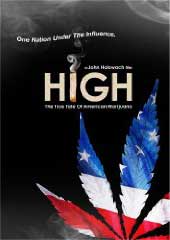
A picture named highfilm.jpg.Some time ago, I reviewed the film High: The True Tale of American Marijuana by Drug WarRant friend John Holowach.
It’s an powerful and excellent film.
“High” is finally being released to DVD. There’s a premiere at Columbia College tomorrow evening, and it can now be ordered at Amazon.com.
More information is available at the High site.
Note: I’m pretty sure the film has been updated (and trimmed down some) since I reviewed it. The new trailer for the film is available here.

In conjunction with the release, John Holowach has also riffed off Radley Balko’s recent call for a list of famous and productive people who have used marijuana. Here it is:


Posted in Uncategorized | Comments Off on High coming to video

Everyone gets their 15 minutes of representation

The cost of the drug war is just simply overwhelming

MIAMI — Public defenders’ offices in at least seven states are refusing to take on new cases or have sued to limit them, citing overwhelming workloads that they say undermine the constitutional right to counsel for the poor. […]

In September, a Florida judge ruled that the public defenders’ office in Miami-Dade County could refuse to represent many of those arrested on lesser felony charges so its lawyers could provide a better defense for other clients. Over the last three years, the average number of felony cases handled by each lawyer in a year has climbed to close to 500, from 367, officials said, and caseloads for lawyers assigned to misdemeanor cases have risen to 2,225, from 1,380.

Those are absolutely impossible, and ridiculous, numbers. And, you see, in America, we have a little thing called the Bill of Rights.

Amendment VI: In all criminal prosecutions, the accused shall enjoy the right to a speedy and public trial, by an impartial jury of the state and district wherein the crime shall have been committed, which district shall have been previously ascertained by law, and to be informed of the nature and cause of the accusation; to be confronted with the witnesses against him; to have compulsory process for obtaining witnesses in his favor, and to have the assistance of counsel for his defense.

The drug war completely destroys our ability as a nation to live up to our commitments as a nation.
This is just one more instance where the staggering financial burden of the drug war will clash with our national fiscal crisis.

Posted in Uncategorized | Comments Off on Everyone gets their 15 minutes of representation

Where are they now? Part 2

Remember when Joseph Frederick lost his famous Bong Hits 4 Jesus case in the Supreme Court?

A picture named bonghits.jpg

Well, there were a few extra issues lying around that didn’t get included in the first case (having to do with the school violating his free speech rights under the Alaska Constitution), and Frederick eked out a victory.

The district will pay Frederick $45,000. In exchange Frederick will drop remaining claims not heard by the U.S. Supreme Court […]

The settlement also calls for the district to spend as much as $5,000 to hire a neutral constitutional law expert to chair a forum on student speech at JDHS. This is to be done before this school year ends next spring.

Congrats, Joseph!

Posted in Uncategorized | Comments Off on Where are they now? Part 2

Where are they now? Part 1

Sgt. Joseph Chavalia, the killer of unarmed Tarika Wilson in her own home, returns to work this week.
He won’t be patrolling streets right now, because

“…we also have to be concerned with his safety, and quite frankly, the safety of other officers,” said police department Maj. Kevin Martin

It’s nice that the Lima, Ohio police department is so concerned with people’s safety.

Posted in Uncategorized | Comments Off on Where are they now? Part 1

Bolivia accuses DEA of drug trafficking, bribery and murder

Bolivia’s Evo Morales did more than kick out the DEA last week. He made some powerful charges.

Presidential Minister Juan Ramon Quintana presented a series of documents and press clippings at a news conference, which he described as “object data” that had influenced Morales’ decision to suspend DEA activities last week.
Quintana said Morales was ready to present the evidence to incoming US president Barack Obama “to prove the illegality, abuse and arrogance of the DEA in Bolivia.”
Throughout the 1990s, the DEA in Bolivia “bribed police officers, violated human rights, covered up murders, destroyed bridges and roads,” said Quintana.
Morales earlier Thursday said that after a 1986 operation in Huanchaca National Park, it was determined that the largest cocaine processing plant “was under DEA protection.”
He also charged that the DEA had investigated political and union leaders opposed to neoliberal economic policies, which he said amounted to political persecution.
On Wednesday, he had accused the DEA of shooting and killing Bolivians during their anti-drug operations, including members of the coca farmers’ movement.

Of course, I have no way of knowing how true Morales’ charges are, yet the sad thing is that they don’t actually surprise me at all, given what I know about the DEA.

Posted in Uncategorized | Comments Off on Bolivia accuses DEA of drug trafficking, bribery and murder

The right conversation

This OpEd by Richard M. Evans in several papers in Massachusetts says it right.

Don’t look now, but the resounding two-to-one victory of Question 2, the marijuana decriminalization initiative, may well turn out to be a blessing to Gov. Deval Patrick and the legislature as they face the current fiscal reckoning.

It’s not that the new law will save a lot of money – the proponents claimed around $30 million, but even that will not make a big difference. What makes a big difference is that for the first time, voters statewide have gone on record as supporting drug policy reform, providing the first opportunity in decades to rethink the laws that have flooded our courts, packed our prisons and strained our treasuries. [emphasis added]

Yes.
And it continues flawlessly.

Ronald Reagan, naturally, said it clearly: “Government exists to protect us from each other. Where government has gone beyond its limits is in deciding to protect us from ourselves.” Purging the criminal justice system of people we are protecting from themselves could free up hundreds of millions in criminal justice and incarceration savings, without threatening the public safety.
Hopefully leaders will now emerge, not only in politics, but in the media, education, and certainly in law enforcement to guide a new public discussion of this thorny but necessary topic. A good place to start is with some crucial questions that, until the Question 2 vote, few were ready to confront:

  • Is it realistic to think that continuing to pour vast resources into detection, enforcement, prosecution and punishment, we will ever achieve success in the struggle against illegal drugs?
  • When we are “successful,” how many more people will be locked up, and at what cost to taxpayers?
  • Where, exactly, is the line between abhorrent conduct we punish and abhorrent conduct we tolerate?
  • Does it make sense to conflate the concepts of drug use, drug abuse and drug addiction?

For decades, few politicians have dared to criticize the laws lest they be branded “soft on drugs” in the next election. But in an era of evaporating public resources, the question is no longer whether drug offenders deserve our scorn, but whether they deserve our hospitality at $43,000 per year.
Billions have been spent in a mighty effort to fight and condemn drugs. Question 2 may well provide an historic opportunity to come to terms with them.

Outstanding!

Posted in Uncategorized | Comments Off on The right conversation

Public Servant

Hawaii Tribune Herald

The Police Department won’t ease enforcement of marijuana laws following the passage of a ballot initiative making that the “lowest law enforcement priority.”

“No. 1, it’s not a law. It’s a resolution,” Police Chief Lawrence Mahuna said. “No. 2, there will be no change how we prioritize the enforcement of marijuana.

“The resolution does not invalidate federal law,” Mahuna said. “It doesn’t legalize marijuana. It’s still a Schedule 1 controlled substance. […]

“This priority is not something that is given to anybody but the police chief,” Mahuna said. “Nothing will change.”

Translation: “F#ck you! I’m the Police Chief. I don’t listen to the ‘will of the people.’ F#ckin’ people don’t have any say in who gets busted here.”
Add to that the pathetic whining of law enforcement in Massachusetts, and it puts a rather ugly public face on what we were already seeing — a seriously dangerous illness of lawlessness infecting the law enforcement community.

Posted in Uncategorized | Comments Off on Public Servant

Open thread

“bullet” Submit your ideas to the transition team. Make it polite and constructive. Talk about reforming drug policy as a means toward revitalizing the economy, putting people back to work, restoring families, and building communities.
“bullet” Obama speaks with world leaders..

Calderon’s office said Obama pledged continued U.S. support for Mexico’s fight against organized crime and drug trafficking. A statement from the Mexican president’s office says Obama told Calderon he was “conscious of the difficulty of the battle” and offered “decisive” U.S. support.

“bullet” At Digg Dialogg, they’re asking Al Gore some questions submitted by readers that he’ll be answering tonight. One of them (the top vote getter) is:

Tobacco deaths per year – over 450,000. Alcohol deaths per year – nearly 100,000. Marijuana deaths per year – 0. Why is the drug that kills nobody the illegal one?

“bullet” Classic reaction to Massachusetts’ Marijuana Decrim Vote (via Alex at Drug Law Blog):

First This State Passes Gay merrages & Now You Can Posses Drugs.This State Is So Back Words.Children Think Its Gonna Be Ok To Be Gay & Now They Think Its Ok To Use Drugs Thank Mass.Your Great Roll Modals

Compare that erudition with the list of pot heads that Radley Balko is collecting and it not only blows the “marijuana smokers are losers” argument out of the water, but makes a reasonable anecdotal case for using cannabis as a preventative for stupidity.
“bullet” “drcnet”

Posted in Uncategorized | Comments Off on Open thread

Awesome

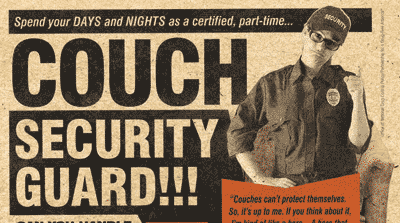
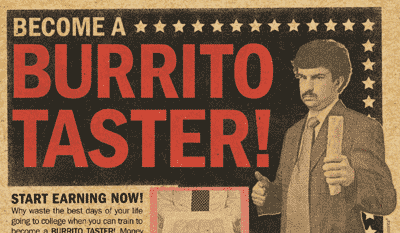
In yet another instance of epic fail, the drug czar’s office has come up with some new anti-marijuana ads.
These will be hanging on dorm room walls and in stoner basements in no time.
Click on the image to see the full-size pdf (each is about 1 meg).

A picture named remote_control.gif

A picture named couch.gif

A picture named burrito.gif

I predict these will be so popular that in a few months cops are going to claim that having one of these posters is probable cause to search for pot.
I, too, want to EARN a JILLION BUCKAROOS as a BURRITO TASTER, with GLAMOUR and EXCITEMENT in EVERY BITE!

Posted in Uncategorized | Comments Off on Awesome

Presidential decisions and public motivation

Via Digby

FDR was, of course, a consummate political leader. In one situation, a group came to him urging specific actions in support of a cause in which they deeply believed. He replied: “I agree with you, I want to do it, now make me do it.
He understood that a President does not rule by fiat and unilateral commands to a nation. He must build the political support that makes his decisions acceptable to our countrymen. He read the public opinion polls not to define who he was but to determine where the country was š and then to strategize how he could move the country to the objectives he thought had to be carried out.

Everybody has an agenda to push with the new President-elect. We’re going to be on a list a mile long. And it’s not enough for a lot of people to be in favor of drug policy reform. They must want it bad enough to make political leaders do it.
That requires making the grass roots overwhelming.
Let’s take a quick look look at two different individual rights issues right now — gay rights and drug use. Both have a strong and committed advocacy core. Both generally enjoy some measure of public support. Both suffer somewhat from the “doesn’t affect me” syndrome (ie, “I’m generally for gay rights, but I’m not gay, so I don’t care that much about making gay marriage legal.” or “I’m generally for decriminalization, but I don’t do drugs, so I don’t care much about making drugs legal.”* )
However, individual rights isn’t all that drug policy reform is about. There are also the cost of prohibition — massive costs in taxpayer financing, in violence and corruption — and those costs affect everyone.
All we have to do is get the entire country outraged at the drug war. And then, the President-elect will have no choice but to make change, regardless of his disposition.
* (It’s hard to read how much that impacted this week’s referenda on the two topics.)

Posted in Uncategorized | Comments Off on Presidential decisions and public motivation