Around the world

bullet image Editorial: Legal pot: worth a try – Copenhagen Post

In a country that regulates the sale of over-the-counter painkillers, you’d have thought that a reasonable way to decriminalise the sale of cannabis would have long since been rolled out, perfected and exported to other cities grappling with the same topic. […]

…mindlessly repeating the same mistakes of drug control is guaranteed to fail.

It’s time we take a different approach to cannabis. Like so many other things, you never know what will happen until you try.

bullet image Drug War Failing in Germany – Spiegel

Germany’s law-enforcement and legal apparatus devotes enormous resources to fighting illegal narcotics. But users are always a step ahead, and lawmakers seem uninterested in exploring alternatives to a broken system. […]

When Leipzig, the prosecutor in Berlin, is asked for his opinion, he says that he could imagine a system in Germany involving the controlled administration of soft drugs, such as cannabis, to adults. The problem is that there is no political pressure in Germany, nor does the federal government have a drug czar who wants things to change.

bullet image New Zealand

The ever excellent Hungarian Civil Liberties Union interviews an official from New Zealand about the new approach they’re instituting to dealing with the ever-shifting introduction of new chemical psychoactive products. This is going to be something to watch in the future to see just how it’s done. It’s a bit scary in that it takes the position that the default is that any new product is banned unless it is proven “safe” (with no stated definition yet as to what that means).

bullet image Why is the U.S. Funding International Drug Rehabs Known for Torture and Abuse? – Alternet

The United States is not just funding an abusive drug war at home; taxpayer funds are propping up violently oppressive “drug treatment” centers that act more like detainment camps abroad. At the U.S.-backed Somsanga Rehabilitation Center in Laos, detainees are subjected to shocking physical abuse, including beating to the point of unconsciousness for showing withdrawal symptoms or attempting to escape. Allegations of sexual assault are also rampant. […]

This June, the U.S. agreed to donate an additional $400,000 to the Somsanga center. US officials heeded no warnings issued by at least three separate reports (2003 UNICEF report, 2004 WHO report, and 2011 Human Rights Watch report), each of which warned against the center’s deplorable conditions and inhumane treatment of detainees. The UN report says past US funds have been used to build dormitories “to expand the capacity of the government to detain drug users, street children, and ethnic minorities,” as well as fences surrounding the center.

[Thanks to Transform]

Posted in Uncategorized | 58 Comments

One Million

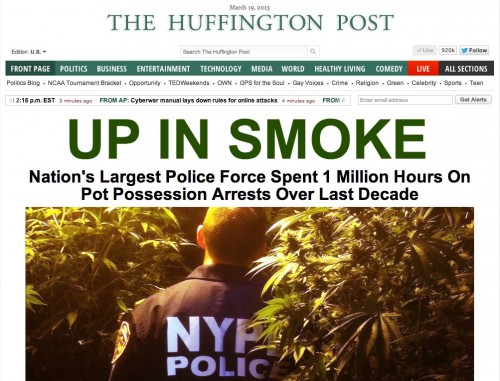
Huffington Post Up In Smoke

This was the front page of the Huffington Post yesterday.

NYPD Spent 1 Million Hours Making 440,000 Marijuana Possession Arrests Over Last Decade

NEW YORK — The NYPD spent 1 million hours making 440,000 arrests for low-level marijuana possession charges between 2002 and 2012, according to a new report released Tuesday — just as legislative leaders in Albany are deciding whether to pass a bill reforming drug laws.

This is a powerful indictment of the incredible waste of law enforcement resources involved in going after marijuana users.

Posted in Uncategorized | 61 Comments

Who is your role model?

Saruman: [talking to Gandalf] “Your love of the halfings’ leaf has clearly slowed your mind.” — Lord of the Rings: The Fellowship of the Ring

Saruman: [talking about Radagast] “It is his excessive consumption of mushrooms, that have addled his brain and yellowed his teeth!” — The Hobbit: An Unexpected Journey

Of course, Radagast cared for the land and ministered to defenseless animals. Gandalf gave his all to protect the people, including the littlest of folk on the fringes of society.

And Saruman, who cultivated political power, was too easily seduced by evil incarnate.

Just sayin’

Posted in Uncategorized | 17 Comments

Finding allies

I’ve long been disappointed that there hasn’t been more public interest shown from gun rights activists in ending the war on drugs. The war on drugs has affected them in two significant ways: as a back door method of restricting gun ownership, and as means of fueling gun violence leading to public backlash on gun ownership.

So I was pleased to see this good OpEd in AmmoLand: Gun Violence and the ‘War On Drugs’

What’s often deliberately ignored is the violence resulting from, or accompanying, “the war on drugs.” The real problem occurs on the mean streets of our inner cities […]

It’s rare to find a rational discussion relating to the amount of violence caused by the drug war, and the illicit use of drugs. We may not like to admit it, but it’s one war we cannot win. We know that legalizing drugs may not be the best public policy, but what damage has “the war on drugs” done to global and local society?

We need to have an open, objective dialogue about this unwinnable war, and discuss public policy options and implications.

Here’s a start. Dr. Jeffrey Miron, an economist and Senior Lecturer and Director of Undergraduate Studies at Harvard University, explains that violence occurs when prohibitions against goods or services are enforced because there is an increased “inability of drug market participants to settle disputes using the official dispute resolution system.” This occurs globally, and is the cause of a great deal of global violence. However, this fact is frequently ignored and replaced by increasingly hysterical calls for international weapons controls. […]

We need to get the truth out about the roots of violent behavior. And part of that truth is that the global drug policy is a large part of the problem.

This is good to see.

In fact, if you look at almost any aspect of society – any argument for political activism – you can find a good argument for ending the war on drugs. Perhaps as we continue to help move the drug policy discussion out of the “whisper” phase and into the sunlight, we’ll find many allies out there willing to publicly help promote reform.

Posted in Uncategorized | 22 Comments

Interesting…

Washington State Selects Botec Analysis Corp. as Finalist for Marijuana Consulting Contract

The Washington State Liquor Control Board will announce tomorrow that it has tentatively selected Botec Analysis Corp. to provide cannabis-related consulting services tied to the emerging recreational marijuana industry, according to information obtained by MMJ Business Daily. […]

Little public information is available about Botec, at least on the Internet. A Botec Analysis Corporation based in Massachusetts has conducted studies on various issues – including substance abuse treatment and domestic violence – for several states. Mark Kleiman – a professor of public policy at the University of California in Los Angeles and co-author of the 2012 book “Marijuana Legalization: What Everyone Needs to Know” – reportedly heads up Botec, according to an author profile on Amazon.com.

More here

Posted in Uncategorized | 15 Comments

Odds and Ends

Back from an exciting trip to New York. Saw some great shows and ate some amazing food. As usual, walked all over the city, and the weather mostly cooperated.

A lot has been going on, and hopefully you’ve been following the comments where our team has been hard at work on the couch.

Here are a few random notes…


bullet image Some determined master thieves, caught in the act, appear to have given up trying to steal this particular item….

Feds Give Up Trying to Seize a Motel Based on Drug Offenses by a Few Guests by Jacob Sullum

Today the U.S. Attorney’s Office in Boston said it will not appeal a ruling that blocked the federal government’s attempt to seize and sell a family-owned motel in Tewksbury, Massachusetts, based on drug offenses committed by a tiny fraction of the people who stayed there. The government conceded that the owner, Russell Caswell, did not participate in those crimes and was not aware of them at the time, but it argued that he was “willfully blind” to them.

I’m sure they’re already scoping out other lucrative targets.


bullet image U.N. development chief slams War on Drugs

Even some U.N. officials are unhappy with what the U.N. is doing in drug policy.

Helen Clark, the head of the United Nations Development Program, has publicly slammed global strategies to combat drugs, claiming there is increasing evidence that “the war on drugs” has failed. The former prime minister of New Zealand urged Latin American leaders to develop new policies to tackle drugs, which she says should be addressed as a public health problem rather than criminalized. “I’ve been a health minister in my past and there’s no doubt that the health position would be to treat the issue of drugs as primarily a health and social issue rather than a criminalized issue,” she told Reuters.


bullet image A View of the Drug War: Stop Blaming Police and Start Emphasizing Personal Responsibility

Sergeant John Bruhns wants us to stop blaming police for the problems of the drug war. Well, we don’t blame all police — after all, we’re big fans of LEAP, and we know that not all police are alike. So what’s his argument?

An anti-law enforcement sentiment currently exists in American society, particularly among those who are disconnected from the realities of inner-city areas that are plagued by crime. In these circles, I often hear law enforcement personnel blamed for the “prison industrial complex, mass incarceration, and the war on drugs.” […]

Like all wars, the drug war was started by policy makers. Law enforcement personnel had no say in when the war began, nor will they have a say in when it ends.

Oh really? We’ve heard that line before. How come every time I’ve been at a legislative hearing about drug policy, there have been police officers in uniform there to testify in favor of keeping the drug war as it is? Law enforcement holds an incredible amount of power over legislators, in terms of campaign contributions, lobbying efforts, and public visibility. Why do you think the Byrne grants keep getting re-funded despite multiple administrations admitting they do no good? Bizarrely, we even see police officially commenting to the media on whether marijuana is an efficacious medicine.


bullet image Here’s the news that’s giving everyone a kick… Steve Katz Arrested: New York State Assemblyman Charged With Marijuana Possession

A New York State assemblyman who has opposed medical marijuana legislation was arrested and charged with unlawful possession of marijuana after he was pulled over for speeding this week.

Oops.

As Lee Rosenberg tweeted:

Anti-pot politicians getting busted for weed is going to be the new anti-gay politicians busted with gay escorts.


bullet image I don’t understand. Here’s an email I received (and I’ve received several like it over the years I’ve been doing this blog):

Subject: need help with dope dealing trashy neighbors

my new neighbors are obviously selling drugs, have parties and throw
trash into my yard.
I am happy to give any info i can including address, vehicle
descriptions, etc. thanks for any help

Why are you telling me? I don’t have a trash pickup service. Are your new neighbors a CVS store? About the parties – is it that they’re too loud, or you’re not invited? Have you asked them not to throw trash in your yard? I really don’t know how to advise you. Excuse me, but I need to go write Radley Balko and ask him what to do with the dog poo in my alley.

Posted in Uncategorized | 57 Comments

What excuse do we have for doing a better job regulating chewing gum than heroin?

That’s the premise behind this excellent article in Alternet by Bill Fried: What Would It Be Like If Heroin Were Legal

Posted in Uncategorized | 66 Comments

Victory?

It’s often been noted here that calling the drug war a failure is only true depending on what you consider to be the true goals of the drug war.

Kevin Carson does a nice riff on that with Fifteen Benefits of the War on Drugs

1. It has surrounded the Fourth Amendment’s “search and seizure” restrictions, and similar provisions in state constitutions, with so many “good faith,” “reasonable suspicion” and “reasonable expectation of privacy” loopholes as to turn them into toilet paper for all intents and purposes. […]

5. As a result of the way DARE interacts with other things like Zero Tolerance policies and warrantless inspections by drug-sniffing dogs, the Drug War has conditioned children to believe “the policeman is their friend,” and to view snitching as admirable behavior, and to instinctively look for an authority figure to report to the second they see anything the least bit eccentric or anomalous.

6. Via civil forfeiture, it has enabled the state to create a lucrative racket in property stolen from citizens never charged, let alone convicted, of a crime. Best of all, even possessing large amounts of cash, while technically not a crime, can be treated as evidence of intent to commit a crime — saving the state the trouble of having to convert all that stolen tangible property into liquid form.

7. It has enabled local police forces to undergo military training, create paramilitary SWAT teams that operate just like the U.S. military in an occupied enemy country, get billions of dollars worth of surplus military weaponry, and wear really cool black uniforms just like the SS. […]

Posted in Uncategorized | 91 Comments

The U.N.’s complicity in international human rights abuses

A very powerful OpEd in the New York Times by Fernando Henrique Cardoso (former President of Brazil) and Ruth Dreifuss (former President of Switzerland): An Ugly Truth in the War on Drugs

This week, representatives from many nations will gather at the annual meeting of the United Nations Commission on Narcotic Drugs in Vienna to determine the appropriate course of the international response to illicit drugs. Delegates will debate multiple resolutions while ignoring a truth that goes to the core of current drug policy: human rights abuses in the war on drugs are widespread and systematic.

Consider these numbers: Hundreds of thousands of people locked in detention centers and subject to violent punishments. Millions imprisoned. Hundreds hanged, shot or beheaded. Tens of thousands killed by government forces and non-state actors. Thousands beaten and abused to extract information, and abused in government or private “treatment” centers. Millions denied life-saving medicines. These are alarming figures, but campaigns to address them have been slow and drug control has received little attention from the mainstream human rights movement. […]

The U.N.’s International Narcotics Control Board has refused to condemn torture or “any atrocity” carried out in the name of drug control, claiming it was not its mandate to do so. This is both shocking and contradictory: oversight of international drug control treaties is the control board’s very mission.

Late last year, despite the evidence before it, the U.N. Committee against Torture failed to condemn the widespread abuse of people who use drugs in the Russian Federation. […]

You can’t have a drug war without human rights abuses, and the harder you prosecute it, the greater those abuses. This is a painful truth often carefully ignored by those who have chosen the drug war as their path.

Good to see this getting more visibility.

I don’t expect much from the upcoming CND sessions – the same posturing from U.S., Sweden, Russia, etc. – but it’s getting harder for them to pretend that they represent the will of the world (or what’s best for it).

Just hours ago, the sessions began with ONDCP’s Yuri Fedotov calling Iran “UN’s number one partner in the war on drugs.”

Posted in Uncategorized | 20 Comments

Open Thread

I’m heading out early Saturday morning for New York with a group of students for a week-long theatre trip. We’ll be seeing Matilda, Vanya and Sonia and Masha and Spike, Breakfast at Tiffany’s, Kinky Boots, and Caveman.

I’ll check in when I can, and bring back some cheesecake from Junior’s (and maybe some pastrami from Carnegie Deli).

Posted in Uncategorized | 44 Comments