Drug Action Network

Thanks to Andrew Somers for featuring Drug WarRant on the About.com’s Civil Liberties page. Be sure to check out Somers’ organization: Drug Action Network.
A sample of his work from “Keeping Drugs Away from Your Children”

It’s a sad, indeed tragic, fact that Nixon’s war on drugs has actually made it 7 times MORE likely for your child to come into contact with illegal drugs. The reasons are very straight forward: As the government increases the criminal penalties associated with prohibition, the price of various illegal drugs is increased. The increased price means greater profits for drug dealers. These greater profits attract more and more dealers, and especially, young teenagers.
Posted in Uncategorized | Comments Off on Drug Action Network

“A.M. Rosenthal, Drug War Stooge”

Last week, we were treated to one of the standard drug war cheerleader columns that could have been a press release from the Drug Czar. But this was by a Pulitzer Prize and Light of Truth winning, Presidential Medal of Freedom receiving, former Managing Editor of the New York Times. So what’s up?
A picture named rosenthal.jpg
For those who haven’t followed Rosenthal’s writings over the years, or the glee with which drug policy reformers have responded to the rich wealth of stupidity in his drug war pieces, it’s a strange story.
Today, I’m going take you on this little exploration of a supposed journalist who has spent much of his career spreading propaganda, and even conspiring with the ONDCP to find ways to use the press and the government to attack drug policy reformers.
Start with the current piece: Case for legalized pot is a deadly con job by A. M. Rosenthal. A few of the points he makes.

The specialists say legalization of it would create mass addiction and vastly multiply the cost of drug treatment.

What specialists? Unspecified. Based on Rosenthal’s past references to “specialists,” they tend to be drug addiction personnel who make their living from the war, or even work for the Drug Czar. History shows us that the mass addiction scare is completely false. Experiences in the Netherlands and past decriminalization in the states have demonstrated at most, a mild increase in use, and generally a decrease in addiction.

John Walters, the head of federal drug enforcement, says that of the 7 million Americans who need treatment for drug addiction, 60% are hooked on marijuana. “Marijuana is at the heart of drug problems,” he says.

Here, Rosenthal takes Walters’ distortions and stretches them further. This is one of the recent favorites of the drug warriors. The fact that 60% of those in treatment are there because of marijuana has nothing to do with dependence or addiction or being “hooked.” It’s because the criminal justice system is putting people in treatment who are caught using marijuana (regardless of any dependence issues) and treatment is used in the same way to deal with positive drug tests in the workplace, schools, etc. In fact, the over-use of treatment for marijuana users is actually reducing treatment availability for those who need it for harder drugs. (If we made everyone who was caught eating chocolate go through treatment, then I guess we’d say they’re all hooked and that chocolate is at the heart of the drug problem.)

Experts also point out that one marijuana cigarette contains as much tar as four tobacco cigarettes.

Rosenthal tries to infer danger above that of tobacco (which is legal). Yet, studies have shown no established link between marijuana and mortality, unlike tobacco.

For example, marijuana has now been shown to cause physical dependence and physical withdrawal.

True. So have snack foods. The National Institue of Medicine showed that dependency rates for marijuana use are dramatically lower than those for tobacco and alcohol (which are legal), and “marijuana dependence appears to be less severe than dependence on other drugs.” In fact, addictions specialist Jack Henningfeld (see, I can use specialists, too) ranked marijuana lower than caffeine in dependence, tolerance, and withdrawal.

[quoting a statement by “prominent specialist” Dr. Herbert Kleber] “Unfortunately, the American public too often is sold a bill of goods by a clever campaign funded by a small group of billionaires who have engaged in extraordinary advertising and political manipulation.”

This is a favorite rant of Rosenthal’s — that the drug reform movement is heavily funded and using their great resources to hoodwink the public with an expensive advertising campaign. Well, let’s see, so far my pay for doing this has come up to a whopping $0. And most of the drug reform organizations I know are being run by interns and begging for funds to pay for their web server space and postage (more on this tomorrow). However, on the other side, the ONDCP has an almost unlimited budget paid for by… us, the taxpayers. Whose propaganda ads do you see on national television all the time? (Oh, and by the way, the prominent “specialist” he quoted is a former deputy drug czar!)
Does A.M. Rosenthal matter?

Posted in Uncategorized | Comments Off on “A.M. Rosenthal, Drug War Stooge”

Instapundit on Bad Laws: Ignore Them

Via TalkLeft. Glenn Reynolds’ column today at MSNBC — Breaking the Law — points out that there are too many laws, and notes:

Sometimes — not often, but sometimes — the best way to get a law changed is for people to ignore it.

According to SAMHSA, over 19 million Americans were current illicit drug users in 2002. I wonder if that qualifies as enough people ignoring the law to change it.
Glenn also notes:

…law is like anything else: when the supply outstrips the demand, its value falls. If law were restricted to things like rape, robbery, and murder, its prestige would be higher. When we make felonies out of trivial crimes, though, the law loses prestige.

This is particularly appropriate to drug laws. Since so many people use (or have used at some time in their lives) an illicit drug, it’s hard for them to get excited about assisting law enforcement. Additionally, since the laws for drugs are so harsh, they devalue more important violent crimes. If a criminal could get 20 years to life for a drug offense, the additional penalties for things like murder have little deterrence. In fact, violence can seem a reasonable tactic by the criminal to attempt to avoid capture for drug crimes. (Rarely do drivers try to shoot it out with the police to avoid a $75 speeding ticket.)
Now I’m not advocating ignoring drug laws, but it is important to note that they are ignored, and have been by every segment of society, from the most underprivileged to the extremely privileged (like future American Presidents). It’s time to realize that drug laws are bad laws, are ignored, and should be changed.
Update: Corrected the figure of drug users from “annual use” to “current illicit drug use” and added citation link. Thanks, Mithras.

Posted in Uncategorized | Comments Off on Instapundit on Bad Laws: Ignore Them

Satire, Circuses, and Libertarians…

A smorgasbord of interesting reading…
bullet image
MacAttack, a new blogger in the UK, has this piece of satire about England’s move to re-classify marijuana, including harpooning public figures on both sides of the Atlantic:

…There has also been immense pressure from America over the move. George Bush released this statement: ‘Cutchy cutchy coo Tony, ohhhh, you know you like it behind the ears… good boy,’ before going on to suggest a change in United Kingdom policy.
‘We believe, in the United States of Americana, that a hard stance should be taken on drugs because of the dangers of serious adictivication and termination. They should all be prizonified – us folks can’t have people running around with things that could kill people, then where would our country be?’ he concluded, before tickling Tony behind the ear again.
The Blair Administration leapt furiously to the defence of their softly softly approach to the drug problem… by offering America our prisons…

bullet image
The best coverage of the recent ONDCP circus with the New England governors can be found at the Boston Phoenix.
For an overview of the event, read Behind closed doors: What really went on at the Office of National Drug Control Policy’s Summit of New England Governors
by Camille Dodero.
Then read the current issue’s editorial – Reefer madness, redux: The war on drugs destroys lives but does nothing to mitigate the abuse of drugs in this country.

Despite compelling evidence of the bloated costs and wasted resources devoted to our two-decade-long war on drugs, not to mention shocking racial disparities in arrests and sentencing for drug charges — all documented by organizations such as Human Rights Watch, the Justice Policy Institute, and the Sentencing Project — the Bush administration has embraced the gulag approach to dealing with the societal problems caused by drug abuse. This, more than anything else, was evident at last week’s anti-drug summit organized by the Office of National Drug Control Policy.

Finally, with a focus on the medical marijuana panel: Snake-oil salesmen: Why does the Bush administration seem so intent on denying medical marijuana to adults in extreme discomfort? by Kristen Lombardi.

Forget about meaningful discussion. Indeed, in keeping with the Bush administration’s general assault on patients who smoke pot to manage their illnesses…, the federal government will go to extreme lengths to prevent the push for legalizing medical marijuana — and last week’s panel was no exception. If anything, it amounted to a one-sided exercise suggestive of propaganda such as Reefer Madness (1938), whose characters are driven insane by taking a puff of a joint.
Barthwell, who’s become the ONDCP mouthpiece on medical marijuana by penning op-eds against the cause for newspapers such as the Los Angeles Times, the Kansas City Star, and Newsday, kicked off her remarks with a blunt statement of opposition. Medical marijuana, she said, is “the worst scam” drug legalizers have perpetrated on this country. She went on to dissect the scientific research. Interestingly, she and her fellow panelists fixated on the fact that patients who use marijuana for medicinal purposes typically have to smoke it – a delivery method that, they claimed, isn’t “scientifically proven.”

Interesting indeed. I keep hearing from the government’s medical “experts” that medical marijuana can never be accepted because it’s smoked, and that’s not medicine. Forget for the moment that it’s not true, since other delivery methods like vaporization are possible. It’s still ridiculous. We have accepted medicines that involve bombarding the body with radiation or ingesting poisonous substances. Accepted medications are delivered orally, anally, by injection, by inhaler, and with a patch. Accepted medications have acceptable side effects of having your hair fall out, severe nausea, and even death.
bullet image
The Libertarians have a couple of good articles.
Via RandomActOfKindness comes Libertarian Solutions: How federalized crime threatens our liberty

By intervening in what has traditionally been a state and local matter, federal politicians endanger public safety, threaten civil liberties, and weaken Constitutional safeguards.

Although the article oddly ignores the drug war, the points made are extremely pertinent to what’s been going on with the federalization of drug crime.
While you’re at the Libertarian Party site, check out their attack on the administration’s selective demonization of drug users: America owes talk host Rush Limbaugh a debt of gratitude, Libertarians say

Given their longstanding support for the Drug War, it’s fair to ask:
Why haven’t President George Bush or his tough-on-crime attorney general, John Ashcroft, uttered a word criticizing Limbaugh’s law-breaking?
Why aren’t drug czar John P. Walters or his predecessor, Barry McCaffrey, lambasting Limbaugh as a menace to society and a threat to “our children?”
Why aren’t federal DEA agents storming Limbaugh’s $30 million Florida mansion in a frantic search for criminal evidence?
Why haven’t federal, state, and local police agencies seized the celebrity’s homes and luxury cars under asset-forfeiture laws?
Finally, why aren’t bloviating blabbermouths like William Bennett publicly explaining how America would be better off if Limbaugh were prosecuted, locked in a steel cage and forced to abandon his wife, his friends, and his career?

Posted in Uncategorized | Comments Off on Satire, Circuses, and Libertarians…

The Untouchables

Last night, I watched The Untouchables again on TV. I really enjoy this movie — it’s got a great cast and some fabulous cinematic moments (the baby carriage sequence in the train station, the showdown on the border…), and it’s a good story.
A picture named untouch.jpgThe only problem is that I cannot watch that movie without constantly noting the parallels between the prohibition of that time and the one we suffer through today.

Both Eliot Ness and Al Capone were creations of prohibition.
Capone used prohibition to create a huge, profitable black-market alcohol operation — and since much of the population used the product, it gave him additional cover. The violence he used were part of the black-market “business” to protect the profits. (Legal businesses use marketing, lawsuits and regulations to protect their business, while black-market business use violence and murder.)
Capone was also able to protect his business through the corruption of law enforcement (again because of the massive profits).
Ness was put in the position of stretching (even breaking) the law to pursue Capone.

“You wanna get Capone? Here’s how you get him. He pulls a knife, you pull a gun. He sends one of your men to the hospital, and you send one of his to the morgue.”

Today, it’s often (though not always) a different kind of stretching and breaking the law, through drug task force tactics and the incursions on civil liberties. But all the parallels exist — the black-market profits, increased violence, corruption, loss of public respect for the law, innocents caught in the cross-fire, and excessive law enforcement tactics.
At the end of The Untouchables, there’s a fascinating little moment that shows how little prohibition has to do with what it’s prohibiting. Most of Eliot Ness’ team has been murdered, and he has finally put Capone away for tax evasion when he’s approached by a reporter:

Reporter: They say they’re going to repeal prohibition. What will you do then?
Ness: I think I’ll have a drink.

Interesting parallel there with a recent statement by Canadian Prime Minister Jean Chrétien about marijuana:

“Perhaps I will try it when it will no longer be criminal.”

Prohibition generates its own life, spawning the warriors on both sides, and feeding off the devastation.
– Watching The Untouchables as good film-making — entertaining.
– Seeing that we have not learned anything — depressing.

Posted in Uncategorized | Comments Off on The Untouchables

Around the web…

A few things worth a look:

Update: Link fixed. Thanks Tad

Posted in Uncategorized | 1 Comment

With friends like us…

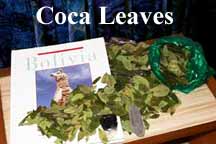
In case you’ve missed it (doesn’t hit the news much in the states), there’s been trouble in Bolivia lately, with citizen riots, killings, protests, and all the usual Andean instability.
A picture named bolivia.jpg
Yesterday’s Financial Times had an excellent analysis of the situation:

…the US must be prepared to consider change to the country’s drugs eradication programme. Plans to clear more coca should be suspended until realistic and credible economic alternatives are available. These should centre on labour intensive products such as textiles, jewellery and other sectors already identified by the Bolivian authorities.
Beyond that the United States needs to re-examine its drugs policy which – it seems – is often pursued in isolation from broader policy and development objectives. The danger is that such an approach is short-sighted and could further undermine precarious stability. In an Andean region already beset by mounting violence, that is a risk that the US can ill afford.

Too bad the advice came too late (not that the United States would have considered following it).
Today, Bolivian president Gonzalo Sanchez de Lozada resigned following a huge popular uprising over (in part) gas exports to the United States and Bolivian government’s cooperation with the United States’ drug eradication programs. Vice-President Carlos Mesa was sworn in to serve out the president’s term.

Mesa, a former television journalist, has been critical of many of Sanchez de Lozada’s reforms, including a proposed new income tax and a U.S.-backed effort to eradicate the production of coca, the leaves of which are used to produce cocaine.

Naturally, the United States’ State Department showed its lack of understanding of the problems by praising the ex-President.

“We commend ex-President Sanchez de Lozada for his commitment to democracy and to the well being of his country,” a State Department statement said.

Last week, Drug Czar John Walters kept up his foreign policy track record:

“…we should begin to see substantial changes in the availability of cocaine throughout the world in the next six to 12 months,” Mr. Walters said… He added that although Bolivia and Peru have more work to do, those governments are working more closely with the United States as well.

And back in August:

American drug czar John Walters said Tuesday that freshly-minted governments in Bolivia and Colombia will inject new strength into the fight against drugs and terrorism. “I think we have a unique consensus today about how we need to work together to seize the future,” Walters, director of the Office of National Drug Control Policy, told reporters in Washington.

As I’ve said before, cooperating with John Walters’ foreign drug policy is the kiss of death, as Lozado has learned.
By the way, in case you’ve forgotten how drug eradication works down there, here’s a helpful visual aid.

[Thanks to Disgustedvet for the heads up. More at Big, Left, Outside.]
Posted in Uncategorized | Comments Off on With friends like us…

Numbers are tricky things…

In this week’s DrugSense Weekly Newsletter:
A picture named numbers.gif

While the dangers and horrible effects of prohibited drugs are given great play in the press, when government-paid “experts” are found to have exaggerated “facts” little attention is paid.æ In New Zealand last week, a government scientist who promotes drug testing was forced to admit she had exaggerated by some 244% the number of drug users detected by random tests.æ The government’s “expert”, Dr Susan Nolan, twice testified to court last week that drugs were found in 22 percent of samples collected from workers tested.æ But when called on it, the government-hired expert conceded that only 9 percent contained drugs, not 22 percent as she had originally testified.æ The 244% mistake (in the government’s favor) was merely a “copying error,” explained Nolan.

You know, that happens to me all the time. I mean to type a “9” and end up hitting the “2” key twice instead. Easy mistake.

Posted in Uncategorized | Comments Off on Numbers are tricky things…

Your tax dollars hard at work!

A picture named virginia.jpg
University of Virginia:

At a press conference last Friday, local authorities announced the indictment of 33 people on charges of drug distribution and sales… The arrests mark the conclusion of a 15-month undercover operation conducted by the Jefferson Area Drug Enforcement (JADE) Task Force. The investigation, dubbed “Operation Spring Break Down,” involved agents from the Charlottesville, University and Albemarle County police departments, the Virginia State Police, the Drug Enforcement Administration, The Federal Bureau of Investigation and the Bureau of Alcohol, Tobacco and Firearms. These law enforcement officials were aided in the investigation by several University students and employees.

Wow! What a massive operation! Look at all those agencies. Must have cost a fortune! But obviously a success, right? After all, 33 indictments, must have been a major drug ring…
Nope. No drug ring. Just a bunch of students and staff at a university selling marijuana and other drugs (much as you would find at any university in the world, without needing 15 months of investigation). They weren’t even connected. And what did they seize? $20,000-$22,000 worth of drugs. That’s about $650 per person indicted.
Each could face up to 10 years in prison. If so, the cost to taxpayers would be approximately seven million dollars, not counting the costs of trials and the 15 month investigation.
So how do you like your drug war?
See the articles on this bust from the Cavalier Daily here, here(!), here, and here. (Thanks to Michael on the discussion group of SSDP for the links.)

Posted in Uncategorized | Comments Off on Your tax dollars hard at work!

Venezuala’s Vice President Disses Drug Czar

This Week’s Drug War Chronicle also mentions that Venezuelan Vice-President Jose Vicente Rangel gets as pissed off at John Walters as I do:

“This is a lie, a calumny, a total infamy,” retorted Rangel

Yep.


Note: By the way, DRCNet, who puts together this wonderful weekly newsletter, needs some help. If you can, give them a donation. I did today.

Posted in Uncategorized | Comments Off on Venezuala’s Vice President Disses Drug Czar