The War on Drugs’ War on Minorities

In today’s Los Angeles Times is a blistering OpEd by Arianna Huffington

Democratic presidential candidates crave the Latino and black vote, but ignore the Drug War’s unfair toll on people of color. […]
The silence coming from Clinton and Obama is particularly deafening.
Obama has written eloquently about his own struggle with drugs but has not addressed the tragic effect the war on drugs is having on African American communities.
As for Clinton, she flew into Selma, Ala., to reinforce her image as the wife of the black community’s most beloved politician and has made much of her plan to attract female voters, but she has ignored the suffering of poor, black women right in her own backyard. […]
Avoidance of this issue comes at a very stiff price (and not just the more than $50 billion a year we’re spending on the failed drug war). The toll is paid in shattered families, devastated inner cities and wasted lives (with no apologies for using that term). […]
Maybe the president will suddenly wake up and decide to take on the issue five days before he leaves office. That’s what Bill Clinton did, writing a 2001 New York Times Op-Ed article in which he trumpeted the need to “immediately reduce the disparity between crack and powder cocaine sentences” Ö conveniently ignoring the fact that he had the power to solve it for eight years and did nothing. […]
A 2000 study found that 1.4 million African American men Ö 13% of the total black male population Ö were unable to vote in the 2000 election because of state laws barring felons access to the polls. In Florida, one in three black men is permanently disqualified from voting. Think that might have made a difference in the 2000 race? Our shortsighted drug laws have become the 21st century manifestation of Jim Crow.
Shouldn’t this be an issue Democratic presidential candidates deem worthy of their attention?

Really powerful stuff. Read the whole thing. Print it out and mail it to the Presidential candidates.

Posted in Uncategorized | Comments Off on The War on Drugs’ War on Minorities

Ranking drugs in Great Britain

If you haven’t been following recent developments in the UK, there’s been quite an upheaval and controversy over drug policy (the best coverage is at Transform Drug Policy Foundation blog).
Actual new and creative ideas are being discussed (although that is also causing backlash from the prohibitionists, who are attacking with renewed vigor).
And studies that actually trash entrenched thinking are not only being published, but reported in the media. In reporting the Lancet study published yesterday, the Associated Press and the Globe and Mail even shouted in the headline: Booze, smokes worse than some illegal drugs: study.

New ‹landmarkŠ research finds that alcohol and tobacco are more dangerous than some illegal drugs like marijuana or Ecstasy and should be classified as such in legal systems, according to a new British study. […]
Heroin and cocaine were ranked most dangerous, followed by barbiturates and street methadone. Alcohol was the fifth most harmful drug and tobacco the ninth most harmful. Cannabis came in 11th, and near the bottom of the list was Ecstasy.
According to existing British and U.S. drug policy, alcohol and tobacco are legal, while cannabis and Ecstasy are both illegal. Previous reports, including a study from a parliamentary committee last year, have questioned the scientific rationale for Britain’s drug classification system.

To me, the interesting thing here is the discussion — the fact that conventional wisdom about the relative dangers of drugs is being questioned — not the specific rankings. The methodology, though interesting, is subjective and can’t really control completely for the effects of a drug’s legal status.

Prof. Nutt and his colleagues used three factors to determine the harm associated with any drug: the physical harm to the user, the drug’s potential for addiction, and the impact on society of drug use. The researchers asked two groups of experts Ö psychiatrists specializing in addiction and legal or police officials with scientific or medical expertise Ö to assign scores to 20 different drugs, including heroin, cocaine, Ecstasy, amphetamines and LSD.

Still, this is a great opportunity for dialogue, and even the U.S. press is carrying the story.
Update: Of course, the notion that illegal drugs can be less dangerous than legal drugs is not anything even remotely new, and is, in fact, a big yawn to drug policy reformers. However, it’s something that is still a bit of a surprise to many of those uneducated about drugs and drug policy.

Posted in Uncategorized | Comments Off on Ranking drugs in Great Britain

Stuff to read

“bullet” At Alternet It’s Been an ‘All Out War’ on Pot Smokers for 35 Years
“bullet” At Austin Criminal Defense Lawyer: A Government Agency Tells the Truth About Marijuana
“bullet” At the Agitator: Puppycide
“bullet”

Posted in Uncategorized | Comments Off on Stuff to read

Personal notes (and open thread)

“bullet” I was quoted reasonably well (they got a few things wrong) in this article in the Illinois State University newspaper.
“bullet” Big event locally on March 29 (a week from today). “Prohibition Kills: An Evaluation of the War on Drugs” featuring Greg Francisco (LEAP), Pete Guither (Drug WarRant), and George Pappas (IDEAL reform) at 7 pm on the Illinois State University campus (Bone Student Center, Old Main Room). If you’re in the area, please come.
“bullet” I’ve been busy recently with work and a bunch of other stuff, including putting together a girl band. (Yes, you heard that right.) It’s for a production of Caryl Churchill’s “Vinegar Tom” and the director (Deb Alley) wanted a girl band on stage for the 7 songs in the play, so I put the 3-piece band together (guitar, bass, drums), arranged the music and directed it. We’ve named the band “Succubi” and I think they’re great (but I’m biased, of course). The music is a combination of beautiful, yet horrifyingly creepy, ballads and complex rock that’s a little bit twisted (and definitely for mature audiences). “Vinegar Tom” opens Wednesday (March 28) in Westhoff Theatre (at Illinois State University) and runs through next Sunday.

Posted in Uncategorized | Comments Off on Personal notes (and open thread)

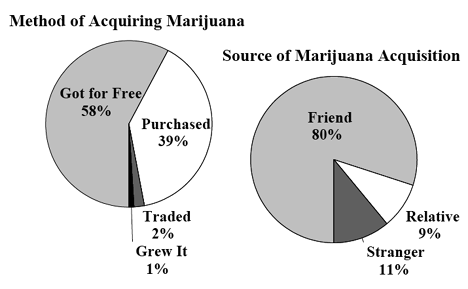
Marijuana distribution is social

This isn’t new, or startling, but it was interesting to see it in graph form. Via the Center for Substance Abuse Research (CESAR)…

Marijuana Distribution Relies Primarily on Friends and Family
A picture named source.gif
*Data was taken from the 2001 National Household Survey on Drug Abuse (since renamed the National Survey on Drug Use and Health) marijuana market survey questions.

I think the point here is that efforts to attack marijuana through criminal enforcement are doomed to failure and also inevitably cause tensions between citizens and law enforcement.

Posted in Uncategorized | Comments Off on Marijuana distribution is social

My anti-drug

Posted in Uncategorized | Comments Off on My anti-drug

DOJ wants to hide the truth from juries about interrogations

This disturbing post from Glenn Greenwald details some revelations that have come from the documents related to the firing of U.S. attorneys.
It was revealed that the DOJ (and other agencies within the government, including the DEA) have resisted the idea of videotaping interrogations.

The DOJ solicited the views of all federal law enforcement agencies — the FBI, ATF, DEA, U.S. Marshall’s Service — and each of them vigorously opposed mandatory recording. In doing so, one of the principal arguments was that they wanted to conceal from jurors the conduct of law enforcement agents in interrogating defendants and obtaining confessions, because that conduct would appear coercive and improper to jurors.

As Glenn notes:

The difference between recording v. no recording is not whether the conduct of federal agents will be an issue in a trial. The difference is whether there will be an accurate or inaccurate record of what these law enforcement agents are doing to extract statements and obtain confessions. Yet here, every federal law enforcement agency is expressly arguing against recordings because they want to conceal from the jury what they did (or because they want to conceal what the defendant actually said).

Welcome to America.

Posted in Uncategorized | Comments Off on DOJ wants to hide the truth from juries about interrogations

Thank God for Willie Nelson

Just watched Willie on the Colbert Show. A fairly brief appearance and he really didn’t get a chance to talk much, but he did get to sing a few notes. During the show, there must have been a dozen marijuana references, including one from Ambassador Richard Holbrooke (who also sang with Willie and Stephen), with Willie dutifully adding “Wheat? I thought they said ‘weed.'”
Everybody loves Willie. And everybody knows he smokes pot. And nobody thinks that it’s wrong.
Five minutes with Willie Nelson can wipe away the effects of months of reefer madness lies from prohibitionists, and you start to believe that everything really could be OK.
I think America would be a much better place if our leaders all spent a couple of hours in Willie’s trailer.

Posted in Uncategorized | Comments Off on Thank God for Willie Nelson

Open Thread

“bullet” An outstanding guest post from Rev. Alan Bean of Tulia Friends of Justice at Grits for Breakfast: Talking Snitches in Atlanta. Grits also has a disturbing story about the procedural and scientific sloppiness in urine testing that ends up determining the fate of parolees.
“bullet” About that super-skunk marijuana that the British journalists are smoking that apparently is more than 100% THC and immediately causes drooling idiocy (which might explain their articles if it were true)… Transform covers it in How the Independent on Sunday got it horribly wrong on Cannabis, and Scott Morgan has The Truth About Marijuana Use in the UK and Philip Smith wonders if madness awaits him around the corner.
“bullet” The Sibel Edmonds story isn’t going away. A couple of years ago, I mentioned this connection between Turkish mafia, Dennis Hastert, drug smuggling, neocons, and the State Department. This story has significant potential implications on what we are doing in the drug war in Afghanistan. To get caught up, read What the heck is Sibel Edmonds’ Case about? And why should I care? over at Daily Kos.
“bullet” Radley has the scoop on the new fatally-flawed, but well-intentioned Georgia No-Knock Bill.

Posted in Uncategorized | Comments Off on Open Thread

Report: Prohibition not effective

Via Transform comes this article in the Australian Age:

… the recently released report on amphetamines and other synthetic drugs by the federal Parliamentary Joint Committee on the Australian Crime Commission is a brave document.
Most notably, in contrast to the report from the House of Representatives Standing Committee, the committee unanimously supported harm minimisation and recommended that “harm-reduction strategies and programs receive more attention and resources”.
In its conclusions, the committee said “prohibition, while theoretically a logical and properly intentioned strategy, is not effective”. It also argued that “the current national approach to illicit drugs – supply reduction, demand reduction and harm reduction – will achieve greater outcomes if a better balance between these approaches can be reached”. In common parlance, this means there should be less emphasis on law enforcement and more on education and drug treatment.
Unfortunately, it is a rare event when any government body decides to make drug policy recommendations that are based on evidence. The report was not received warmly by the Government.

Familiar story. Think U.S. Shaffer report in 1972. Think Canadian Senate Report 2002. Shunned in their own countries.
Transform sees hope, and offers a tease…

…coming soon is a major new document produced by Transform with the sole aim to aid rational debate on drug policy. ëTools for Debate‰ will be a groundbreaking point-of-reference for anyone wishing to challenge non-rational policy positions, no matter how persuasive the rhetoric.

Posted in Uncategorized | Comments Off on Report: Prohibition not effective