This is one I’ve definitely been waiting for.
Ethan Nadelmann started off the session by indicating that every year, the Drug Policy Alliance sends invitations to the head of the DEA, the drug czar, the head of the UNODC etc., but this is the first time someone of this stature has ever accepted. Costa surprised them by calling back a few weeks ago and said he’d be happy to speak.
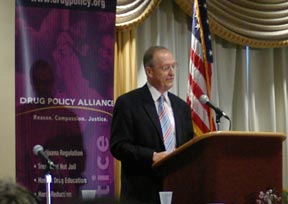
Antonio Maria Costa, executive director of the U.N. Office of Drugs and Crime (effectively the U.N. drug czar).
Mr. Costa started out very amiable and at various times throughout his presentation, acknowledged that most of the people in the room might disagree with him, but that it also was more than that…
From both sides of the aisle, there have been noises about my presence here.
– Is there a common ground between those who insist on a world free of drugs and those who insist on a world of free drugs? Perhaps the following…
- Desire for health and security.
- Reducing the harm caused by drugs.
- Drug policy should be evidence-based, not based on political considerations.
- Prohibition vs. Legalization is too simplistic a way of referring to the policy issues.
– There are signs of world market stability in drug “containment” over the past few years (he exempts the 78% of Afghanistan opium production “controlled” by the Taliban)
– Despite containment, there is still a huge drug problem. However, it’s important to note that for those with serious drug problems, that problem still represents less than 0.6% of the world’s population.
– The world seems to be in agreement that with all the damage caused by alcohol and cigarettes, a tightening of controls is appropriate for those two.
– So if we tighten controls on alcohol and cigarettes, why decrease the control on drugs when they are now such a small percentage of the problem? Why make them a bigger problem?
It sounds counterintuitive to me to call for a tightening of control on alcohol and cigarettes, but to release controls on other drugs.
He realizes that some U.N. statements are ridiculed.
I am not the author of the “drug free world” slogan.
Yes, he admits that his office (prior to his tenure) did put out posters with that slogan on it.
Is a drug free world attainable? Probably not.
Is it desirable? Probably yes. [boos]
In the same way, we wish to eliminate poverty, sickness, etc. we should wish to eliminate drug use.
– He does some “dreaming.”
- 1st dream: Seize all the drugs. Reality: If every bit of drugs was seized, a new supply would simply come the next year. So obviously that doesn’t work.
- 2nd dream: Lets say we convince all the farmers to stop growing drugs. Reality: Even that wouldn’t solve the drug control problem. Other sources of supply would open up.
- 3rd dream. Reduce the demand for drugs. Prevention, treatment, harm reduction combined in a comprehensive way. That’s the solution.
Some people say that drug use is a personal choice and nobody else’s business. [cheers] I have a few problems with this. First there is a health issue…
And then he conflates drug abuse and use — a common tactic. THen:
“Drugs are illegal because they are dangerous.”
[1,000 people booed.]
Health and security….
– He has heard the discussions about legalization providing a solution to organized crime. He agrees with this to a point, but says that legalization will result in greatly increased abuse, causing worse security issues.
– Human trafficking is hard to stop — is that a reason to give up on it?
– His office is putting a stronger emphasis on treatment. Let us replace criminalization with treatment (cheers)
– If drugs are legalized, people will be condemned to a life of addiction without help.
– Imagine legalization in developing countries without the resources of treatment. Terrible
– Help us balance international policy by pushing the emphasis toward treatment and harm reduction measures. [applause]
– Join me as an extremist of the center. [laughter]
[Disruption as the fire alarm went off. It was a test.]
– Most importantly, make drug policy a society-wide issue. It requires society-wide engagement.
He did relatively well, considering the strong opposition he faced in this hall. It took courage. But it had many of the standard drug warrior flaws, even though he seemed not to see them. His nods toward treatment were still within the context of prohibition and enforcement, and he was unable to consider anything past that.
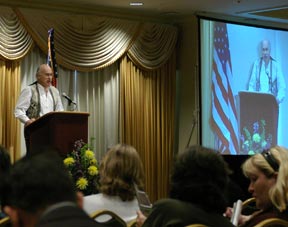
Kasia Malinowska-Sempruch, Director, IHRD Open Society Institute
The problems she wished to address were:
- Law Enforcement, at the expense of health and safety
- Major HIV epidemics
- Lack of drug treatment and abuses in the name of drug treatment
- What about women?
She talked about drug addicts being arrested in countries who were trying to get help for their drug problems.
“In china, police are known to wait by syringe distribution points to arrest drug users.”
She talked about abuses in China, Kazakhstan, Russia, Ukrain, Thailand, etc.
A good presentation with strong data about the increases of harm for drug addicts and the prevalence of HIV/AIDS in countries who follow high prohibition-style tactics.
– The U.S. federal ban on needle exchange is exported to the rest of the world. 15 billion is spent worldwide on HIV, but none of it is being spent on needle exchange.
– U.S. is very pushy about making their views known to the rest of the world.
Powerful stuff.
Then the lunch session ended and we adjourned to a smaller room for the Costa follow-up session.
Question and Answer period with Antonio Maria Costa
Note: after the conference schedule was printed, it was decided to not make this simply a Q and A, but rather offer a chance for several panelists to respond to his talk. I’ll just hit on some of the points.
First speaker. Alex Wodak, President, Australian Drug Law Reform Foundation
– Drugs are a very important problem, not because of drug consumption, but because of death, disease, crime and corruption. Many feel that those problems are primarily due to the fact of drugs being distributed by the Al Capones of this world.
– High marks to the UNODC for changes in recent years to increase interest in harm reduction.
– The scientific discussion regarding harm reduction is over. Harm reduction is proven.
– International drug treaties that exist today can be used as a reasonable tool to move forward without re-doing everything.
– It’s ridiculous to assume that Swaziland and Sweden should have the same policies.
– Move forward from prohibition, by allowing individual countries more freedom to interpret treaties for their own value (just as U.S. ended alcohol prohibition and sent it to the states).
– The problem is allocated deficiencies. Too little money goes to what really works.
– The ONDCP is still too close to the war on drugs. We have to accept that supply control doesn’t work.
– Costa’s comment that ‘drugs are illegal because they are dangerous’ cannot be ignored. It is wrong.
– Drugs should be controlled.
Second Speaker. Professor Craig Reinarman from UC Santa Cruz
– Congratulates Costa for his wit and charm — “If you’re wrong on most of your arguments, it helps to be charming.”
– Costa said: If alcohol and tobacco kills so many people, why would we want to legalize drugs. Response: I don’t think availability is so specifically related to drug problems, abuse, addiction. The notion that there is a correlation between repressive drug policy and reduction of abuse is wrong.
– Costa said: Treat those who use drugs. Response: This is wrong. The vast majority of those who use illicit drugs do not have the disease of addiction. And the idea of forcing treatment on those who don’t want it is bad medicine.
– Your agency could fund a study where you study oppressive regimes and see if there is any correlation between that and addiction/abuse, etc.
Third Speaker. Nanna W. Gotfredsen, Street Lawyer, Copenhagen
Health worker in Copenhagen who works with victims of drug policy, including refugees of the Swedish drug policy. She said that Costa speaks differently here than in some of his other speeches.
“Mr. Costa. You have, I hate to say it this way, a Swedish fantasy. Please stop the Swedish fantasy.”
– Criminalization leads to further exclusion.
Punishment, as a tool to prevent them from potentially harming themselves, is without meaning.
Very powerful and moving.
Fourth Speaker. Pat O’Hare, Honorary President of International Harm Reduction Association
– Most of your comments, Mr. Costa, flew in the face of reality.
“I would be prepared to accept slightly increased drug use for a load less harm.”
– The deficit model of drug use (desperation, etc.) doesn’t explain most drug use — only a small amount of it.
– It’s easy to criticize this thing called harm reduction, because it’s not being done well by the countries in this world.
Question: Given the supremacy of the human rights convention over the drug convention, isn’t that an avenue to pursue changes in drug policy? After all, drug policy damages human rights.
Question: I’d like to hear your comments on the role of the International Narcotics Control Board (INCB), that seems to think it is an autonomous agency unaccountable to anyone.
Fifth Speaker. Martin Jelsma, Transnational Institute, Netherlands
Consumption rooms versus Injection sites (a terminology issue) came up. Not sure what this means.
He did a little more of a speech regarding his views about drug policy than directly addressing Costa’s comments.
Costa responds (he also brought a colleague to help him answer questions).
– He is limited in his decisions regarding the allocation of funds because all funds he receives from the United Nations are tied to specific uses.
– Regarding the U.N. Convention and flexibility — true, there is some flexibility there. The INDCB offers interpretation, but there is flexibility or countries to follow.
– The Netherlands has poisoned the rest of the world. It is a primary source of amphetamines. People take amphetamines because they are sick. [This was his way of answering a question about cannabis use in the Netherlands.]
He wandered around making a number of small non-substantive comments, but it wasn’t all that coherent. Hard to blog this part.
During this session, he started to get testy.
Costa’s colleague, former member of INCPB then talked a bit. Talks too fast with too strong an accent for me to share much of it
– Drugs are used by some to cover real problems.
– Exposing more people to drugs, exposes the more vulnerable people.
Ethan then opened it up to questions on the floor and selected about 7 of us to comment or ask questions with Costa waiting until the end to respond.
Questions:
Sanho Tree had a really great comment about prohibition being the price support for drug criminals. Law enforcement catches primarily the stupid. Only the most efficient drug traffickers succeed.
I was given an opportunity to comment as well. I brought upthe two statements he had made in OpEds and talked about being evidence based and not using provocative demonization like this..
“Today the harmful characteristics of cannabis are no longer that different from those of other plant-based drugs such as cocaine and heroin,”
June, 2006
“Amid all the libertarian talk about the right of individuals to engage in dangerous practices provided no one else gets hurt, certain key facts are easily forgotten. … Would even the most ardent supporter of legalisation want to fly in an aircraft whose pilot used cannabis?”
March 2007
Howard Woolridge (LEAP) – Drug policy doesn’t make us safer.
John Gilmore “I’m one of the very few who would actually unregulate all drugs.”
John made a very interesting point that compared the persecution of drug users with the persecution of homesexuals, noting that homosexuals were considered morally wrong, and required treatment/adjustment. We have the same attitude toward drug users.
Note: There were a couple of other questions as well, but I didn’t get their names. Someone asked what he had against Kate Moss. There was no proof that she did cocaine.
Costa (some scattershot responses to the questions):
– I don’t judge. It’s not my task. I follow the rules. I am just the executive director. We try to execute ways and means to reduce problems of all kinds, but we don’t judge.
– Netherlands coffee shops are poorly conceived and implemented.
Then he kind-of responded to my question:
– Regarding the articles in the Independent. If you look at THC content today compared to what it was, the amount active dangerous drug is similar to those other drugs. I stand by my statement.
– Regarding: What about cannabis for medical purposes. I don’t believe in joints as medicine. You don’t prescribe mold, you prescribe penicillin.
– Regarding Kate Moss. I never said she was snorting cocaine. I said she was snorting. I was careful.
– No country will ever unilaterally legalize drugs.
– Terrorism being funded with drug money. Best way to solve that is don’t buy drugs.
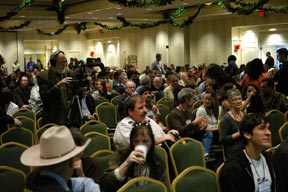
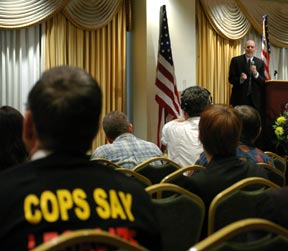
By this point, he was just pissed off and seemed anxious to leave. The crowd got unruly at times responding to his ridiculous statements, but they really tried to give him the chance to respond.
One last round from the panel, which included:
Craig:
– Costa is the only economist in the world who doesn’t believe in the law of supply and demand.
– Regarding the U.N. convention — that is primarily a result of bullying by the U.S.
Update: See also Transform’s coverage



Psilocybin protects against nerve damage from chemotherapy: September 3, 2026 -- Chemotherapy is brutal. The cancer treatment is often lifesaving,…