
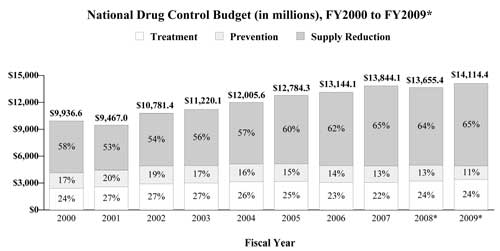
* 2008 and 2009 based on estimated actual/anticipated figures
[Via CESAR Fax]
Statement this morning in Vienna by Antonio Maria Costa, director of the United Nations Office on Drugs and Crime:
“I attended the meeting of the drug alliance [DPA] in New Orleans last December, 1200 participants, 1000 lunatics, 200 good people to talk to. The other ones obviously on drugs.”
“bullet” Thailand
In the end, the war on drugs was simply a populist killing spree of small fry. No big drug dealers were ever affected, and after a while the drug business returned to normal.
What is so sad about the state of Thai Society is that the drug war policy was, and still is, extremely popular (except, of course, among the families of the victims). It shows that our society doesn’t care about the rule of law, or about basic human rights.
“bullet” How do you define success in drug enforcement?
According to the head of the HIDTA (High Intensity Drug Trafficking Area) task force in Atlanta, you know you’re doing the job right when you see an increase in burglaries, armed robberies and murders!
“bullet” Editorial
“The most destructive force” in his city and others isn’t drugs; it’s the drug war that drives up the price of drugs and makes dealing them so attractive to criminal elements.The drug war isn’t working. It’s time for officials to stop worrying about being tagged with the soft-on-crime label and take courageous steps to re-evaluate a failed policy.
“bullet” It won’t fly. Conservative Illinois Review tries to attack medical marijuana with the stoned-mother-almost-drowns-baby nonsense, and is delightfully slammed by commenter TaxMeMore, who notes that by that logic, children should be taken away from parents who own guns, homeschool their children, or attend bible school.
“bullet” Prison Nation.
…signs that the country may finally be waking up to the fiscal and moral costs of bulging prisons.
“bullet” American Drug War The Last White Hope now on Showtime On Demand. Here’s a taste:
“bullet” DAMN SKIPPY
come sit right back and you’ll hear a tale
a tale of a fateful trip
that started when an actress fair
smoked something too hip…
A coalition of groups including the International Harm Reduction Association, Human Rights Watch and the Canadian HIV/AIDS Legal Network, have published a report taking the United Nations drug control policies to task for not being in compliance with essential human rights principles — principles which, by United Nations charter, take precedence over other United Nations treaties.
The report is: Recalibrating the Regime: The Need for a Human Rights-Based Approach to International Drug Policy (pdf).
Here’s an extended quote from the Executive Summary that I think makes some strong points:
Historically, policies aimed at prohibiting and punishing the use of certain drugs have driven the international approach to drug control and dominate the approach of most countries, guided as they are by the three UN drug control conventions and the dominant policy directions emanating from the associated international bodies. Such an approach is usually defended with moralistic portrayals that demonise and dehumanise people who use drugs as representing a ‘social evil’ menacing the health and values of the public and state. Portrayed as less than human, people who use drugs are often excluded from the sphere of human rights concern.
These policies, and the accompanying enforcement practices, entrench and exacerbate systemic discrimination against people who use drugs and result in widespread, varied and serious human rights violations. As a result, in high-income and low-income countries across all regions of the world, people who use illegal drugs are often among the most marginalised and stigmatised sectors of society. They are a group that is
vulnerable to a wide array of human rights violations, including abusive law enforcement practices, mass incarceration, extrajudicial executions, denial of health services, and, in some countries, execution under legislation that fails to meet international human rights standards. Local communities in drug-producing countries also face violations of their human rights as a result of campaigns to eradicate illicit crops, including
environmental devastation, attacks on indigenous cultures, and damage to health from chemical spraying. At the level of the United Nations, resolving this situation through established mechanisms is complicated by the inherent contradictions
faced by the UN on the question of drugs. On the one hand, the UN is tasked by the international community with promoting and expanding global human rights protections, a core purpose of the organisation since its inception. On the other, it is also the body responsible for promoting and expanding the international drug control regime, the very system that has led to the denial of human rights to people who use drugs. All too often, experience has shown that where these regimes come into conflict, drug prohibition and punishment has been allowed to trump human rights, or at least take human rights off the agenda. […]
Despite the primacy of human rights obligations under the UN Charter, the approach of the UN system and the international community to addressing the tensions between drug control and human rights remains marked by an ambiguity that is inexcusable in the face of the egregious human rights abuses perpetrated in the course of enforcing drug prohibition.
The report goes on to describe some of the human rights violations around the world explicitly or implicitly endorsed by U.N. drug policy, from execution of drug prisoners in various countries, to the mass murders in Thailand, to the racially unbalanced incarceration of drug offenders in the U.S., etc.
This is just one of many important efforts being taken in this important year for international drug policy as the U.N. evaluates its last 10-year-plan (you know, the drug-free by 2008 nonsense) and develops its next one.
To a greater degree than ever before, the international drug war hawks are facing extensive and organized opposition — probably not enough to stop international prohibition regimes now, but perhaps to less some harms and mark the beginning of the end.
Transform says that “the next ten year UN drug strategy could be the last under absolute prohibition.”
“We are witnessing a crumbling in the consensus behind a dogmatic prohibitionist approach to drug control. The dramatic failures of global drug prohibition over the last ten years, during which time the problems associated with drug misuse and illicit production have worsened dramatically, demonstrate that the current punitive enforcement led approach to drug control cannot continue for another ten years.”
Medical cannabis bill distinct from legalization
In the recent Pantagraph story about a medical cannabis bill advancing to the Illinois Senate (March 6, Page A8), Limey Nargelenas of the Illinois Association of Chiefs of Police complained about the appearance of patients at the hearing. “I think it’s a shame what they’re doing here. They’re using sick people here to try to legalize marijuana. I think if the Legislature wants to legalize marijuana, let’s talk about it, debate it and see if that’s what the people want.”
It’s outrageous and a sign of the sickness of special interests for Mr. Nargelenas to imply that the Senate shouldn’t be listening to patients when considering a medical bill, but instead should listen to lobbyists like him.
Let’s be clear that two very distinct and separate issues are involved here.
The first one is providing a legal means for sick people to get useful medication. Medical cannabis is a matter for patients and their doctors, plus experts such as the American College of Physicians.
If anyone should be ashamed of using sick people, it is those who would deny patients useful medicine for no other reason than to protect the funding for the war against marijuana users.
The second, separate issue is the legalization of marijuana for other purposes.
If Mr. Nargelenas is serious about wanting to debate that to talk about eliminating black market profits, finally regulating use to keep it away from kids, and finding more effective uses for the billions of taxpayer dollars spent annually than making pot profitable for criminals and gangs well then, bring it on. I’ll be happy to debate him anytime.
Pete Guither
Bloomington
Mukasey Puts Latest Crack in Truth on Drugs – a powerful piece in the Chicago Tribune by Carol Brook, Deputy Director of the Federal Defender Program for the Northern District of Illinois.
This week, my phone has been ringing off the hook.
Mothers, sisters, wives and daughters, voices soft and shaking, ask whether their loved one might be eligible for the new retroactive crack cocaine reduction. When I tell them yes, they cry.
Many of those eligible for sentence reductions have no prior criminal history and were convicted of simple possession. Many more were convicted of distributing just a small amount of crack cocaine one time.
Nonetheless, U.S. Atty. Gen. Michael Mukasey recently told Congress that the early release of these offenders would unleash “violent criminals” onto our streets and pose “significant public safety risks.”
She goes on to give an excellent bit of history on how all this goes back to the Len Bias incident, along with the racial connections, something I covered here before in Len Bias – the death that ushered in two decades of destruction.
Also check out this searing takedown of the Attorney General: Mukasey’s Racist Threats on Changing Crack Sentencing Fall on Deaf Ears by Liliana Segura at Alternet
Some excerpts:
The attorney general has been issuing dire warnings for months about the horrible things to befall society if Congress allows a change in federal sentencing guidelines that could lead to the early release of some 20,000 prisoners convicted for crack cocaine offenses. […]
The attorney general — who some would argue might have better things to do — went before Congress multiple times to try to derail the measure, employing classic White House-style fear-mongering. […]
Anybody with a capacity for common sense can see the problem. But common sense has never had a governing role in the disastrous policies of the 30-year War on Drugs. Racism, on the other hand, has. […]
Nor should it have taken policy makers 20 years to realize that a sentencing disparity of 100 to one is horrible, racially discriminatory policy. But that’s what happens when the people most brutally affected by unjust laws are the same people who are chronically ignored or — when it’s politically expedient — demonized by elected officials. […]
Earth to the AG: You can stop now. No one’s buying it anymore.
Attorney Generals. You’d think that it would be a good idea to have somebody in that position that understood… uh… justice, and maybe… the Constitution. But I’m trying to remember. Have we ever had a decent Attorney General? Seriously.
Seems to me that I recall Isaac MacVeagh (Garfield’s AG) might have been good, but he was around such a short time.
This, apparently, is some kind of actual serious scientific research (although I’m really starting to wonder about the lab scientists down under — it seems like some of the kookiest marijuana stuff is coming from the Aussies and the Kiwis.
Lithium may help kick marijuana habit
SYDNEY, March 7 (UPI) — Australian researchers said lithium, commonly used for bipolar disorder, can help pot smokers kick the habit without withdrawal symptoms.
A research team from Corella Drug Treatment Services and the University of New South Wales prescribed 500 milligrams of lithium twice a day for seven days to 20 people who were longtime, habitual cannabis users, the Sydney Morning Herald reported Thursday. After three months, most of the users were smoking cannabis less often. Many had given up completely, the newspaper said.
Good thing is that lithium is relatively safe with only mild side effects including dehydration… As long as you don’t take a little too much (it has a relatively low toxicity ratio), which could lead to death and/or kidney failure… As opposed to marijuana, which can’t kill you.
Hey, I’ve got an idea! You could just smoke marijuana if you want to, and not smoke it when you don’t want to. It really is that easy. It’s not something difficult like tobacco, or caffeine, or cinnamon rolls. Hundreds of millions of people have discovered that they can end marijuana addiction by just not smoking anymore.
I wonder if they’ll give me a grant.
The film Super High Me, featuring comedian Doug Benson spoofing Morgan Spurlock’s “Super Size Me,” appears to be the hit of the South by Southwest 2008 film festival.
Here’s a teaser…
Update: Another important film at the Festival is Tulia, Texas – a documentary on the drug war events in that town. Check out the film reviews by Grits for Breakfast and Drug Law Blog.
“bullet” Via Hit and Run comes this extraordinary statement by the writers of “The Wire” in an interview in Time magazine:
If asked to serve on a jury deliberating a violation of state or federal drug laws, we will vote to acquit, regardless of the evidence presented. Save for a prosecution in which acts of violence or intended violence are alleged, we will Ö to borrow Justice Harry Blackmun’s manifesto against the death penalty Ö no longer tinker with the machinery of the drug war. No longer can we collaborate with a government that uses nonviolent drug offenses to fill prisons with its poorest, most damaged and most desperate citizens.
Also, Radley interviews Ed Burns
We‰ve been fighting the drug war for 30 years. Thirty years of failure. But there‰s some reason that we persist in this. What is it? We never explore why that is. But you just can‰t spend this much money and get these few results and continue on like this. Someone has to start wondering what the fuck is going on.
“bullet” Police officer so in love with the drug war that he alerts parents of a non-existent drug.
“bullet” You Fit The Profile
“bullet” Get Your Cocaine from Superdrug
“bullet” Drug WarRant Video Page — I’ve put a few useful youtube videos on one page for reference purposes. Let me know if there are others I should have there.
“bullet” Drug WarRant on Facebook
“bullet” DrugSense Weekly
“bullet” “drcnet”
There’s a fascinating 5-part series of videos on Bolivia and coca at vbs.tv. Definitely worth watching — I learned quite a bit about the coca leaf. I was particularly interested in Law 1008 — a law written by an American in English controlling what Bolivians could do with their coca leaves. A law, like every drug prohibition law, that had roots in racism and lies. And a law, like every other drug prohibition law, that actually caused the conditions for developing a massive international black market.
The first three parts of the video are the most interesting, and you do have to get past the smarmy fashion disaster correspondent, but it’s worth it.

 Servetus on It isn’t about the drugs.: “Pete Hegseth is being blamed for committing three war crimes, including perfidy in the bombing of boats off the coast…” Jan 14, 20:38 on Marijuana prohibition and the origins of totalitarianism: “CBD treats fetal alcohol disorder in laboratory studies on mice: 14-Jan-2026 – Cannabidiol (CBD) could become a therapeutic tool to…” Jan 14, 20:25 on Marijuana prohibition and the origins of totalitarianism: “Gene therapy alternative for chronic pain might replace use of opioids: 7-Jan-2026 –Philadelphia—A preclinical study uncovered a new gene therapy…” Jan 11, 10:57 on Marijuana prohibition and the origins of totalitarianism: “Yoga as an adjunct to chemotherapy can treat opioid withdrawal: 7-Jan-2026 – In this randomized clinical trial, yoga significantly accelerated…” Jan 11, 10:27 on Marijuana prohibition and the origins of totalitarianism: “Modifications of chemical scaffolds associated with psychedelic compounds can be achieved using ultraviolet light: 7-Jan-2026 — UC Davis researchers have…” Jan 11, 09:46
 on It isn’t about the drugs.: “Sure, it’s regime change—now let’s take Iran, Cuba, Colombia, Mexico. All sterling examples of a self-determination for indigenous people. Also,…” Jan 4, 06:14 on It isn’t about the drugs.: “Colombian fisherman dies in a U.S. boat strike, no evidence of drug smuggling. Hegseth blamed. Family files a formal complaint.…” Dec 29, 16:01 on It isn’t about the drugs.: “Boat debris in U.S. Caribbean attack on boat by U.S. contained packaging with traces of marijuana, NY Times: Dec 29,…” Dec 29, 15:54