… the Musical!
From the folks at Funny or Die
… without any mention of drug policy (except from protestors)
And, as Matt Welch notes, the Democratic Party Platform does not contain the words “drug war,” “war on drugs,” “Fourth Amendment,” “marijuana,” or “cocaine.”
And my reaction is… “whew.”
Because, quite frankly, I knew that nothing resembling reform was going to come in a party convention. For some strange reason, the political masters consider it to be more politically dangerous than using euthanasia to abort gay immigrant assault weapons in a vegetative state.
So, if there was to be any mention of drug policy, it was more likely to be a “we need to get tougher about drugs in our streets” charge, which pleasantly, I did not hear.
But it’s nice to dream what it would be like if politicians could talk about drug policy reform. I imagined it at various moments through Obama’s speech tonight…
It‰s a promise that says each of us has the freedom to make of our own lives what we will, but that we also have the obligation to treat each other with dignity and respect. […]
Our government should work for us, not against us. It should help us, not hurt us. […]
The challenges we face require tough choices, and Democrats as well as Republicans will need to cast off the worn-out ideas and politics of the past. […]
I will also go through the federal budget, line by line, eliminating programs that no longer work and making the ones we do need work better and cost less š because we cannot meet twenty-first century challenges with a twentieth century bureaucracy.
The principles that our politicians espouse are not incompatible with drug policy reform. It’s just that the notion of drug policy reform is incompatible with politics.
On that note, it was interesting to read Paul Armentano’s post about Nancy Pelosi’s recent confrontation regarding medical marijuana.
Pelosi said:
“We have important work to do outside the Congress in order for us to have success inside the Congress for [the] use of medical marijuana. … [W]e need peoples’ help to be in touch with their members of Congress to say why this should be the case.”
Paul Armentano’s reaction:
I humbly submit that those of us who work ‘outside’ the so-called ‘hallowed halls’ of Congress have done our part. It’s now time for our federally elected officials, in particular Speaker Pelosi and Democratic Presidential Nominee Obama, to pledge to do theirs.
The thing is, I believe that both Paul and Nancy are right.
Paul’s right — we’ve done the work, we’ve made the case, we’ve done more than enough for our elected representatives in a fair world to take on the charge.
But, annoying as she is, and as frustrating as it is that she is unwilling to make the sacrifice to put if forward, Pelosi is also right. And it’s not about medical marijuana. It’s about drug policy reform as a whole. Throughout history, there have been a handful of issues that fit in this same predicament. The politicians are never going to lead in this area. Once the people have risen up with overwhelming outrage, the politicians carefully, slowly, haltingly, will shuffle into line behind them. Only when the people hold the politicians accountable for the damage caused by the drug war will Congress find their courage.
This editorial seems to be identifying some slight issues with the mayor….
Mayor Frank Paterra — who, by all indications, would not care if Charleroi slid into the Monongahela River as long as it did not involve crack cocaine — concerns himself only with his personal war against illicit drug trafficking. […]
But in virtually the same breath, he called on council to cut other departments to pay for more police.
“I need an army to fight a drug war,” he said. “I need soldiers, and they’re not giving it to me. They need to prioritize the needs of this community.”
I never knew that the position of Mayor of Charleroi, Pennsylvania was also Commander-in-Chief of the army.
That’s Charleroi, Pennsylvania. Population 4,871
|
I just watched the documentary on Tommy Chong that was released on DVD yesterday. It’s a very delightful piece about an American icon. I learned a lot about Tommy and his life, and even learned more about Operation Pipe Dreams (although I had followed it very closely at the time). It was amazing how much of a hard-on they had for busting Tommy (and how all it did was wake up the activist in him).
Surreal moment in the film… a brief scene where prosecutor Mary Beth Buchanan is using a powerpoint to demonstrate how to use a bong. Bonus: How “Dave’s not here” was created. |
LEAP Becomes Latest Victim of Government Censorship
Arlington: Virginia – Retired police detective Howard Wooldridge, representing Law Enforcement Against Prohibition (LEAP), was ousted from the National Asian Peace Officers Association (NAPOA) Conference in Crystal City because he was representing a view contrary to U.S. government policy.
LEAP is a 10,000-member organization of police, judges, prosecutors, DEA & FBI agents, and others who know ending drug prohibition will reduce death, disease, crime, and addiction, while saving billions of our tax dollars each year.
On Tuesday (8.26.2008) acting under pressure from unnamed federal officials, Reagan Fong, President of the NAPOA, insisted on the immediate removal of LEAP from the conference vendor roster. It appears that some of the event‰s other exhibitors took exception to the LEAP message and put pressure on the event organizer to expel LEAP from the event. While the incident was civil and took place prior to the second day‰s session it represents a serious violation of Constitutional rights as cited within the First Amendment.
Federal agency representatives manning booths at the conference included DEA, Federal Air Marshals, NCIS, and Coast Guard. The prior day LEAP‰s spokesperson had visited the DEA booth and described the agent as ‹decidedly unhappyŠ with an opposing viewpoint. In sharp contrast at 37 national and international law enforcement Conferences where LEAP has been allowed to exhibit, 80% of booth visitors agreed with LEAP‰s stance for ending this failed drug war.
As for the Crystal City NAPOA incident, the appearance of impropriety is almost as bad as the real thing. LEAP has attempted to establish contact with Mr. Fong, NAPOA President, to confirm the details of the incident but we have received no response so we can only conclude it is blatant censorship originating from a judgmental ‹Big BrotherŠ mentality. LEAP believes that this group owes us an apology. We ask that Mr. Fong identify the individual, agency or group that lobbied for our eviction from the event.
If this was an independent effort then he or she was acting outside the scope of authority and should receive administrative punishment for unprofessional actions. If this action was sanctioned by upper level management then the managers need to explain their behavior in an open forum. If this was sanctioned official action by the U.S. Government it is a serious matter which requires serious and immediate attention.
Now if only LEAP had some connections with people in law enforcement, or some judges, or lawyers or someone who could… Oh, right.
Not a very smart move on the part of NAPOA.
We’ll be waiting to hear what NAPOA President Reagan Fong (who works for Homeland Security) has to say.
So, what’s going on? I really can’t handle watching the conventions in the hopes that someone, somewhere, will mention drug policy, so any who are, please let me know if anything important happens. (Also, I’m working on a major addition to Drug WarRant that’ll take some time as it seems to be expanding to about a dozen web pages.) Probably the entirety of my convention watching will be through the greeters of rich white Oligarchs
…
I am curious as to whether Denver police are busting folks for marijuana and going against city rules during the convention. They may be too busy playing police state.
…
One thing I’ve learned so far — PUMA (or those claiming to be them) seems to be doing a good job of demonstrating how not to protest. It’s a lesson that drug policy reformers can take to heart (although we’ve never taken the angry, bitter, ineffectual approach).
…
Colleen McCool does some nice portraits of rebels who are trying to make a difference. She has finished her 2008 Rebels With Just Cause Awards — Americans for Safe Access and the Ron Paul Love Revolution. In case you missed it, check out her portrait of Howard Wooldridge in 2006.
…
John McCain, druggie? Apparently, McCain’s been taking drugs that have serious side effects
A variety of abnormal thinking and behavior changes have been reported […] Some of these changes may be characterized by decreased inhibition (e.g., aggressiveness and extroversion that seemed out of character), similar to effects produced by alcohol and other CNS depressants. Visual and auditory hallucinations have been reported as well as behavioral changes such as bizarre behavior, agitation and depersonalization. […] Complex behaviors such as ‹sleep-drivingŠ (i.e., driving while not fully awake after ingestion of a sedative-hypnotic, with amnesia for the event) have been reported.
Shouldn’t he be taking something safer, like, oh, I don’t know… marijuana?
…
Marijuana found in fire chief’s vehicle!!! Everybody panic!
…
Update: Libertarian candidate Bob Barr was on the Colbert report. Maybe I missed something because he was mumbling, but it appears all he had to say in this national exposure opportunity was that he enjoyed sharing a cigar with Al Gore and that Libertarians believe in letting people make ice cubes out of glaciers if they want to.
North Charleston police have scored a major pot bust, seizing 500 pounds of marijuana with a street value of more than $2 million.
Yet another (yawn) major seizure.
This is the part that got me:
Police said there was so much marijuana they couldn’t let reporters see it because the smell would overpower them. They instead showed pictures of the haul.
Now that’s powerful. Must be some really dank green nugs, huh?
But then I looked at the pictures. And noticed that they just left it sitting in a room with cops working (I guess they could handle the smell, unlike reporters.
Now I may be out of touch, but is that what weed looks like these days? The close-up picture looks more like fertilizer (which would explain the strong odor). Of course, that wouldn’t explain why the criminals were smuggling it in bricks with a cache of guns.
Seriously, what kind of weed is that?
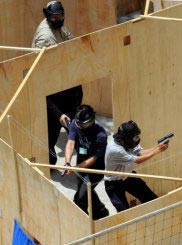
Wearing black helmets and police T-shirts, their handguns levelled, a drug raid team inches along the outside of a compound, throws open the door, spots a man with a gun and opens fire.
With the pop-pop-pop of a Glock 9mm an armed suspect is shot and hits the floor as seven counter-narcotics officers fan out and clear the adjoining rooms, checking for any more armed and hostile drug runners.
The training operation over, the team leader had some stern words for his men.
“We must aim better and make every shot count so no one is injured unnecessarily and we go home safe to our families,” he bellowed as some of the law enforcement officers stared at their boots. […]
This Hanoi paintball op is part of a US-Vietnamese training exercise in which Drug Enforcement Administration (DEA) agents pass on some of the skills of their dangerous trade to their local counterparts.
Yes, this is what we, as Americans, have to share with the world. How to bust down doors and shoot the residents. (No indication as to whether they had workshops on shooting dogs.)
This is part of our global contribution. The drug war has become the preferred foreign policy approach toward controlling much of the world. We export our drug war, our tactics, and, most of all, our DEA.
With that kind of presence, we insure that the rest of the world follows our lead. And if they don’t toe the line in the way we want to fight the drug war, we threaten to cut foreign aid, or in the case of Venezuela, which kicked out the DEA for spying, we accuse them of allowing drug trafficking.
Most countries are hesitant to buck the system, and would rather appear eager to participate
Phnom Penh: The National Authority for Combating Drugs has asked the US Embassy to create an office for the enforcement of the anti-drug law in Cambodia, in order to train the Cambodian anti-drugs authorities in different skills, and in order to help them to combat drugs worldwide.
Why can’t we go back to exporting Big Macs and “Baywatch”? Sure, they may not have been very fulfilling, but at least they generally didn’t kill you in the middle of the night.
Apparently, Obama has picked Biden for his VP. Certainly disappointing, though not hugely significant, since:
But let’s review:
Biden was a hard core drug warrior for a very long time. He tried his best to outdo the first President Bush in 1990 in developing a drug control strategy in the Senate that was just as tough, and included expanded use of military in the drug war.
In 2003, after earlier failed attempts, he managed to sneak the Reducing Americans’ Vulnerability to Ecstasy Act (yes, the RAVE Act) into law, moving us toward an increased police state.
Oh, and yeah, he helped create the office of the Drug Czar.
Now, to be fair, he also introduced a bill to reduce sentencing disparities between crack and powder cocaine.
It’s possible, from looking at his record, that his drug warrior stance has softened somewhat over the years. Still, he’s far from demonstrating any kind of acceptable overall position.
While he has refused to answer vote-smart issue questionnaires, it is possible to see how his voting record has stacked up in Civil LIberties/Civil Rights.
Biden voted the same way as the ACLU…
Appears to have a strong potential trend toward improvement, particularly post-911.
Again, as V.P., he’s not that much of a concern. It seems to me that he would be much less dangerous as V.P. than McCain as P.
But, if something happens to Obama, or if Biden continues on to be President after Obama, I sure hope his learning curve is quickly continuing to improve.
“bullet” Coincidence? Shortly after a group of University presidents announce an initiative to look into whether the 21 year drinking age makes sense (it doesn’t) and suggests we look into other options…
… the Department of Justice announces $19 million in block grants to the states to enforce underage drinking laws. Now local law enforcement, already making good money writing up drinking tickets at college parties, will get grants to do so, so of course you know how they will respond publicly regarding the notion of a dialogue on drinking ages…
“bullet” Ronald Fraser: Drug raids not the cure for law agencies’ tight budgets (annoying free registration required)
On the streets, where illegal drugs are still easy to get at affordable prices, Arizona’s police chiefs are losing the decades-long drug war.
But, ironically, back in their headquarters, many of these officers depend on drug raids to fatten their operating budgets. While the drug trade still enriches the bad guys, police chiefs now get a piece of the action. […]
What to do? It is time for federal and state legislators to shut down the conflict-of-interest loophole that allows police departments to profit from their official duties at the expense of the very citizens they are hired to protect.
“bullet” The Cost of Marijuana Prohibition — videos by MPP.
“bullet” Steve Rolles at Transform does a nice job fisking Ian Oliver’s incoherent call for keeping drugs illegal.
“bullet” We must outlaw this new dangerous drug called pumpkins… you know… for the sake of the squirrels.
“bullet” “drcnet”
Research shows coffee compounds extend life and lower rates of chronic illnesses among those who are not prohibited by their…