Vote Fraud by Sombody Unclear on the Concept

Via TalkLeft, this strange article in Pennsylvania:

County elections officials confirmed yesterday that an undetermined number of students had their voter registration switched to Republican when they signed a petition supporting the legalization of medicinal marijuana in September. …

The bizarre scam has everyone involved scratching their heads over a suspect and a motive. Voters whose party was switched will have no trouble voting on Nov. 2. It could only affect a primary vote, because only party members can vote in a primary.

Posted in Uncategorized | Comments Off on Vote Fraud by Sombody Unclear on the Concept

Drug Ring Nabbed

Midway Customs Agents Charged In Drug Ring.

“We’ve successfully plugged a significant pipeline of drugs to Chicago
A picture named pipeline.gif
and halted the flow of cash back to the suppliers,”
A picture named money.jpg
said Richard W. Sanders, special agent in charge of the Chicago office of the Drug Enforcement Administration.
Posted in Uncategorized | Comments Off on Drug Ring Nabbed

Presidential Endorsement 2004

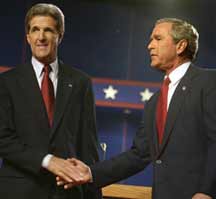
At long last, here is Drug WarRant’s analysis and endorsement for the Presidential race. I’ve taken a look at the two major party candidates in several specific areas (some of which have been ignored in other analyses I’ve seen), a quick summary of 3rd party alternatives, and then finally, the endorsement.

A picture named BushKerry.jpg

Head to Head: Kerry v. Bush

Medical Marijuana Actions and Statements
Kerry has said that he would end federal raids of medical marijuana patients and has at various times indicated some degree of support regarding medical marijuana. Bush said “I believe each state can choose that decision as they so choose.” Of course, both men’s statements are suspect as they are campaign promises. Bush’s statement, however, was made in the 2000 campaign. So we have a potentially broken campaign promise from Kerry versus a proven broken campaign promise from Bush. Slight advantage Kerry.
Kerry co-authored a letter asking the Drug Enforcement Administration to approve a proposal from the University of Massachusetts Amherst to manufacture marijuana for FDA-approved medical marijuana research. In the October 20, 2003 letter to DEA Administrator Karen Tandy, Kerry criticized the National Institute on Drug Abuse’s “unjustified monopoly on the production of marijuana for legitimate medical research.”
Bush’s DEA head Asa Hutchinson claimed (pdf) that the United Nations Single Convention on Narcotic Drugs prevented the United States from establishing such a medical marijuana research facility. Of course, the notion that the Bush administration would avoid doing something because of the United Nations is a little silly, making Hutchinson’s move transparent. The other problem was that Hutchinson was lying — the treaty didn’t prevent this type of medical research facility at all.
(a reasonably good summary of these points available here)
One other point: California is the leader in medical marijuana. Bush has very little interest in pandering to blue-state California — in fact, it sometimes seems that the administration goes out of its way to attack what California does. On the other hand, Kerry needs California, and will need to work to keep California. Federal intervention on medical marijuana in California will hurt Kerry, so he has political motivation to (quietly) leave them alone.

Advantage: John Kerry

The People Surrounding the President
Bush has surrounded himself with some of the most outrageous people in the history of the drug war. There’s the Minister of Disinformation (AKA Drug Czar, AKA Drug Lord) John Walters and the rest of the loonies at the ONDCP, corrupt girls Karen Tandy and Michele Leonhart heading up the DEA, and of course, that Let the Eagle Soar megalomaniac who lost to a dead man in his last election, but was bizarrely put in charge of justice — John Ashcroft. These are just the ones who are most publicly drug war cheerleaders. Clearly there are other advisors in the administration who have developed a strong administration policy that is pro-prohibition.
Kerry, of course, doesn’t have much of a staff yet, but the people he already has are horrible. His choice for Homeland Security Advisor, Rand Beers is a seasoned and committed drug warrior and one of the architects of the notorious Plan Colombia. His Vice President, John Edwards, received an “F” from the Marijuana Policy Project and Granite Staters for Medical Marijuana in part because he supported federal raids on medical marijuana patients.
Frankly, I don’t know how anyone could possibly have a worse set of people overseeing drug policy than the one George W. Bush assembled, but then again, I thought the same thing about Clinton, until Bush came along.

Advantage: Neither

Supreme Court
The next 4 or 8 years could make a big difference in the Supreme Court and the Federal Courts, and this is another area where those of us in drug policy reform find help or hindrance. For the past three decades, the courts have allowed the government to erode much of the 4th Amendment as it relates to the drug war. On the other hand, the courts have overruled the government in a few important cases (including the recent hemp foods case), and we look forward with optimism to the Supreme Court consideration of Raich v. Ashcroft.
So to whom do we look for favorable judge appointments? Drug policy is never talked about as one of the litmus tests in appointments, and keep in mind that justices don’t always follow the viewpoints for which they were appointed.
It is possible, however, to look at other legal philosophies for guidance.
Federalism: States’ rights can be of help to drug policy reform at this point in our struggle. This concept allows states like California to experiment with different drug policies, rather than being stuck lock step in national policy. Normally, you might look to a Republican administration for judges who support states’ rights. While some Republicans individually support states’ rights, this particular administration has demonstrated a complete disdain for the concept, and seems very much more interested in centralized national power. I don’t look for either Kerry or Bush to be hunting for judges committed to defending states’ rights.
Privacy and liberty: Privacy and liberty are huge potential areas for the drug policy reform movement, and these relate to two hot judiciary topics: abortion and gay rights.
Roe v. Wade depends largely on an implicit right of privacy in the constitution. This right of privacy can help our movement as well. Take a look at Alaska, where the State Supreme Court has ruled in favor of the legal possession of up to 4 ounces of marijuana in the home, specifically because the state constitution has an stated right of privacy. In the area of gay rights, you have Lawrence v. Texas, which is either dependent on a right of privacy or a right of liberty, depending on the analysis. (Check out my article: Gay Sex Ruling May Help Drug Policy Reform.)
In both of these areas, although not for the purpose of advancing drug policy reform, John Kerry is much more likely to attempt to appoint judges who will support constitutional rights of privacy and/or liberty. George W. Bush will appoint judges who claim that since the right of privacy is not specifically stated in the constitution, individuals have no such right.

Advantage: John Kerry

International Relationships in Drug Policy
Under either the Bush or Kerry administration, you can expect more of the same drug war stupidity in Colombia and all of Latin America, plus Afghanistan, and serving as a world-wide bully in forcing other countries to follow failed U.S. policies.
Global drug policy reform, unfortunately, is not going to come from the United States. We have lost our capacity for moral leadership in this area.
Global drug policy reform will be led primarily by the EU and possibly Canada
Check out this report from Transform, a British drug policy think tank, where they lay out the plans for reform over the next decade.
In order for these efforts to succeed, other countries will have to, at some time, work to overturn existing international treaties. Given the power of the U.S., their efforts may be somewhat dependent on how well they can essentially get the U.S. to the table to talk. A Kerry administration will be more interested in international cooperation than a Bush administration.

Advantage: John Kerry

The Administration Working with Congress
Rarely am I pleased with what Congress dreams up regarding drug policy. So having a President willing to sign anything Congress passes is of little interest. Divided government may slow down the ability of government to ruin our lives. Since it’s likely that Congress will remain Republican in this election…

Advantage: John Kerry

With Enemies Like These, Who Needs Friends?
OK, this one comes from trying to find an actual positive in drug reform from a George W. Bush administration, and the only thing I could find was the fact that some of the drug policy moves are so outrageous and laughable, that they actually help recruit people to drug policy reform. Such as: Sending 30 armed federal agents in flack jackets (after 911) to bust sick people in wheelchairs; Arresting Tommy Chong; Outlawing hemp foods; etc.
However, it’s a faux advantage. While it can be an interesting thought to play around with intellectually, here’s the important question: Can you face the medical marijuana patient who is harassed by federal agents and say “Just hang in there. You are helping make the administration look silly.”?

Advantage: George W. Bush

Third-party Candidates

A picture named badnarik.jpg
Michael Badnarik
Michael is on the ballot in approx. 48 states.
From the National Political Awareness Test:

  • Decriminalize the possession of small amounts of marijuana.
  • Allow doctors to prescribe marijuana to their patients for medicinal purposes.
  • Eliminate federal funding for programs associated with the “war on drugs.”

I will instruct the DEA to cease the persecution of medical marijuana users. I will advocate that all states legalize medical marijuana. I will pardon all persons incarcerated for non-violent drug offenses. I will be begin a policy of dismantling the insane War on Drugs. The Federal Government has no constitutional authority to regulate or outlaw drugs. When the Federal Government outlawed alcohol, it required a constitutional amendment to do so. Nonetheless it has assumed the legal authority to wage its “War on Drugs.”

A picture named Cobb.jpg
David Cobb
David is on the ballot in approx. 28 states.
From the National Political Awareness Test:

  • Decriminalize the possession of small amounts of marijuana.
  • Expand federally sponsored drug education and drug treatment programs.
  • Eliminate federal funding for programs associated with the “war on drugs.”

The “war on drugs” is actually a war on our civil liberties. It is also a war on people . . . most of whom are poor, young, and disproportionately people of color.

A picture named Nader.jpg
Ralph Nader
Ralph is on the ballot in approx. 34 states.
From the National Political Awareness Test:

  • Decriminalize the possession of small amounts of marijuana.
  • Allow doctors to prescribe marijuana to their patients for medicinal purposes.
  • Expand federally sponsored drug education and drug treatment programs.
  • Eliminate federal funding for programs associated with the “war on drugs.”

The Nader-Camejo campaign supports an end to the failed War on Drugs — responsible and rehabilitation focused drug policy. The drug war has failed — we spend nearly $50 billion annually on the drug war and problems related to drug abuse continue to worsen. We need to acknowledge that drug abuse is a health problem with social and economic consequences. Therefore, the solutions are — public health, social services and economic development and tender supportive time with addicts in our depersonalized society. Law enforcement should be at the edges of drug control not at the center. It is time to bring some illegal drugs within the law by regulating, taxing and controlling them. Ending the drug war will dramatically reduce street crime, violence and homicides related to underground drug dealing.

It’s clear that all three of these have better drug policy views than either Kerry or Bush. Of these three, Badnarik is the clear choice.

  1. Badnarik is on the ballot in more states
  2. What a vote for Nader means right now is so confusing, that voting for him for drug policy reform is completely wasted.
  3. Votes for Cobb are more likely to be seen as an environmental statement.
  4. Libertarians have been consistently leading the political charge in drug policy reform. A vote for Badnarik will, at the bare minimum, be seen as a vote for limited government, and is more likely to be seen as a vote for drug policy reform than would a vote for any other candidate.
Advantage: Michael Badnarik

Final Endorsement

Either Bush or Kerry will be President, and neither of them will be good for drug policy reform. Kerry will be bad. Bush will be worse.
As Dean Becker said in the Houston Free Press:

The response of both candidates to the drug war is silence; just like the Houston City Council, just like everyone in government. Superstition and ignorance were the original means of creating this drug war. But now greed has found a goldmine the “prospectors” are unwilling to abandon. This greed is currently disguised, as ignorance, so thick, so molded, ancient and deadly, that to now abandon their claim would mean the destruction of their word, their income and their very futures.

Incrementalism is their only option. A smaller mandatory minimum here, fining pot smokers instead of sending them to prison there. and of course more piss tests to fund the Drug Czar’s affiliates and their urinary universities.

Who do you trust? I trust neither little W nor Big John, but I do trust W a lot less.

The third party candidates would be much better, but they will lose.
The best way I can see to handle this is to split the endorsement geographically. If you are in a state that is clearly going for Bush or Kerry, vote for Badnarik and make a statement for change. If you are in a state where the vote is close, vote for Kerry and say that you won’t support continuing what the administration is doing now. To check the color of your state, check a site like this one right before election day (Note: red state Oklahoma doesn’t have the option of voting for Badnarik, or even write-in options, so skip the Presidential vote there.)

boxEndorsement for Red and Blue States: Michael Badnarik
boxEndorsement for Pastel and White States: John Kerry

Posted in Uncategorized | Comments Off on Presidential Endorsement 2004

Tulia, Texas Two?

Via Scott at Grits for Breakfast is what appears to be another Tulia-style outrage, foisted upon us by the ever-corrupt drug task force process.
Following a two year investigation by local, state, and federal law enforcement, there has been a massive bust in Anderson County, Texas netting 72 defendents (56 in state court and 16 in federal) arrested on Wednesday. The charges involve building a crack cocaine distribution ring in Anderson County, and all defendents are residents of the county.
Are you wondering why you haven’t heard of Anderson County? After all, with such a large crack cocaine conspiracy network, it must be huge, right?
Anderson County, Texas is a rural county (about 1,000 square miles) featuring agriculture, grazing land and a timber industry. The largest towns are Palestine, Elkhart and Frankston. The entire population of Anderson County, Texas is 55,109.
Now, according to the government’s national data, approximately .3% of the population uses crack. The number goes up to .4% in the south, but down to .2% in rural counties, so let’s use the .3% figure. That means we can expect that there might be 165 crack users in Anderson County. So a 72 person crack cocaine distribution network? Boy, now that’s service!
Imagine only having to share your crack dealer with one or two others! Sort of like your own personal crack assistant. Not sure how they do that with a median household income in the county of $31,000, though.
So now with the arrest of 72 people, what can we expect? Well, in addition to the costs of a two year investigation and all of the costs to prosecute them, there’s incarceration. Most of the defendants are facing 40 years to life. Assuming the minimum, that’s over $60 million to jail them (which would also pay for 4 years of college for every teenager in the county).
Oh, and people will still use drugs.
Scott really hits the nail on the head when he describes how these stings work.

These long-term “investigations” follow a pattern — the undercover operative befriends non-dealers in the black community and after a while asks for assistance purchasing drugs. Most people netted never profited from any drug sale, but either referred or acted as a go-between for someone they thought was a friend. That doesn’t matter to the drug warriors, though.

Of course, that scenario assumes some of the cases aren’t utterly trumped up to begin with. In Tulia and Floresville, TX, drug task force undercover cops actually set up innocent people. In the most famous of the Tulia scenarios, a young woman was able to prove she was cashing a check in Oklahoma City at the time the officer claimed she sold him drugs in Tulia.

Drug Task Forces – a blight on our communities.

Posted in Uncategorized | Comments Off on Tulia, Texas Two?

Good News in Afghanistan?

Vin Suprynowicz Las Vegas Review-Journal properly ridicules the government’s drug war, focusing on the problems (or interpretation thereof), in Afghanistan:

A huge problem for — and with — the gang in charge in Washington these days is that they define many of their successes as problems, requiring ever more onerous applications of force and looted tax dollars to “solve” what’s already going fine.

In addition, they describe many of their real problems as “insoluble,” when the solutions are right in front of their eyes.

No, we’re not succeeding in creating a modern nation-state.æ But there is good news in Afghanistan: The State Department reports the country is on pace to produce a record opium poppy crop this year.

Yep. Good news. A thriving industry able to support the common worker.

Opium, of course, is one of God’s major gifts to man.æ The first book of the Bible tells us that God gave man every flower- and seed-bearing plant for his use, and few have proved more useful that the poppy, whose sap can be made into codeine and morphine, which ( along with that other Godsend, cocaine ) have relieved the pain and suffering of millions.

So how do the folks in Washington respond to the fact that happy Afghan farmers are once again making an honest living producing a crop which is a Godsend to mankind? …

Needless to say, Defense Secretary Donald Rumsfeld was first into the breach, announcing last month that “coalition forces” in Afghanistan will soon have another task to distract them from tracking down Osama bin Laden — burning poppy fields.æ Imagine how Americans would respond if helicopters full of Afghan warriors descended on Virginia and Kentucky, burning our tobacco crops.æ ( Tobacco is more toxic and slightly more addictive than the opiates, according to Dr.æ Andrew Weil of the University of Arizona, who studies such stuff.æ )

But of course, we have determined that certain drugs are arbitrarily termed “evil” and must be eradicated regardless of whether that’s possible or economically viable, or whether the eradication causes more problems.

Legalize all opium products, allow the Afghans to ship through normal channels at reasonable profits, and the criminals will lose their control over the trade and the farmers, both.

It would then make no more sense for terrorists and underworld figures to try and finance their truly evil enterprises through the opium trade than it would for them to go into the business of manufacturing and smuggling aspirin — a product which our fine German friends at Farben-Fabriken Bayer delayed introducing until 1899, the year after they introduced heroin, since their chemists at the time considered aspirin the more dangerous of the two formulations.

Legalize the poppy.æ Problem solved.

Excellent article. Common sense. Impossible for politicians to accept.

Posted in Uncategorized | Comments Off on Good News in Afghanistan?

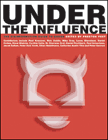
Under the influence

A picture named UTIcover.gif
Dan Forbes — one of the very best investigative journalists to take on the drug war — sent me an invitation to a book event. Not just any book event — this could be the most unusual and entertaining book event I’ve ever encountered. And yes, it’s been made clear that all my readers are invited to the party.

So, you’re invited to an East Village book bash — no stuffy readings, buy the damn book and read it yourself once you repossess your faculties — to celebrate publication of Disinformation’s latest well-schooled rant: Under the Influence: The Disinformation Guide to Drugs.

ææææææ That’s you and whatever emoluments you have at hand, Thursday, October 21, 9pm to 4am at swank-deluxe Uncle Ming’s, in the heart of it all at 225 Avenue B (that’s at 13th St. for you schmoes). Yeah, it’s free. The drinks ain’t, but they’re cheap.

ææææææ Forget the modest number of immodest go-go dancers, the syncopation from renowned Slipper Room vinyl spinner, DJ Ness, the no-doubt dissolute air rubbing shoulders (let’s say) with strangers similarly possessed of a certain moral casualness. Come, rather, seeking proof of the cruelties, absurdities, malfeasance & propaganda promulgated by your government to prop up an ever shakier War on Some Drugs.

Yep. I sure wish I was in New York this week.

ææææææ DisInfo and editor Preston Peet have corralled the top writers on drugs (verily) for a volume chockablock with the sort of truth-to-power rarely found between soft covers:

ææææææ Libertarian big-foot Jacob Sullum, of the usually eponymous Reason magazine and author of Saying Yes: In Defense of Drug Use (Tarcher/Putnam); New York Press columnist, author and irasciblist Paul Krassner; Daniel Pinchbeck, author of Breaking Open the Head: A Psychedelic Journey into the Heart of Contemporary Shamanism (Broadway Books); bona fide contemporary shaman, Rick Doblin, who’s actually buffaloed the feds into approving his investigations of post-trauma, therapeutic Ecstasy; and ex-Village Voice columnist, Cynthia Cotts.

ææææææ Not to mention Ethan Nadelmann, avatar of the Drug Policy Alliance and many state drug-reform ballot initiatives; China Syndrome screenwriter, Mike Gray, whose seminal drug policy books include Drug Crazy (Random House); Lonny Shavelson, author of Hooked: Five Addicts Challenge our Misguided Drug Rehab System (The New Press); rock star and ex-High Timeser Steven Wishnia, author of Cannabis Companion (Running Press); our beloved editor, High Timeser Preston Peet, who also edits DrugWar.com; and Daniel Forbes, a feckless freelancer who engendered four congressional hearings and testified at two after revealing that the Clinton White House steered $22 million to the TV networks for government-approved anti-drug TV scripts and has perpetrated numerous stone-down-a-well scoops ever since. And many others too worthy to begin to try to encapsulate in an e-mail.

If you can go to the party, drop me a line afterward. I’d love to hear about it. I’ll talk about the book more some time in the future.

Posted in Uncategorized | Comments Off on Under the influence

Attorneys General Assert States’ Rights

This article in the SFGate notes that

California Attorney General Bill Lockyer sided with two medical marijuana patients Wednesday in their U.S. Supreme Court battle with the Bush administration, arguing that patients who use locally grown marijuana in states that allow it should be protected from federal drug enforcement.

“The federal government has limited authority to interfere with state legislation enacted for the protection of citizen health, safety and welfare, ” Lockyer’s office said in papers filed with the court on behalf of California, Maryland and Washington, three of the 11 states with medical marijuana laws.

This is good news.
Perhaps a little more surprising, however, is the support that has come from other quarters, demonstrating that the ramifications of this case could be huge.
The states of Alabama, Louisiana, and Mississippi have also filed briefs against the government. Are you trying to remember when those states passed medical marijuana laws? Don’t strain yourself. They haven’t, and aren’t likely to do so anytime soon.

“This is not a case about drug-control policy or (patients’) fundamental rights,” said lawyers from the Alabama attorney general’s office. “The point is that, as a sovereign member of the federal union, California is entitled to make for itself the tough policy choices that affect its citizens.”

Strong words, but it’s important to remember that there is an essential element to federalism that must not be lost. As Justice Brandeis said:

…to stay experimentation in things social and economic is a grave responsibility.æ Denial of theæright to experiment may be fraught with serious æconsequences to the nation.æ It is one of the happyæincidents of the federal system that a single courageousæstate may, if its citizens choose, serve as aælaboratory, and try novel social and economicæexperiments without risk to the rest of the country.

[Thanks to Scott, again]
Posted in Uncategorized | Comments Off on Attorneys General Assert States’ Rights

Scott Burns moves his lips

Scott knows I love it when the Drug Czar’s office gets trashed, so he sent me this gem from the Missoula Independent.

Everyone has heard the joke about how you can tell when operatives from the Bush administration are lying — their lips are moving. …

Moving his lips, [deputy drug czar Scott] Burns got right to the point with his first lie: “I’m not here to tell anyone how to vote,” he said, looking straight into the TV cameras — and then proceeded to tell Montanans that voting for medical marijuana would be a terrible thing. …

Burns said we now “look to experts to tell us what is safe” and claimed: “None of them say smoking this weed is medicine.” Unfortunately, the drug czar must be too busy flying around the country on taxpayer money doing the federal government’s political dirty work to take the time to read the conclusions of medical authorities from all over the world who have found just the opposite — that marijuana is indeed efficacious in treating a number of ailments. …

Rather than get bogged down in messy medical details that disprove his propaganda, Burns simply went on to assure reporters that in every state that had approved the use of medical marijuana, drug use among young people had increased. But an on-going annual study in California found marijuana use by ninth-graders has dropped 45 percent since 1996, when the state legalized medical marijuana.

Instead of interfering in Montana’s elections, the drug czar should have used his federally funded plane ticket to visit Canada. If his preposterous claims were correct, the streets of our northern neighbor should be clogged with stoner youths, barely able to ambulate because of their access to potent B.C. bud. But as many Montanans know from firsthand experience, Canada’s legalization of medical marijuana has produced no such drastic effects. …

Come Nov. 2, Montanans should tell the drug czar to take his lies back to the White House, vote for I-148 and bring legal relief to our most seriously ill citizens.

Oh yeah. Montanans are an independent bunch.

Posted in Uncategorized | Comments Off on Scott Burns moves his lips

Being part of the problem

TalkLeft notes that Edwards Calls for Crackdown on Meth Labs.

Edwards said he and presidential nominee John Kerry would propose legislation to limit consumers to two standard packages per day of cold medicines that contain pseudoephedrine, an ingredient used in Sudafed and other drugs. Bulk sales of cold medicines would be more closely monitored to track suspicious sales.

They also would propose spending $30 million annually for 10 years to fund law enforcement efforts and help farmers buy better locks to secure ammonia tanks where drug dealers steal the ammonia they need to make meth.

After a few commenters at TalkLeft said that they appreciated Edwards’ comments, since Meth labs are a growing scourge in the midwest, I had to speak up. My response was essentially:


Sure, talking about criminalizing cold medicine is going to resonate with some people, but it’s false pandering and is not going to result in positive long term effects.
It’s not that drug reformers don’t care. We care, and we want people to stop using meth and creating dangerous meth labs. It’s that prohibition and enforcement aren’t the answers.
You say “People shouldn’t use meth.” Great. I agree. Is a law going to do that? No. We’ve had drug laws for decades and yet 46% of the country has used illegal drugs.
There’s a very complex equation that revolves around the drug war. When enforcement against one drug increases, people who use drugs look to other options. Is it a coincidence that meth appeared during one of the harshest crackdowns in illegal drugs in our history (including crackdowns on safer, pharmaceutical amphetamines)?
Alcohol prohibition resulted in an increase in dangerous backyard stills, which sometimes poisoned their customers (one brewing method involved car radiators), and often blew up or caused fires. Entire towns were destroyed.
Sound familiar?
The answers lie in harm reduction, regulation, and oversight, not in increasing the profits to black market criminals through prohibition.
If you support prohibition, you are part of the drug problem.

One person claimed that my last line was “Glib and memorable, but purposely divisive and thereby tragically counter productive…”
Interesting. Glib and memorable, true. But is such an approach counterproductive? Or is it possible that such a memorable statement could actually wake some people up?
For too long, drug policy reformers have been hampered by fighting two forces.

  1. Drug Warriors and their self-interest and propaganda
  2. Masses of people who are open to the idea of reform, but don’t consider it to be a critical issue (after all, it’s just about some hippies who want to smoke pot, it’s not like it’s life or death, right?)

This second group has been let off the hook, and therefore have let others get away with murder. Didn’t reform the Rockefeller laws this session? Oh, well, there’s other important stuff for the legislature to do.
Even tacit and passive support of prohibition means that drug policy reform has a much harder time countering the drug warriors, so more people die of drug overdoses who could have lived; violence from black market economies increases; and on and on.
So what do you think? Glib and counterproductive? Glib and memorable? Should it be permanently added to the banner of Drug WarRant?

If you support prohibition, you are part of the drug problem.

Posted in Uncategorized | Comments Off on Being part of the problem

No arrest

Well, Loretta failed to get arrested today, but she had an interesting discussion with a marshall:

While I was standing there waiting on Kev to get back and hating cops in general a Federal Marshal walks over to me and smiles politely and says hello. I returned his gesture and greeting all the while wondering what was about to happen and bracing for a head cracking or some such brutality.

Shockingly though, he began to tell me that he was the Marshal who was in charge of transporting Jonathan Magbie to the jail. He said he was called to the courthouse to pick him up and was expecting just another regular person convicted for smoking pot to be there waiting on him.

He said when he saw Magbie and his condition he was shocked and upset that a person like that could be sent to jail. He said he felt like the lowest piece of scum on earth for having to drive him to jail and that he felt deep down that something horrible might happen.

He told me when he read the story in the Post a few days later he broke down and cried like a baby.

He said he felt responsible to a degree but that as a federal marshal he had to do what he was told. …

He then told me that pot should be legal and that most people even on the federal side as well as regular civilian police officers felt that way as well from what he could tell.

I told him of my plans to enter Judge Retchin‰s courtroom and unfurl my banner at 2 pm and asked him what I could expect from the Marshal‰s. He said that I would be escorted out if I didn‰t get too rowdy and the charge would be disrupting court. He said that if I refused to leave the courtroom or resisted then I would be charged with contempt and arrested.

He said if he were assigned to that courtroom today that he would see that I was handled gently and treated with respect. …

He smiled, thanked me for having the courage to speak out and said with a wink ‹If anyone asks I told you to move on.Š

The judge was gone for the day, so she’s going to try again tomorrow.

Posted in Uncategorized | Comments Off on No arrest