
False witness against legalizers

Scott Morgan and Allan Erickson have already addressed this, but I wanted to comment as well.
In this post by Clara Jeffery at MotherJones.com (which has some good points), there is a really uncalled for remark:

As in so many things these days, one wishes for something approximating independent analysis. I don’t trust the government’s research on drugs; its hyperbole and scare tactics on pot in particular seemed design to defend status quos (border and prison policies) that worsen, not solve, larger societal problems at hand. Nor do I trust NORML et al, even, and perhaps especially, when, having gotten nowhere on legalization per se, they reframe the issue as a balm for the sick and dying. Allowing medical marijuana is a no-brainer in my book, but I just think it’s a little unseemly when perfectly healthy pot-positive types hide behind AIDS and cancer patients.

I would guess that I fit in the “et al” and regardless of whether I do or not, it’s an extremely offensive statement (not to mention exceptionally illogical).
Scott Morgan gets it right in his response:

Clara Jeffery, why is it ok for you to call medical marijuana a “no-brainer,” and not us? We spoke of compassion, and we then built compassionate policies out of thin air and against massive opposition. No, we don’t hide behind AIDS and cancer patients. We march with them.

It’s like accusing an environmentalist of “hiding behind rainforests” if they advocate saving them. To an environmentalist, saving the rainforests is a piece of the total effort. To a legalizer, making marijuana available to the sick is a no-brainer integral part of legalization.
Are we supposed to say “Legalize marijuana, but not for sick people”? That would be absurd. As a legalizer, I want marijuana legally available to any adult who wishes to use it responsibly. As a human being, I put a higher priority on at least making it available to the terminally ill and those who need it to get through the day medically. How can I be a functioning human being and not think that way?
The ignorance reflected in Clara Jeffrey’s post is similar to the unsupported ad hominem attacks by academics like Mark Kleiman:

If you guessed from the above that neither side of the drug-policy debate actually gives a rat’s ass about sick people, you’re a remarkably good guesser.

To be fair, Kleiman seems to have moderated his views recently — at least he hasn’t made one of these nonsense attacks in some time, when he used to do them regularly.
I have to believe that some of it is that people like Klara and Mark have been influenced by the outlandish lies from drug warriors from Barry McCaffrey on to the current characters — that medical marijuana is a cruel hoax — and are somehow tying it in to legalizers’ wish to have marijuana legal.
And, you see, that ONLY works if you believe BOTH these propositions:

  1. That medical marijuana is a cruel hoax — that it somehow gives false hope or prevents patients from following courses of treatment that would actually help them (things that are patently impossible for a drug that is primarily used as a symptom reliever).
  2. That legalizers know marijuana is a false hope that hurts patients and promote it as medicine anyway, in order take steps toward getting it legalized for recreational purposes.

Obviously, both propositions are completely false.
On the other hand, for prohibitionists to be cruel, the following propositions must be true:

  1. Marijuana actually helps sick people.
  2. Prohibitionists fight against medical marijuana, knowing that it can help people, because they’re afraid that it will lead to legalization of recreational marijuana.

Those statements are not only likely true, they’re provably true.
What’s the problem with Mother Jones?
Posted in Uncategorized | Comments Off on False witness against legalizers

Fun with the Lord’s Bong Hits

“bullet” First: Bong Hits 4 Jesus – the game. The trick here is to guess not which ones you should suspend a student for, but which ones you are allowed to suspend a student for/censor, based on the recent Supreme Court decision. Can you get a perfect 23/23 score? (How many times does it take you to do it?)

“bullet” Just wondering… If you were a High School student with some extra cash, and there was a billboard on private property facing your school (and visible from school windows), and you rented it and put up “Bong Hits 4 Jesus” on the billboard…
“bullet” The Sac Bee has a cartoon
“bullet” And just as a reminder… you can make your own Bong Hits 4 Jesus statement.

Posted in Uncategorized | Comments Off on Fun with the Lord’s Bong Hits

Open Thread

“bullet”

Posted in Uncategorized | Comments Off on Open Thread

Democratic candidates touch on the drug war

I didn’t watch this round of debates – Democratic candidates dealing with minority issues: U.S. Senator Joe Biden, U.S. Senator Hillary Clinton, U.S. Senator Christopher Dodd, former U.S. Senator John Edwards, former U.S. Senator Mike Gravel, U.S. Congressman Dennis Kucinich, U.S. Senator Barack Obama and New Mexico Governor Bill Richardson.
But from the brief recaps I’ve seen around the web, the drug war got some play, with Gravel and Kucinich, of course, but also with Biden, Dodd, Richardson, and Clinton at least, giving some mention to things such as eliminating mandatory minimums and crack/powder disparities, and making needle exchange available to reduce HIV.
This is a refreshing change from the notion of appealing to African-Americans by offering increased enforcement in their communities.

Posted in Uncategorized | Comments Off on Democratic candidates touch on the drug war

Why aren’t you in jail yet?

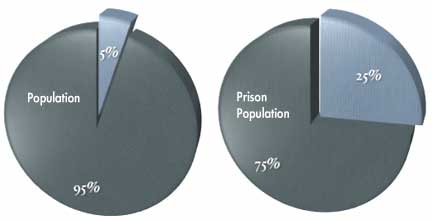
The United States has 5% of the world’s population…

A picture named prisonpop.jpg

… but 25% of the world’s prison population.

We lead the entire world in incarceration rates.

A picture named incarceration-rates2.gif

We even lead the world in actual numbers of those imprisoned

A picture named numberjailed.jpg

So…, and I’m just asking here…, with all these people in jail, how did we manage to miss this one?

Posted in Uncategorized | Comments Off on Why aren’t you in jail yet?

Must reads

“bullet” Transform Drug Policy Foundation has a wonderful chart showing the differences between (in general) the drug policy Status Quo position and the Reform position. Here are a few samples:

Status Quo position Reform position
Illegal drug use must be eradicated People have always used drugs,and illegal drug use cannot be eradicated
Any use of illegal drugs is problematic Most illegal drug use is non-problematic. Many of the health harms associated with illegal drug use are actually because they are illegal.
Legalisation and regulation is a step into the unknown We have centuries of experience in legally regulating thousands of different drugs
Drug law reform is being forced through by the ‘liberal elite‰ Drug law reform is supported by individuals from across the social and political spectrum
Prohibition protects the health of
individuals
Prohibition creates new public health problems and maximises harms associated with illegal drug use
Prohibition sends an important message about avoiding drugs and their dangers The criminal justice system should not be used to send public health messages.
Prohibition is based on a strong moral position that drugs are unacceptable The policy that is most effective at reducing harm and maximising well being is the moral position
Prohibition controls drug use and drug markets Prohibition abdicates control of illegal drug production and supply to the criminal networks and unregulated dealers

There are a lot more at Transform

“bullet” This is something we mentioned in passing earlier this year, but Maia Szalavitz has a strong article in Reason about Mitt Romney and his connection to child torturer Mel Sembler (founder of Straight, Inc.): Romney, Torture, and Teens

“bullet” Via Drug Policy Alliance:

The United States Conference of Mayors (USCM) made history last weekend by passing a resolution calling for a public health approach to the problems of substance use and abuse (PDF). The resolution was sponsored by Mayor Rocky Anderson of Salt Lake City.
The resolution proclaims the war on drugs a failure, and calls for ‹a New Bottom Line in U.S. drug policy, a public health approach that concentrates more fully on reducing the negative consequences associated with drug abuse, while ensuring that our policies do not exacerbate these problems or create new social problems of their own.Š

Posted in Uncategorized | Comments Off on Must reads

United Nations Office on Drugs and Crime World Drug Report

A picture named hammer.jpg
Posted in Uncategorized | Comments Off on United Nations Office on Drugs and Crime World Drug Report

Can’t we just get along? A truce in Mexico

Time Magazine reports A Cease-Fire in Mexico’s Drug War?
But not really.

U.S. and Mexican officials confirm that Mexico’s major rival drug-trafficking organizations, the Sinaloa and Gulf cartels, “may be trying to negotiate a truce” and come to some agreement over control of territory, says a knowledgeable U.S. official.

That’s a little different. I read “cease fire in Mexico’s drug war” and figured that the government and the cartels had come to an agreement. But no, this is a cease-fire in the turf war, not the drug war. Big difference.

The two mafias could be coming to the table for two key reasons. First, “the violence has drawn too much attention and has really begun to hurt [their drug-trafficking] business,” says Steven Robertson, a special agent for the Drug Enforcement Administration (DEA).

It’s actually probably hurt the actual players more than the business, but yes, it makes sense that while turf violence protects black market interests, once it reaches a certain level, it’s no longer productive (of course, in legalized business, violence wouldn’t be productive at all).

And second, Mexican President Felipe Calderon’s popular but oft-questioned strategy of throwing the military at the cartels Ö some 25,000 soldiers have been deployed to violence-ravaged states like Michoacan this year Ö “is starting to pay dividends,” insists a high-ranking Mexican official.

Rolling on the floor, laughing. Love the way they throw that in to try to get some credit, but particularly love the fact that it is attributed to a “high-ranking Mexican official.” That’s right — announcing that a massive government program is having any effect can only be done anonymously (perhaps because they’re afraid of being killed? — which kind of ruins the effect of declaring victory)
Of course, the government efforts have been abysmal, adding to the violence and the human rights violations, and potentially the corruption (and then swelling the ranks of militaristic cartel members).

But both countries, rightly, remain as skeptical as they are optimistic. That’s because Mexico’s narco-terror isn’t just about the Sinaloa-Gulf feud. It’s also a struggle between opposing mind-sets in each cartel: the more pragmatic businessmen, who are worried that all the blood has begun to hamper the efficiency of their cocaine distribution “plazas” in Mexico and along the U.S. border; and the more violent enforcers, who tend to see trafficking competition as a zero-sum game. The latter have enjoyed the upper hand ever since Mexico’s traditional cartel structures began to disintegrate about five years ago and gangs like the Zetas Ö former army special forces soldiers who today are the Gulf cartel’s dominant faction Ö filled the vacuum. As a result, the success or failure of any cartel negotiation is likely to rest on which priority prevails Ö commerce or conquest.

That’s an interesting analysis. Keep in mind that the U.S. spent most of its energies trying to break up the “pragmatic businessmen,” while actually helping to train some of the “violent enforcers.” That’s right, the U.S. Army trained a lot of the members of Los Zetas at the School of the Americas in Fort Benning, Georgia to combat the cartels. They then ended up going into business for themselves.

And even if the cartels do come to an agreement that might reduce the violence, it won’t reduce the trafficking. That’s because the U.S. still has not done enough to reduce its voracious demand for cocaine, marijuana and methamphetamines, and because Mexico has yet to really confront one of the main causes of the country’s narco-chaos: underpaid and under-trained cops who are easily bought by the cartels and, in many states and cities, have simply become part of the cartel fabric (and as a result are often the victims of cartel assassinations).

The U.S. or Mexico have also not had any luck repealing the law of gravity.
The main cause of narco-chaos is that drugs are in the black market. Period.

In the meantime, Mexicans hope the cease-fire reports hold true Ö as does Washington, which stands to see border headaches like illegal immigration worsen if the violence continues to spiral.

Yeah, that’s good policy. Just hope that the drug traffickers can get along. Because the U.S. and Mexico don’t have anything else they’re doing that’ll work any better.

Posted in Uncategorized | Comments Off on Can’t we just get along? A truce in Mexico

Daily Show

Jon Stewart, showing the banner Joseph Frederick held up on that snowy day at the Olympic torch relay, along with video of the large Olympic torch…

“If Jesus had a bong, that is totally the lighter that He’d use.”

Posted in Uncategorized | Comments Off on Daily Show

Progress report

Imagine having an employee who was completely incompetent. Everything this person did on the job was a disaster. He failed to do the proper research or listen to his co-workers who had. He pushed through his own agenda despite all market research clearly saying it wouldn’t work. And he put a huge chunk of the company’s funds into this boondoggle, which promptly tanked.
Now imagine that they he was required to write a self-evaluation to justify his continued paycheck. The employee, realizing his own incompetence, still hopes to delude his bosses.
What he wrote would look something like this:
United Nations Office on Drugs and Crime World Drug Report:

This year’s edition reports signs of long-term containment of the world problem. The overall trend masks however contrasted regional situations, which the report examines in detail. For instance, while an impressive multi-year reduction in opium poppy cultivation continued in South East Asia, Afghanistan recorded a large increase in 2006. Growing interceptions of cocaine and heroin shipments across the world have played an important part in stabilizing the market. However, as we witness successes in some areas, challenges appear in others. Although drug abuse levels are stabilizing globally, countries along major and new trafficking routes, such as those now going through Africa, may face increasing levels of drug consumption.

Posted in Uncategorized | Comments Off on Progress report